

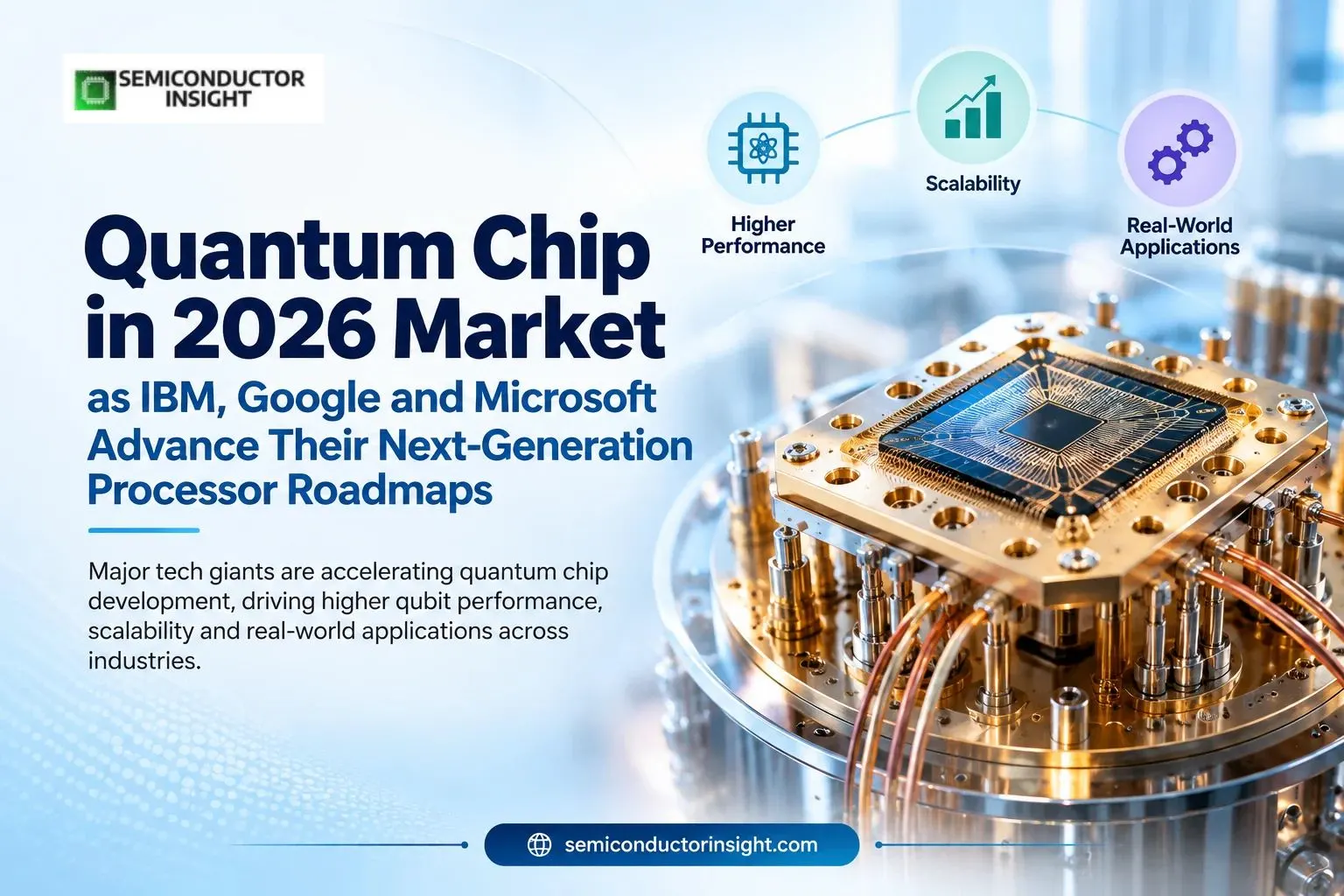
Quantum Chip in 2026 Market as IBM, Google and Microsoft Advance Their Next-Generation Processor Roadmaps
Quantum chips are entering a different stage of development. Rather than competing solely on the number of physical qubits, manufacturers and research teams are concentrating on error correction, processor connectivity, stability and the ability to execute increasingly complex calculations. These developments are changing how Quantum Chip Market should be understood within the wider semiconductor industry.
Unlike conventional processors, quantum chips manipulate quantum states to perform specialised computational tasks. Their architectures include superconducting circuits, trapped-ion systems, silicon spin qubits, neutral atoms and photonic approaches. Each requires a different combination of materials, control electronics, fabrication processes and operating conditions.
Google’s Willow Demonstration Put Error Correction in Focus
- Google unveiled its 105-qubit Willow processor in December 2024 and said that as the number of qubits in its encoded system increased, its error-correction performance improved.
- Google also reported completing a specific benchmark in under five minutes, a task it estimated would take a leading classical supercomputer an exceptionally long time.
- The result was a research milestone, not proof that quantum computers outperform conventional machines across general commercial workloads.
- For chip developers, the wider implication is that processor quality depends on more than adding qubits. Reducing errors and maintaining stable quantum operations are essential to building systems that can deliver repeatable, useful results.
Microsoft and IBM Pursue Different Routes to Reliable Computing
In June 2026, Microsoft announced its Majorana 2 quantum chip and reported a 1,000-fold improvement in qubit reliability over its preceding generation, alongside a mean qubit lifetime of 20 seconds. The company is pursuing a topological approach intended to support more scalable quantum hardware. These are company-reported results and should be interpreted within the context of its specific architecture and development programme.
IBM, meanwhile, is developing superconducting quantum processors alongside modular system architectures and advanced error-correction methods. In June 2026, it announced plans to invest more than US$10 billion in quantum computing over five years, covering research, manufacturing, infrastructure and ecosystem expansion. Its roadmap targets a large-scale, fault-tolerant quantum computer in 2029.
These approaches illustrate why the market does not yet have one universally established winning chip architecture.
For More Detailed Insights, You Can Surf Our Latest Report Here: https://semiconductorinsight.com/report/quantum-chip-market/
Silicon Spin Qubits Bring Semiconductor Manufacturing Into the Discussion
- Silicon spin qubits are attracting attention because they may offer opportunities to use aspects of established semiconductor fabrication
- Their potential compatibility with silicon processing could eventually help developers manufacture dense qubit arrays, although specialised device structures, low-temperature operation and control requirements remain important engineering considerations.
- In October 2026, the US Defense Advanced Research Projects Agency identified Diraq, which develops silicon CMOS spin-qubit technology, among the teams advancing to Stage C of its Quantum Benchmarking Initiative. The programme is evaluating whether different technical approaches can credibly achieve utility-scale quantum computing.
- This milestone demonstrates continued institutional interest in assessing multiple hardware approaches rather than assuming that a single technology will dominate.
Cryogenic Engineering Is Becoming Part of Chip Design
Many superconducting quantum processors operate at temperatures close to absolute zero. As systems scale, engineers must coordinate the quantum processor with cryogenic infrastructure, control electronics, wiring and signal delivery.
In August 2026, IBM described connecting two large cryogenic modules as an engineering step towards its planned modular quantum architecture. Such work highlights a practical issue: increasing processor capacity requires progress in the surrounding system, not simply a larger chip.
For semiconductor suppliers, this creates technically specialised requirements involving interconnects, packaging, low-noise electronics and materials that can perform reliably under demanding thermal conditions.
Quantum Chip Progress Also Has Implications for Cybersecurity
Quantum processors may eventually threaten some widely used public-key cryptographic systems, although the timing and capabilities of a cryptographically relevant quantum computer remain uncertain. The US National Institute of Standards and Technology finalised its first three post-quantum cryptography standards in 2024, allowing organisations to begin adopting algorithms designed to withstand attacks from future quantum computers.
- This is an important distinction: quantum-resistant cybersecurity can be implemented today without waiting for commercially useful large-scale quantum hardware.
What Will Make a Quantum Chip Commercially Useful?
Processor development is increasingly measured through several connected factors, including logical-qubit reliability, gate accuracy, circuit depth, connectivity, operating stability and the resources needed for error correction. A system with more physical qubits may not necessarily outperform a smaller system if its errors are difficult to manage.
The next stage of development will depend on demonstrating reliable performance on meaningful scientific and industrial workloads. For semiconductor companies, equipment suppliers, research institutions and technology investors, tracking these technical milestones provides a more grounded way to assess opportunities than relying on qubit counts alone.
Explore Quantum Chip Market in Greater Detail
A focused market assessment can help organisations evaluate quantum processor architectures, fabrication requirements, emerging suppliers, research partnerships and potential application areas.
Understanding the differences between experimental demonstrations and commercially deployable systems is essential when developing investment priorities, technology roadmaps and semiconductor supply-chain strategies.

Comments (0)