
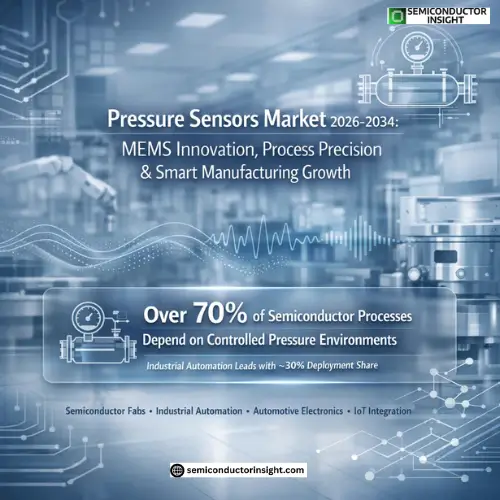
Pressure Sensors Market Outlook Strengthens Semiconductor Innovation and Connected Device Demand
Pressure sensors market represents semiconductor-enabled devices that measure and monitor pressure levels of gases or liquids and convert them into electrical signals for processing, control, or monitoring systems. These sensors are fundamental components in automotive electronics, semiconductor fabrication equipment, healthcare devices, industrial automation, and smart infrastructure systems.
Within semiconductor ecosystems, pressure sensors function as critical process control elements, maintaining vacuum stability, gas flow precision, and chemical handling accuracy in fabrication environments. Their ability to deliver real-time measurements enhances operational safety and improves system efficiency across multiple industries.
Today, pressure sensing technologies operate at the intersection of MEMS engineering, material science, and advanced semiconductor packaging, making them indispensable in modern electronic systems.
Please Take a Look at Our Updated Report before Continuing:
https://semiconductorinsight.com/report/pressure-sensors-market/
Why Pressure Sensors Matter in Modern Semiconductor Systems?
Pressure sensing technology plays a central role in semiconductor manufacturing environments where precise atmospheric control is essential. Semiconductor fabs rely on pressure monitoring to maintain vacuum conditions, regulate gas deposition, and ensure uniform wafer processing.
More than 70% of semiconductor manufacturing processes depend on controlled pressure environments, particularly during etching, chemical vapor deposition, and wafer cleaning stages. The need for consistent process stability is pushing sensor manufacturers toward ultra-sensitive MEMS-based solutions.
In addition, pressure sensors contribute to equipment reliability by detecting system anomalies early. This reduces operational downtime and improves production yield, which is a major priority in advanced chip manufacturing.
Technology Architecture and Material Engineering
Pressure sensors combine mechanical sensing elements with semiconductor electronics to create compact and reliable monitoring solutions. Their performance is closely linked to material composition and micro fabrication methods.
Modern designs increasingly rely on silicon-based MEMS structures, which provide high sensitivity and long-term stability. MEMS technology also enables miniaturization, allowing integration into smartphones, medical devices, and automotive control systems.
Material selection remains a critical factor influencing performance:
- Silicon diaphragms provide high sensitivity and precision
- Ceramic sensing elements offer thermal stability and corrosion resistance
- Piezoelectric materials enable dynamic pressure measurement
The ongoing shift toward chemical-resistant coatings and high-temperature materials reflects demand from harsh industrial and semiconductor processing environments.
Industrial Adoption Landscape and Usage Trends
Pressure sensors are now widely deployed across multiple sectors, demonstrating strong adoption levels in process industries and advanced electronics.
Industrial automation accounts for nearly 30% of global sensor deployment, where pressure monitoring ensures operational safety and efficiency in manufacturing systems.
Automotive applications represent another major segment, with modern vehicles integrating multiple sensors for engine control, braking systems, and safety mechanisms.
Other major adoption areas include:
- Semiconductor fabrication equipment monitoring
- Healthcare diagnostic instruments
- Consumer electronics pressure detection
- Environmental monitoring systems
The expansion of smart factories and connected infrastructure continues to accelerate sensor deployment globally.
Chemical Process Integration in Sensor Manufacturing
The pressure sensors market is closely linked with chemical processing technologies, particularly in material preparation and device fabrication.
Semiconductor-grade pressure sensors require:
- Chemical etching processes for MEMS structure formation
- Thin-film deposition techniques for sensing layers
- Protective chemical coatings for corrosion resistance
- Gas-sensitive materials for specialized industrial monitoring
Chemical compatibility determines sensor durability in applications such as oil refining, pharmaceutical production, and semiconductor manufacturing environments where exposure to reactive substances is common.
This integration between chemical engineering and semiconductor fabrication continues to expand product innovation.
Process Control Role in Semiconductor Manufacturing
In semiconductor fabrication plants, pressure sensors act as guardians of process precision. They regulate vacuum chambers, gas flow systems, and chemical delivery units.
Even minor pressure deviations can cause wafer defects or yield loss, making accurate sensing essential for production reliability. Advanced fabs therefore deploy distributed sensor networks across equipment to ensure consistent operating conditions.
Emerging process nodes demand higher precision, pushing manufacturers to develop ultra-low pressure detection capabilities and real-time monitoring systems.
Key Market Forces Influencing Growth
Several structural drivers are reshaping demand patterns for pressure sensors globally.
- Rising adoption of industrial automation systems
• Growing demand for smart vehicles and safety electronics
Beyond these factors, the increasing adoption of IoT devices and connected infrastructure has significantly expanded pressure monitoring requirements in residential, commercial, and industrial applications.
Digital transformation initiatives across manufacturing sectors are also increasing demand for predictive maintenance solutions, where sensors enable early fault detection.
Challenges Limiting Market Expansion
Despite strong growth potential, the market faces certain constraints that influence adoption patterns.
High integration costs in advanced systems can restrict adoption in price-sensitive industries. In addition, sensor performance can be affected by temperature fluctuations, chemical exposure, and mechanical stress, requiring specialized material engineering.
Another challenge involves calibration complexity, particularly in high-precision semiconductor manufacturing environments where measurement accuracy must remain consistent over long periods.
Competitive Technology Development and Industry Direction
Technology competition in this market focuses on miniaturization, power efficiency, and enhanced accuracy. Manufacturers are investing in sensor integration with wireless communication and edge computing capabilities.
The industry is also moving toward:
- Ultra-miniature sensors for wearable electronics
- AI-enabled predictive monitoring systems
- Flexible and printed pressure sensing technologies
- High-temperature industrial sensing solutions
These developments reflect a broader transition toward intelligent sensing ecosystems across industrial and semiconductor environments.
The future of the pressure sensors market will be shaped by the convergence of semiconductor innovation, industrial automation, and digital infrastructure expansion.
Smart manufacturing systems, autonomous vehicles, and advanced healthcare monitoring technologies are expected to drive long-term adoption. The continued push toward miniaturized electronics and energy-efficient devices will further expand sensor integration.
The market’s strategic direction centers on precision monitoring, material innovation, and intelligent system integration, positioning pressure sensors as essential components in next-generation electronic and industrial systems.

Comments (0)