

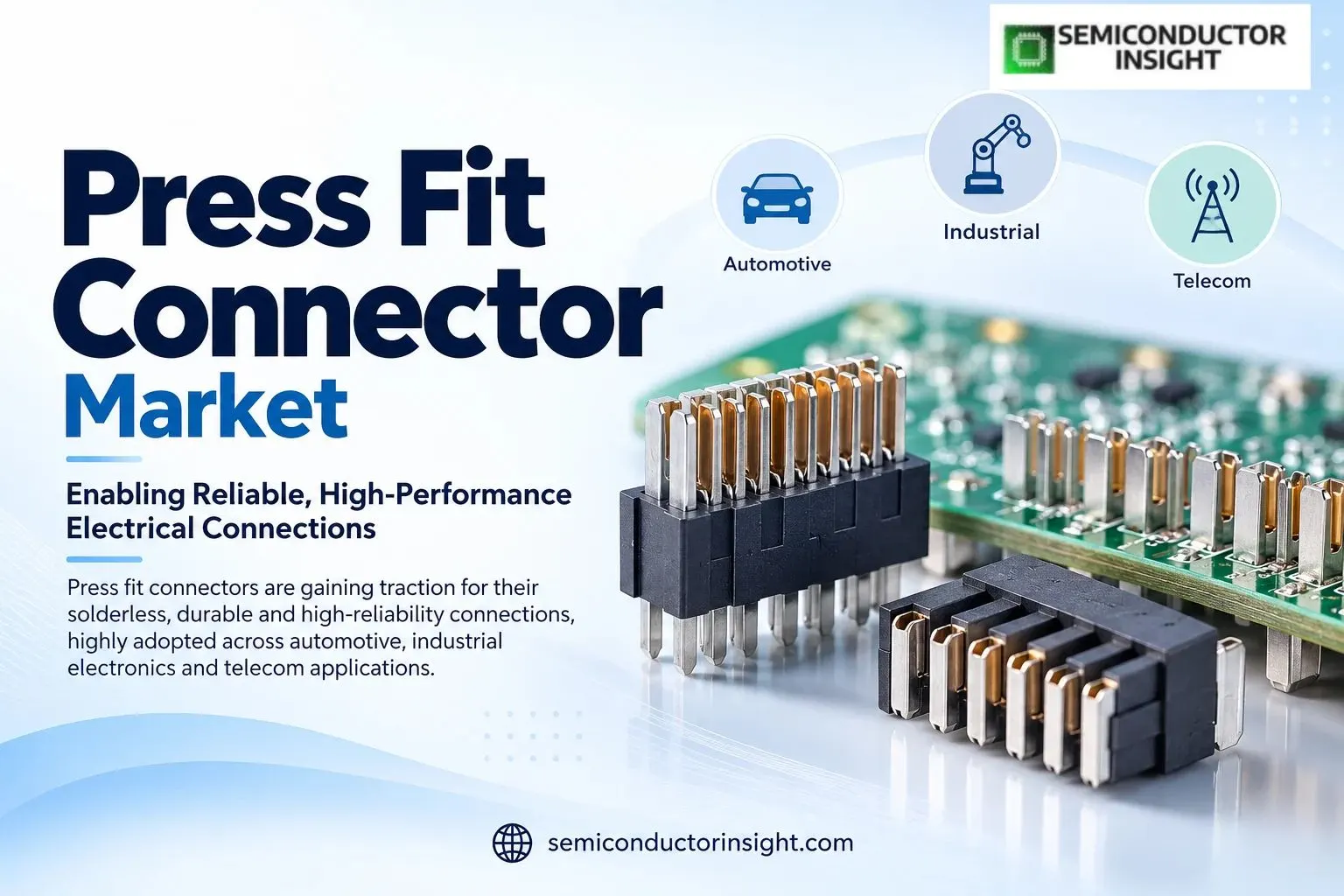
Press Fit Connector Market Review in 2026: Why Solderless PCB Connections Are Finding New Roles in High-Performance Systems?
Press-fit connectors are gaining importance as electronic manufacturers look for reliable PCB connections without relying on conventional soldering at every interface. Instead of solder, a compliant or solid press-in section is mechanically inserted into a plated-through PCB hole to create the electrical and mechanical connection.
IEC 60352-5:2020 specifically covers solderless press-in connections and establishes requirements and test methods for evaluating their mechanical, electrical and environmental performance. That formal standardization gives press-fit technology a defined engineering framework rather than leaving it as a niche assembly technique. IEC Webstore
The technology is particularly relevant where manufacturers need repeatable assembly, controlled insertion forces, serviceability and reliable connections in demanding environments.
Automotive Electronics Is Putting More Connections into Less Space
- The automotive sector is one of the most visible application areas. TE Connectivity lists press-fit technology for airbag control units, sensors, convenience systems, engine management and ABS/ESC systems. Its automotive portfolio includes compliant-pin designs developed for smaller PCB holes and tighter packaging requirements. TE Connectivity
- The scale of the underlying electronics opportunity is substantial. Global vehicle production reached approximately 96.4 million units in 2025, up from 92.7 million in 2024, according to OICA data reported by the Society of Indian Automobile Manufacturers. Asia-Oceania alone produced around 59.2 million vehicles.
- Every vehicle does not translate directly into press-fit connector demand, but the growing electronic content per vehicle creates more potential PCB-to-system interfaces.
Miniaturization Is Changing the Shape of the Connector
Connector development is increasingly being driven by the physical limitations of electronic modules. TE Connectivity’s NanoMultispring press-fit technology is designed for a PCB end-hole diameter of 0.6 mm and addresses the demand for smaller pitch and reduced packaging space in automotive applications.
That 0.6 mm figure illustrates how connector engineering is moving toward much tighter mechanical tolerances.
Smaller contact structures can help designers preserve PCB space for processors, sensors, power-management components and other electronics while maintaining a dedicated interconnection architecture.
Press-Fit Is Finding a Place between PCB Assembly and System Integration
Press-fit technology is not simply a replacement for soldering. Its value becomes more apparent when a connector has to be installed after other PCB processes or when manufacturers want a controlled mechanical insertion operation.
TE Connectivity offers dedicated pin-insertion and connector-seating equipment, including automated and servo-driven systems. Its product portfolio covers insertion machines and seating presses designed specifically for press-fit assembly.
This creates an interesting manufacturing chain: connector design, PCB hole geometry, insertion force, plating, tooling and inspection all have to work together.
The Reliability Equation Starts with the PCB Hole
The connection may appear simple from the outside, but its performance depends on the interaction between the compliant pin and plated-through hole.
- IEC 60352-5:2020 addresses mechanical, electrical and atmospheric conditions and provides methods for evaluating press-in connections under defined conditions.
- This matters for semiconductor and electronics supply chains because a connector cannot be considered independently from the board material, copper plating, hole dimensions and assembly process.
For high-density electronics, the interface is therefore becoming a precision-engineering problem rather than simply a component-selection decision.
Electrification Adds New Electronic Modules to the Vehicle
Vehicle electrification is also changing where connectors are needed. Electric and hybrid platforms require power-management electronics, battery monitoring, thermal-management systems, charging electronics and increasingly sophisticated control modules.
Press-fit connectivity can be attractive in selected electronic assemblies where mechanical retention and solderless PCB attachment provide manufacturing or reliability advantages.
The same principle extends beyond passenger vehicles into commercial vehicles and industrial equipment, where electronics must operate amid vibration, temperature cycling and other environmental stresses.
You can freely browse our most recent updated report to learn more about it before scrolling further: https://semiconductorinsight.com/report/press-fit-connector-market/
Manufacturers Are Designing for Repair and Production Flexibility
- Another emerging consideration is manufacturing flexibility. Press-fit connections can allow certain connector interfaces to be installed mechanically rather than sent through another soldering operation.
- TE’s automotive portfolio includes multiple press-fit configurations and connector-seating equipment, demonstrating how the technology is being integrated into dedicated production processes rather than treated as a manual workaround.
- For manufacturers operating high-volume assembly lines, controlled insertion can become important for consistency, throughput and process monitoring.
The Next Connector Race Is Happening Inside the PCB
Press Fit Connector Market is increasingly connected to a broader transformation in electronic architecture. Smaller control units, greater electronic content, tighter PCB layouts and increasingly demanding operating environments are pushing connector suppliers toward finer pitch, controlled insertion and more application-specific compliant-pin designs.
The strongest opportunities are therefore emerging where space is limited but reliability cannot be compromised. Automotive control units, sensors, industrial electronics and other high-density PCB systems are turning press-fit connectivity into a strategic design option.
As electronics continue moving toward compact modules and more distributed architectures, the humble connector is becoming an increasingly important part of system-level engineering. The next phase of Press Fit Connector Market will likely be defined not simply by the number of contacts sold, but by how efficiently those contacts can occupy less board space while maintaining stable electrical and mechanical performance.

Comments (0)