

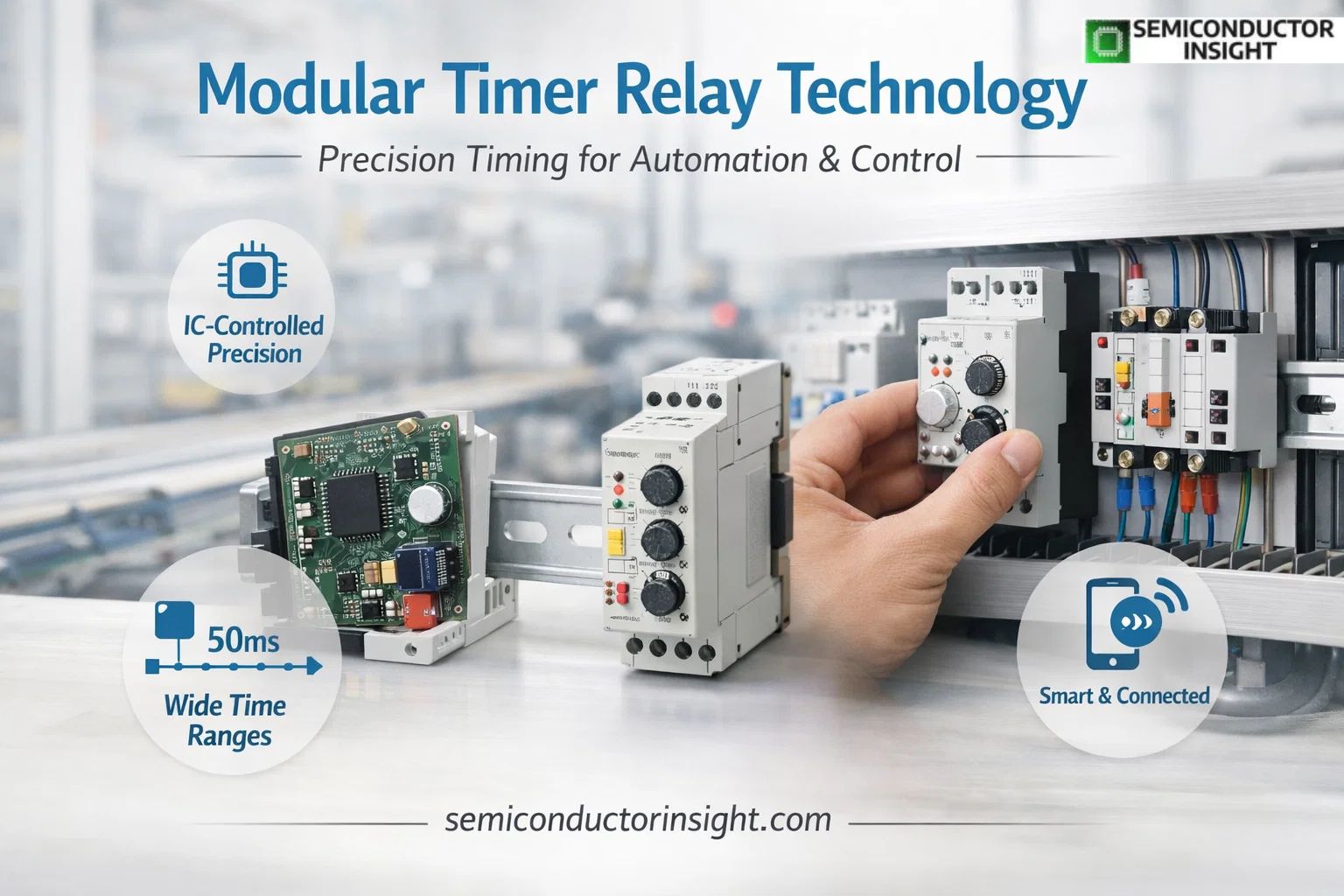
Precision Timing Innovations Elevating Modular Timer Relay Market Today
Modular timer relay market sits quietly at the core of modern electrical and automation systems, enabling machines and infrastructure to operate with precise timing control.
These devices combine relay switching with programmable timing functions, allowing engineers to automate sequences such as motor starts, lighting cycles, and HVAC operations with remarkable accuracy.
Semiconductor ICs at the Core of Reliable Timing
- At the heart of every high-performance modular timer relay sits a dedicated integrated circuit that translates dial settings or digital inputs into precise delays.
- In a typical teardown of an on-delay model, voltage hits the input terminals and the IC starts its internal clock before energizing the relay coil handling everything from 1.2 seconds to 300 hours across selectable ranges.
- Those front-panel dials connect through brushed contacts and binary encoder pads that feed absolute position data straight to the IC, allowing field-adjustable functions without extra hardware.
- Phoenix Contact’s ETD-BL series takes this further with a slim 6.2 mm housing, four selectable functions via DIP switches or thumbwheels, and time ranges as tight as 50 milliseconds to one hour, all while maintaining ±1 % basic accuracy and a mechanical life of 15 million cycles.
- This semiconductor backbone not only shrinks the footprint but boosts input resistance and supports programmable modes that older electromechanical timers simply couldn’t manage.
Click on the link below to see the most recent full report: https://semiconductorinsight.com/report/modular-timer-relay-market/
Modular DIN-Rail Designs Optimizing Control Panels
Engineers love the plug-and-play nature of these relays because they snap onto standard DIN rails alongside PLC modules and circuit breakers. TE Connectivity’s time-delay lineup, for instance, offers socket-mount or solder-hook versions with gold-plated pins for reliable connections in high-vibration environments, plus optional side brackets that keep panels tidy.
Chint’s JSZ3 series adds microcomputer-controlled delay with installation flexibility across equipment, panels, or rails, operating from -5 °C to +40 °C while drawing less than 3 VA and delivering 100,000 electrical operations. The result is denser control cabinets that save space and reduce wiring time critical when factories are retrofitting for higher throughput.
App-Connected Timing for IoT Ecosystems
Connectivity has moved beyond simple contacts. ABB’s digital time switches embed Bluetooth and support a free mobile app that lets technicians program daily, weekly, or astronomical schedules on the fly, complete with twilight sensing and automatic summer/winter adjustments. One channel can expand to eight with extension modules, cutting commissioning time by up to 80 % compared with traditional thumbwheel setups. In practice, this means a maintenance team can configure lighting or ventilation cycles from a tablet before the panel is even powered up, then monitor status remotely. Omron’s H5CC family pushes the envelope further with an intuitive six-digit LED interface and a built-in replacement-time notification that flags preventive maintenance windows features rolled out in recent firmware updates to support predictive upkeep in 24/7 production lines.
Precision Controls in High-Stakes Environments
Where downtime isn’t an option, solid-state timing circuitry shines. TE’s military-qualified relays use semiconductor timing to control FCA-210 series contacts rated up to 25 A, hermetically sealed for aerospace fuel transfer or nuclear cooling systems that must survive temperature swings to 125 °C.
These units deliver fixed or adjustable on-delay, off-delay, and interval timing without relying on power for the delay itself in pneumatic variants, giving system designers true redundancy. In industrial settings, the same precision prevents overlapping motor starts or ensures safe purge cycles before ignition small timing windows that prevent costly faults.
Live Industry Implementations Delivering Measurable Value
- In 2026, you will see these relays everywhere in a contemporary food-processing factory or an automotive assembly line.
- A European packaging plant recently replaced old timers with Phoenix Contact ETD units that have push-in connections.
- The move cut panel assembly time by 30% and got rid of contact bounce problems that used to cause false stops.
- In a North American data center upgrade, ABB app-enabled switches now turn on backup generator pre-heaters every 15 minutes, making sure they are ready without wasting time.
- Meanwhile, aerospace suppliers using TE solid-state models report zero timing drift across temperature cycles that previously required frequent recalibration. Semiconductor supply stabilization after earlier global disruptions has accelerated adoption newer ICs arrive faster, letting manufacturers roll out thinner, multi-function units that fit tighter budgets and tighter spaces alike.
These modular timer relays aren’t flashy headline-grabbers, yet they quietly underpin the reliability of Industry 4.0 systems worldwide. By leaning on proven semiconductor intelligence, DIN-rail simplicity, and real-time connectivity, they turn abstract automation goals into measurable, repeatable performance on the factory floor.

Comments (0)