Modular Timer Relay Market Insights
Modular Timer Relay market size was valued at USD 303 million in 2026. The market is projected to reach USD 423 million by 2034, exhibiting a CAGR of 5.0% during the forecast period.
A modular timer relay is a device that combines the functions of a timer and a relay in one unit. It is typically used in industrial automation applications to control the timing of various processes or equipment. The modular design allows for easy installation and customization, as different modules can be added or removed depending on the specific requirements of the application. Some common features of modular timer relays include adjustable timing settings, multiple timing modes (such as on delay, off delay, and interval timing), and the ability to control multiple outputs simultaneously. These devices are often used in conjunction with sensors, switches, and other control devices to create complex timing sequences and control logic. Overall, modular timer relays are versatile and reliable devices that provide precise timing control in a wide range of industrial applications.
The market is experiencing steady growth due to several factors, including surging demand for industrial automation, expansion in HVAC systems and lighting control applications, and the rise of smart manufacturing initiatives. Furthermore, advancements in energy-efficient technologies and integration with IoT-enabled systems are driving further expansion. Key players in the market, such as Phoenix Contact, Schneider Electric, Siemens, Honeywell, and Eaton, continue to innovate with broad product portfolios to meet diverse industry needs.
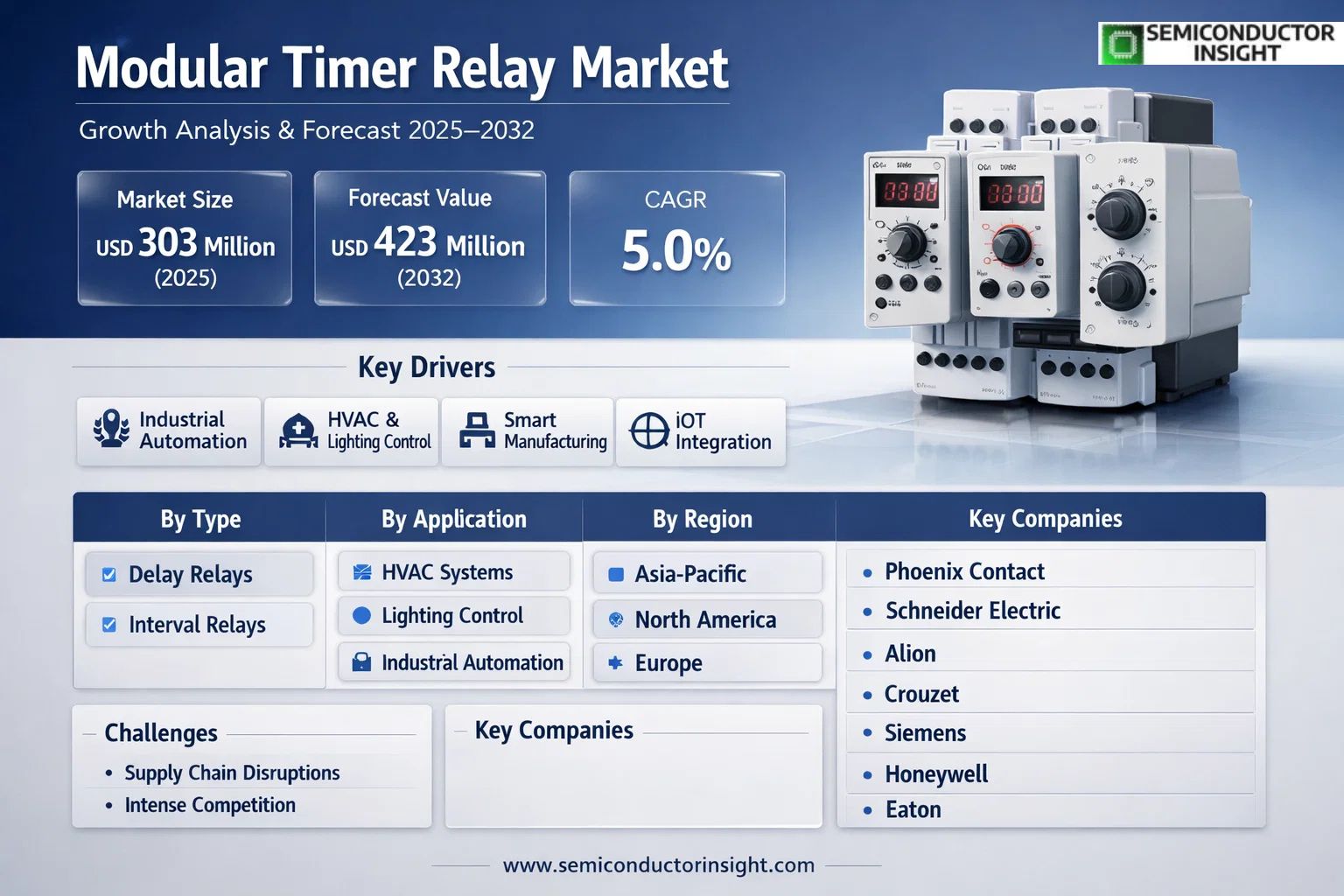
MARKET DRIVERS
Industrial Automation Surge
Modular Timer Relay Market is propelled by the rapid adoption of industrial automation across manufacturing sectors. With factories increasingly integrating smart controls, demand for precise timing devices like modular timer relays has surged, enabling efficient sequence operations in assembly lines. Global automation investments reached approximately $200 billion in 2023, significantly boosting this segment.
Energy Efficiency Mandates
Regulatory pressures for energy conservation are key drivers, as modular timer relays optimize power usage in HVAC systems and lighting controls. These devices support delayed actions that reduce unnecessary energy consumption, aligning with global sustainability goals. The market benefits from a projected 6% annual growth in energy-efficient industrial components through 2028.
➤ Integration with IoT platforms enhances real-time monitoring, further accelerating Modular Timer Relay Market expansion in smart factories.
Advancements in compact DIN-rail designs cater to space-constrained panels, making them indispensable in modern control systems and driving consistent market growth.
MARKET CHALLENGES
Supply Chain Disruptions
Modular Timer Relay Market faces hurdles from volatile semiconductor supplies, impacting production timelines. Recent global shortages have increased lead times by up to 20%, challenging manufacturers to meet demand in critical applications like automation equipment.
Other Challenges
Intense Competition
Diverse players offering similar products pressure pricing, with over 50 key vendors vying for share in a fragmented market estimated at $1.2 billion in 2023.
Technical Integration Issues
Compatibility with legacy systems poses difficulties, requiring custom adaptations that raise costs and slow adoption in brownfield industrial sites.
MARKET RESTRAINTS
High Development Costs
Substantial R&D investments for advanced features like multi-function timing hinder smaller entrants in Modular Timer Relay Market. Development cycles often exceed 18 months, limiting innovation pace amid rising material costs.
Evolving safety standards, such as IEC 61850 compliance, impose rigorous testing, delaying product launches and restraining market entry for non-compliant devices.
Preference for programmable logic controllers (PLCs) over standalone relays in complex setups caps growth, as PLCs offer greater flexibility despite higher upfront expenses.
Geopolitical tensions disrupt raw material sourcing, particularly rare earth elements used in electronics, constraining supply and overall market expansion.
MARKET OPPORTUNITIES
IIoT and Smart Manufacturing
Modular Timer Relay Market holds strong potential in IIoT convergence, where wireless-enabled relays enable predictive maintenance. This shift could capture 15% more share in Industry 4.0 projects valued at $500 billion by 2027.
Expansion into emerging economies like India and Southeast Asia offers untapped demand, driven by infrastructure booms and a 7% CAGR in industrial electrification.
Customization for renewable energy applications, such as solar inverters, presents niches where precise timing enhances grid stability and efficiency.
Modular Timer Relay Market Trends
Growing Adoption in Industrial Automation
In Modular Timer Relay Market, a prominent trend is the increasing adoption of these devices in industrial automation applications. Modular timer relays combine timing and relay functions into a single unit, enabling precise control over processes and equipment. Their modular design facilitates easy installation and customization by allowing the addition or removal of modules based on specific needs. This flexibility supports complex timing sequences when integrated with sensors, switches, and other control devices, enhancing operational efficiency across manufacturing environments.
Other Trends
Dominance of Delay Timer Relay Segment
The Delay Timer Relay segment leads within Modular Timer Relay Market, driven by its versatility in applications requiring on-delay or off-delay functions. These relays offer adjustable timing settings and multiple output controls, making them essential for sequential operations in machinery. Industry surveys indicate strong demand from manufacturers and distributors, as this segment addresses core needs for reliable timing in automation setups.
Expansion in HVAC and Lighting Control Applications
Another key trend in Modular Timer Relay Market is the expansion into HVAC systems and lighting control. In HVAC, these relays manage timing for compressors, fans, and valves, optimizing energy use and system performance. Similarly, in lighting control, interval and delay modes enable automated sequences for energy-efficient operations. Regions like North America, Europe, and Asia-Pacific, including China and Germany, show heightened activity, with key players such as Phoenix Contact, Schneider Electric, and Siemens advancing product features to meet diverse application demands. This growth reflects broader shifts toward reliable, customizable control solutions amid evolving industrial requirements.
COMPETITIVE LANDSCAPE
Key Industry Players
Leading Manufacturers in Modular Timer Relay Market
Modular Timer Relay Market, valued at US$ 303 million in 2026 and projected to reach US$ 423 million by 2034 at a CAGR of 5.0%, features a moderately concentrated structure dominated by established multinational corporations. Phoenix Contact and Schneider Electric stand out as leading players, leveraging their extensive portfolios in industrial automation and robust distribution networks to capture significant global revenue shares. The top five manufacturers, including these frontrunners alongside Siemens and Honeywell, collectively command a substantial portion of the market, driven by innovations in adjustable timing functions, multiple modes like on-delay and interval timing, and integration with sensors for precise control in automation applications. This oligopolistic dynamic fosters intense competition focused on reliability, customization via modular designs, and compliance with industrial standards.
Beyond the market leaders, a cadre of niche and regional players contributes to diversification, particularly in specialized segments such as Delay Timer Relay and applications in HVAC systems, lighting control, and other industrial processes. Companies like Crouzet, Eaton, and Littelfuse offer versatile solutions emphasizing compact designs and multi-output capabilities, while emerging Asian manufacturers including Alion, GEYA Electrical Equipment Supply, and YUANKY Electric address cost-sensitive demands with tailored products. Schrack Technik, Wuxi Fenigal Science & Technology Co., Ltd., and Wenzhou Ourtop Electrical Co., Ltd. further enhance competition through targeted innovations and expansions in regions like Europe and Asia-Pacific. This mix of global giants and agile specialists drives ongoing advancements, challenging incumbents to innovate amid evolving demands for energy-efficient and IoT-compatible timer relays.
List of Key Modular Timer Relay Companies Profiled
- Phoenix Contact
- Schneider Electric
- Alion
- Crouzet
- Siemens
- Honeywell
- Eaton
- Schrack Technik
- GEYA Electrical Equipment Supply
- Littelfuse
- YUANKY Electric
- Wuxi Fenigal Science & Technology Co., Ltd
- Wenzhou Ourtop Electrical Co., ltd.
Segment Analysis:
| Segment Category | Sub-Segments | Key Insights |
| By Type |
|
Delay Timer Relay leads due to its versatility in industrial automation.
|
| By Application |
|
HVAC Systems dominates applications with its critical role in climate management.
|
| By End User |
|
Industrial Manufacturing is the primary end user for its automation needs.
|
| By Mounting Type |
|
DIN Rail Mount prevails for its standardization in control panels.
|
| By Voltage Rating |
|
Medium Voltage (110-240V AC) leads for broad compatibility.
|
Regional Analysis: Modular Timer Relay Market
Asia-Pacific
Asia-Pacific leads in industrial automation where modular timer relays enable synchronized operations in assembly lines. Factories leverage these devices for delay functions in robotics and PLC integrations, boosting efficiency in electronics manufacturing hubs like Shenzhen and Bangalore.
As the world’s manufacturing epicenter, the region drives modular timer relay demand through automotive and appliance production. Proximity to suppliers ensures quick customization for high-speed applications, reinforcing cost advantages in competitive global supply chains.
Innovations in multi-function modular timer relays with digital interfaces proliferate here. Japanese and Korean firms pioneer compact designs for space-constrained machinery, while Indian startups focus on affordable IoT-enabled versions for SMEs.
Seamless integration of modular timer relays into regional supply chains supports just-in-time manufacturing. Export dynamics to Europe and North America highlight reliability, with quality certifications aligning international standards.
North America
North America’s modular timer relay market thrives on technological sophistication and stringent safety standards in industrial applications. The United States and Canada emphasize advanced automation in sectors like oil & gas, pharmaceuticals, and food processing, where these relays ensure precise control in hazardous environments. Innovation hubs in Silicon Valley and Detroit drive demand for programmable variants integrated with SCADA systems, enhancing operational reliability. Regulatory frameworks promote energy-efficient designs, spurring adoption in smart grid initiatives and renewable energy installations. Key players collaborate on R&D for cybersecurity features amid rising IIoT adoption. While high costs pose barriers for smaller firms, the focus on customization and aftermarket services sustains steady growth. Market dynamics reflect a mature ecosystem prioritizing quality over volume, with exports bolstering regional influence.
Europe
Europe’s modular timer relay market is characterized by rigorous regulations and a push for sustainability. Germany, France, and Italy lead in automotive and machinery sectors, utilizing these relays for efficient timing in assembly and testing processes. The EU’s emphasis on green manufacturing accelerates integration into energy management systems and electric vehicle production lines. Compliance with harmonized standards like CE marking fosters trust, while collaborative projects advance modular designs with reduced carbon footprints. Challenges from supply disruptions are met with localized production strategies. This region’s dynamics highlight precision engineering, with strong after-sales networks supporting diverse applications from elevators to wastewater treatment.
South America
South America’s modular timer relay market is emerging amid infrastructure modernization in Brazil, Argentina, and Mexico. Industrial expansion in mining, agriculture, and utilities drives adoption for basic timing controls in pumps and conveyor systems. Economic recovery fuels investments in automation upgrades, favoring cost-effective modular solutions from regional assemblers. Government incentives for local manufacturing enhance accessibility for SMEs. Volatility in raw material prices prompts diversification strategies. Market dynamics showcase potential in urbanization projects, with gradual shifts toward digital variants enhancing process reliability across fragmented industries.
Middle East & Africa
The Middle East & Africa modular timer relay market gains momentum from oil & gas dominance and rapid urbanization. Gulf nations like Saudi Arabia and UAE prioritize these relays in petrochemical plants for safe sequencing, while African growth in construction and power sectors boosts demand. Harsh environments necessitate rugged designs, with imports filling technology gaps. Visionary diversification plans integrate automation in non-oil industries. Regional dynamics emphasize partnerships for training and maintenance, fostering long-term resilience in mission-critical applications like desalination and smart cities.
Report Scope
This market research report provides a comprehensive analysis of Modular Timer Relay Market, covering the forecast period 2026–2034. It offers detailed insights into market dynamics, technological advancements, competitive landscape, and key trends shaping the industry.
Key focus areas of the report include:
- Market Overview: The report begins with an overview outlining its current market scenario, key growth indicators, and industry transformation drivers. It discusses macroeconomic factors, demand–supply balance, regulatory landscape, and the strategic role of modular timer relays in powering advancements across industries such as industrial automation, HVAC systems, lighting control, and manufacturing.
- Market Size & Forecast: Historical data and future projections for revenue, unit shipments, and market value across major regions and segments.
- Segmentation Analysis: Detailed breakdown by product type, technology, application, and end-user industry to identify high-growth segments and investment opportunities.
- Regional Insights: Insights into market performance across North America, Europe, Asia-Pacific, Latin America, and the Middle East & Africa, including country-level analysis where relevant.
- Competitive Landscape: Profiles of leading market participants, including their product offerings, R&D focus, manufacturing capacity, pricing strategies, and recent developments such as mergers, acquisitions, and partnerships.
- Technology Trends & Innovation: Assessment of emerging technologies, integration of AI/IoT, timer design trends, fabrication techniques, and evolving industry standards.
- Market Drivers & Restraints: Evaluation of factors driving market growth along with challenges, supply chain constraints, regulatory issues, and market-entry barriers.
- Stakeholder Insights: Insights for component suppliers, OEMs, system integrators, investors, and policymakers regarding the evolving ecosystem and strategic opportunities.
Primary and secondary research methods are employed, including interviews with industry experts, data from verified sources, and real-time market intelligence to ensure the accuracy and reliability of the insights presented.
FREQUENTLY ASKED QUESTIONS:
What is the current market size of Modular Timer Relay Market?
-> Modular Timer Relay Market was valued at USD 303 million in 2026 and is expected to reach USD 423 million by 2034, at a CAGR of 5.0% during the forecast period.
Which key companies operate in Modular Timer Relay Market?
-> Key players include Phoenix Contact, Schneider Electric, Alion, Crouzet, Siemens, Honeywell, Eaton, Schrack Technik, GEYA Electrical Equipment Supply, and Littelfuse, among others.
What are the key growth drivers?
-> Key growth drivers include expansion in industrial automation, rising demand in HVAC systems and lighting control, and need for precise timing control.
Which region dominates the market?
-> Asia is the fastest-growing region, while North America remains a dominant market.
What are the emerging trends?
-> Emerging trends include modular design for customization, multiple timing modes such as on-delay and interval, and integration with sensors for complex control logic.

Get Sample Report PDF for Exclusive Insights
Report Sample Includes
- Table of Contents
- List of Tables & Figures
- Charts, Research Methodology, and more...
 Download Sample Report PDF