
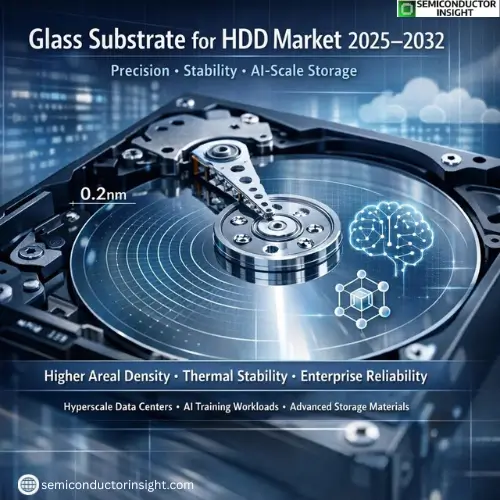
Precision Glass Revolutionizes Hard Disk Drive Substrates for AI Workloads
Precision Glass Revolutionizes Hard Disk Drive Substrates for AI Workloads
Glass substrate for hard disk drives market is emerging as a critical semiconductor-linked material segment, enabling higher data density, mechanical stability, and next-generation storage performance in an era dominated by cloud computing and AI workloads.
A Silent Shift Beneath the Data Explosion
The global conversation around data storage usually centres on capacity, speed, and cloud scalability, but beneath every high-performance hard disk drive lies a material innovation quietly reshaping the industry: glass substrates. As hyper scale data centres, AI training models, and edge computing continue to push storage limits, traditional aluminum substrates are increasingly unable to meet the precision and stability requirements of modern HDDs.
Glass substrates are no longer experimental materials. They are becoming a structural enabler for next-generation hard disk drives, offering superior flatness, dimensional stability, and thermal resistance characteristics that directly influence areal density and long-term reliability. For semiconductor and data infrastructure ecosystems, this shift signals a material-level transformation rather than a simple component upgrade.
Why Glass Is Gaining Ground over Aluminum?
The transition from aluminum to glass substrates is rooted in physics, chemistry, and manufacturing precision. Glass substrates provide a significantly smoother surface at the nanometer level, allowing tighter magnetic head flying heights and more precise track placement. This directly supports higher data density, which is critical as HDD manufacturers race to keep pace with expanding data volumes.
Unlike aluminum, glass exhibits minimal thermal expansion, which becomes crucial in high-speed, continuously operating environments such as enterprise servers and cloud storage facilities. Temperature fluctuations that once caused subtle distortions in aluminum disks can lead to read/write errors at today’s ultra-tight tolerances. Glass reduces this risk, offering a stable platform that aligns with the demands of advanced semiconductor-driven storage architectures.
Semiconductor Manufacturing Standards Influence HDD Materials
One of the most defining trends in the glass substrate for hard disk drives market is the cross-pollination of semiconductor manufacturing standards into storage hardware. Precision polishing, defect control, and surface uniformity requirements for glass substrates increasingly resemble those used in wafer fabrication.
This convergence is not accidental. As HDDs integrate more advanced controllers, sensors, and signal-processing chips, mechanical tolerances must align with semiconductor-grade expectations. Glass substrates support this evolution by enabling:
- Lower surface roughness for improved signal integrity
- Tighter dimensional consistency across large production volumes
- Reduced vibration and mechanical noise in high-RPM drives
These characteristics make glass substrates particularly attractive for enterprise and nearline HDDs, where performance consistency matters more than marginal cost differences.
For More Detailed Insights You Can Surf Our Latest Report Here:
https://semiconductorinsight.com/report/glass-substrate-for-hard-disk-drives-market/
Data Centres and AI Workloads Drive Market Demand
The rapid expansion of hyper scale data centres is one of the strongest demand drivers for glass substrate adoption. While solid-state drives dominate performance-critical tasks, HDDs remain indispensable for cost-effective, high-capacity storage. However, modern data centres require HDDs that are not only large in capacity but also exceptionally reliable under continuous load.
Glass substrates enhance shock resistance and long-term durability, reducing disk deformation over time. This is especially relevant as AI workloads generate massive datasets that must be stored, accessed, and retrained repeatedly. In practical terms, glass-based HDDs help data centre operators:
- Improve storage density per rack
- Lower failure rates over extended operating cycles
- Maintain consistent performance in temperature-controlled but high-activity environments
These operational advantages are pushing storage manufacturers to increasingly integrate glass substrates into premium HDD product lines.
Manufacturing Complexity and Cost Realities
Despite clear performance advantages, the glass substrate for hard disk drives market faces manufacturing and cost challenges. Glass is inherently more brittle than aluminium, requiring advanced handling, cutting, and polishing technologies to minimize breakage during production.
Yield optimization remains a critical focus area. Even minor defects at the substrate level can compromise entire disks, increasing scrap rates. As a result, manufacturers are investing heavily in automation, defect inspection systems, and chemical strengthening processes to improve throughput and reduce unit costs.
Encouragingly, economies of scale are beginning to take effect. As adoption grows and production volumes increase, the cost gap between aluminium and glass substrates continues to narrow making glass a more commercially viable option for broader HDD segments.
Further, in the coming years of the glass substrate for hard disk drives market extends beyond incremental HDD improvements. As storage systems increasingly integrate with semiconductor logic, AI accelerators, and advanced controllers, the physical medium must keep pace.
Glass substrates offer a future-ready foundation one capable of supporting higher recording densities, emerging magnetic technologies, and extended product lifecycles. While SSDs continue to grow, HDDs with glass substrates are positioning themselves as the backbone of large-scale data retention, where cost efficiency and reliability matter most.
The glass substrate for hard disk drives market represents a subtle yet powerful shift in how data storage hardware is engineered. By borrowing precision standards from semiconductor manufacturing and addressing the real-world demands of modern data infrastructure, glass substrates are redefining what HDDs can achieve.
In an industry obsessed with speed and capacity, glass proves that sometimes the most meaningful innovation starts at the foundation.

Comments (0)