Key Statistics
Key Takeaways
- 3.5-inch nearline glass substrates are the strategic demand anchor even though the source report describes 2.5-inch as the largest type. HOYA states that 3.5-inch substrates accounted for the vast majority of its FY25 HDD-substrate sales while 2.5-inch consumer volumes continued to decline significantly.
- Data-center and enterprise storage remain the most durable end-use pools because cloud and generative-AI workloads expand retained data. Seagate is already ramping HAMR-based 32 TB products and sampling up to 36 TB, demonstrating why platter quality and areal-density capability matter more than consumer HDD unit growth.
- Asia Pacific is the largest regional market because the only disclosed glass-HDD-substrate producer is headquartered in Japan and is adding a new Vietnam manufacturing facility, while China’s stored data reached 2.53 ZB in 2025 and its data-production volume rose 27.28%.
- Consumer HDD substitution by SSDs is the principal structural restraint. HOYA’s FY25 disclosure shows 2.5-inch substrate sales continuing to fall, so growth in 3.5-inch nearline glass must offset a shrinking consumer base rather than merely add to it.
- HAMR and increasing platter counts create the strongest value opportunity. HOYA links its long-term share expansion in 3.5-inch nearline substrates to HAMR and higher platter counts, while Seagate’s Mozaic 3+ platform uses a 10-platter design at up to 3.6 TB per platter.
Glass Substrate for Hard Disk Drives Market Overview
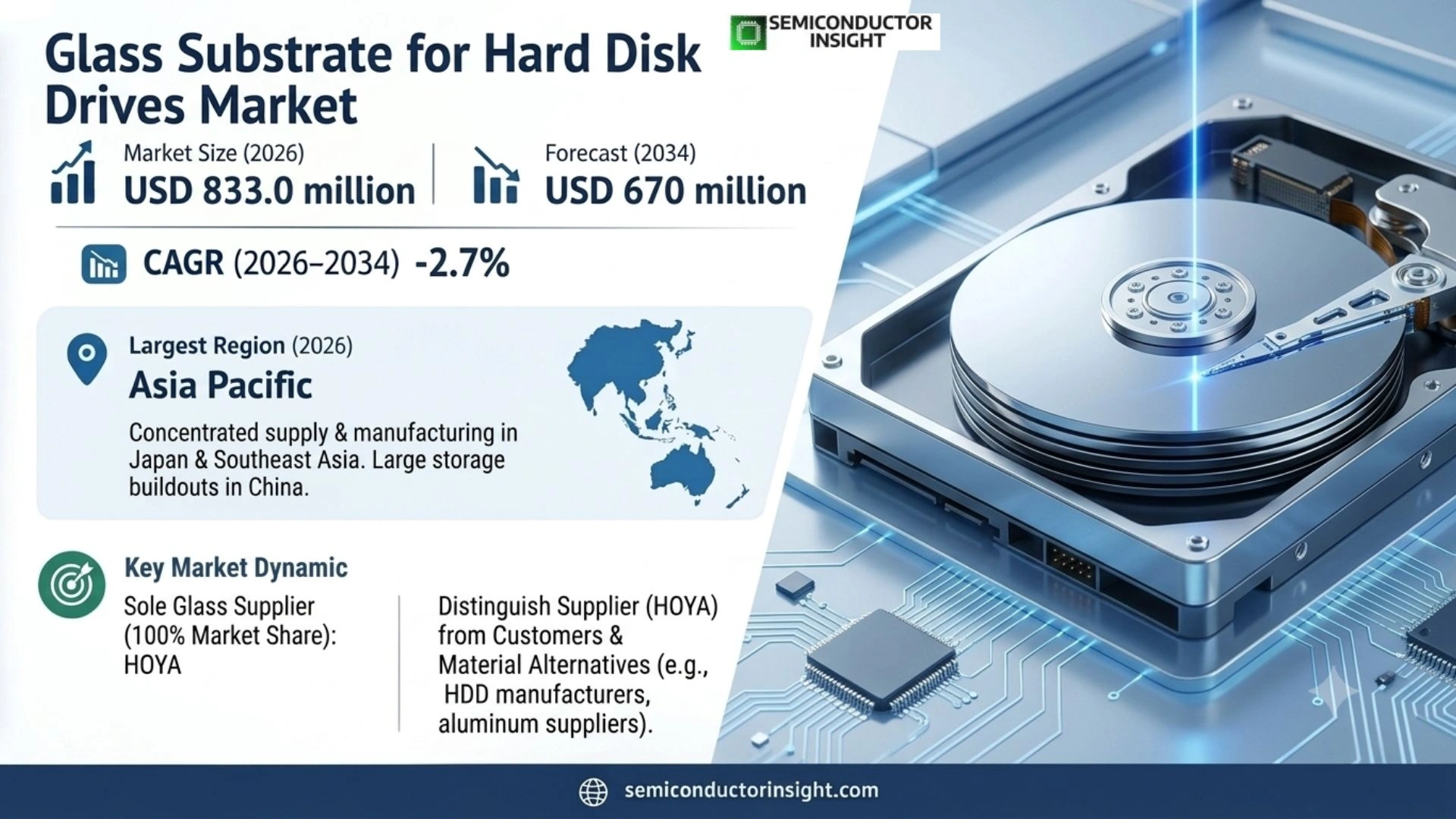
Glass Substrate for Hard Disk Drives Market is valued at USD 856 million in 2025. Applying the source page’s two published size anchors consistently produces an estimated USD 833.0 million in 2026 and a projected USD 670 million by 2034, equivalent to a -2.7% CAGR during 2026–2034. Asia Pacific is the largest market, while the industry’s commercial center is shifting away from shrinking 2.5-inch consumer drives toward 3.5-inch nearline systems used in cloud and enterprise storage.
Glass HDD substrates are precision-engineered discs that become the mechanical base of magnetic recording media. Their commercial value is not simply the price of glass: the substrate must remain extremely flat, smooth and dimensionally stable through polishing, coating, high-speed rotation and thermal cycling. That performance supports tighter head-to-media spacing, thinner disks and larger platter counts, which directly affects achievable drive capacity, reliability and power efficiency in dense storage systems.
The addressable market is unusually concentrated. HOYA describes two commercial product families: 3.5-inch substrates for nearline HDDs and 2.5-inch substrates for consumer HDDs. Its FY25 integrated report states that the company held 100% of the glass-based HDD substrate market, while its estimated share of the broader 3.5-inch nearline HDD substrate market was about 40% because aluminum remains an alternative substrate in that form factor. This distinction is essential when interpreting supplier share.
Demand is therefore bifurcated. Consumer 2.5-inch HDD applications continue to lose volume to solid-state storage, but nearline HDDs remain important for economical, high-capacity retention of data generated by cloud services, AI training, inference pipelines and enterprise archives. The commercial question is not whether flash replaces some HDD workloads; it is whether the number of glass platters and the share of glass within each high-capacity nearline drive increase fast enough to outweigh the decline in consumer HDD substrate demand.
Segment Analysis: By Type
By type, the market is segmented into 2.5-inch and 3.5-inch glass substrates. The source report labels 2.5-inch as the largest type, but supplier evidence indicates that this framing is no longer representative of current commercial demand: HOYA states that 3.5-inch substrates represented the vast majority of FY25 HDD-substrate sales, while 2.5-inch consumer substrate sales declined significantly.
| Type | Market position and evidence-led demand characteristics |
|---|---|
| 2.5-inch | Used primarily in consumer-oriented HDDs such as external drives and legacy compact storage. HOYA says this addressable substrate market uses glass entirely, giving it 100% supplier share, but FY25 sales continued to decline significantly. The commercial implication is a structurally contracting volume pool where replacement demand and specialty external-storage uses remain, yet SSD substitution limits the case for meaningful capacity expansion. |
| 3.5-inch | Used in nearline HDDs serving cloud and enterprise data centers. HOYA reports that 3.5-inch products represented the vast majority of its FY25 HDD-substrate sales and estimates its share of the broader nearline substrate market at about 40%. HAMR adoption, increasing platter counts and higher capacity per drive make this type the strategic growth pool even while the total glass-substrate market declines on a headline revenue basis. |
Manufacturing process and storage-capacity context
The source page also classifies products as polished, textured and coated glass substrates and by HDD storage capacity below 1 TB, 1–5 TB and above 5 TB. These are useful scope descriptors rather than independent demand markets. In practice, current nearline innovation is moving toward far higher capacities: Seagate announced 10-platter HAMR products at up to 36 TB in January 2025, making surface quality, thinness and thermal stability increasingly valuable as manufacturers pursue higher areal density and more platters per enclosure.
Segment Analysis: By Application
By application, the source scope comprises data centers, enterprise storage solutions, and PCs & consumer electronics. Data centers are the most strategically important application because high-capacity nearline HDDs preserve a cost-per-terabyte advantage for large retained data sets, while consumer PCs and portable storage face the greatest substitution pressure from solid-state drives.
| Application | Demand characteristics |
|---|---|
| Data Center | Cloud and hyperscale operators purchase storage in exabytes rather than individual drives, so their economics prioritize capacity density, cost per terabyte, watts per terabyte and fleet reliability. Seagate’s 2025 HAMR launch claimed 300% more storage capacity in the same data-center footprint, 25% lower cost per terabyte and 60% lower power per terabyte versus the company’s comparison baseline, making platter technology a direct enabler of infrastructure economics. |
| Enterprise Storage Solutions | Enterprise arrays, backup systems and archival platforms value predictable lifetime cost, retention and rebuild behavior. These buyers may deploy both flash and HDD tiers, using HDD capacity for colder or sequentially accessed data. Glass-substrate demand in this segment therefore depends on the share of enterprise capacity delivered through nearline 3.5-inch drives and on platter counts per drive rather than on overall server shipments alone. |
| PCs & Consumer Electronics | This is the structurally weakest application. HOYA’s FY25 disclosure says 2.5-inch glass-substrate sales for consumer HDDs, including external hard drives, continued to decline significantly. SSD adoption in notebooks, consoles and premium PCs reduces unit demand for compact spinning storage, leaving external backup, value-sensitive systems and replacement channels as the remaining pockets where 2.5-inch glass media can still generate meaningful sales. |
Regional Analysis
Asia Pacific is the largest regional market, supported by the supplier and manufacturing concentration in Japan and Southeast Asia and by very large storage-infrastructure buildouts in China. North America is the most visible hyperscale demand center, Europe is shaped increasingly by data-center efficiency regulation, and South America and the Middle East & Africa are smaller but investable markets where new cloud regions can create stepwise demand for high-capacity storage.
How does regional demand differ across the glass HDD substrate market?
Regional demand is best understood by separating where substrates are manufactured from where high-capacity HDDs are consumed. Asia Pacific contains the disclosed glass-substrate supplier base and growing manufacturing capacity; North America has unusually large hyperscale and AI data-center demand; Europe couples cloud growth with strict energy-performance reporting; South America is led by new cloud infrastructure in Brazil; and the Middle East & Africa is project-led, with Saudi Arabia, the UAE and Kenya building new cloud and digital infrastructure.
| Region | Position | Demand profile | What matters commercially |
|---|---|---|---|
| Asia Pacific | Largest | Supplier and manufacturing concentration plus rapid data growth | HOYA’s Japan base and planned Vietnam plant; China’s 2.53 ZB stored-data base in 2025 create both supply and demand relevance. |
| North America | Major demand center | Hyperscale AI and cloud storage expansion | U.S. data-center electricity consumption reached 176 TWh in 2023 and DOE projects 325–580 TWh by 2028, indicating the scale of infrastructure growth supporting storage demand. |
| Europe | Regulated growth market | Cloud growth constrained by energy and sustainability rules | The European Commission says the EU aims to triple data-center capacity by 2035 while introducing reporting and rating mechanisms for energy performance. |
| South America | Emerging | Cloud-region investment concentrated in Brazil | AWS announced R$10.1 billion of planned Brazilian cloud and data-center investment through 2034, making Brazil the region’s clearest storage-demand anchor. |
| Middle East & Africa | Project-led emerging | New sovereign cloud, AI and data-residency infrastructure | AWS, Microsoft and local partners have announced multi-billion-dollar digital-infrastructure programs in Saudi Arabia, the UAE and Kenya, creating new storage estates from a smaller installed base. |
Key Glass Substrate for Hard Disk Drives Manufacturers and Competitive Landscape
HDD substrate Market is not a conventional multi-vendor materials market. HOYA states that it holds 100% of the glass-based HDD substrate market, while the source report’s broader company list also includes HDD manufacturers and an aluminum-substrate supplier. Competitive analysis therefore needs to distinguish the actual glass-substrate supplier from customers and material alternatives rather than presenting all profiled companies as direct competitors.
HOYA’s competitive position rests on qualification history, precision glass processing and the ability to scale thinner, thermally stable media for both 2.5-inch and 3.5-inch formats. The company’s estimated share of the 3.5-inch nearline substrate market is about 40%, which is different from its 100% share within glass-based HDD substrates because nearline disks can still use aluminum. That leaves the main competitive contest as glass versus aluminum within 3.5-inch drives rather than HOYA versus another disclosed glass supplier.
Seagate, Western Digital and Toshiba are economically powerful participants because HDD OEM architecture determines substrate choice, platter count and qualification timing. They are customers or downstream ecosystem companies rather than suppliers of merchant glass substrates in the evidence reviewed here. Their adoption of HAMR, multi-platter designs and higher areal density can increase the value of glass even when total HDD unit shipments do not grow.
Showa Denko Materials is better understood as an alternative-material participant through aluminum substrate capabilities, not as a direct glass-substrate vendor. This matters strategically because a purchaser evaluating supply concentration is comparing material systems and qualified media stacks, not simply switching between interchangeable glass suppliers. Long qualification cycles and recording-media integration therefore create a high barrier to entry even before the capital cost of precision glass manufacturing is considered.
| Competitive role | Participants | Strategic position |
|---|---|---|
| Tier 1 – Glass substrate supplier | HOYA Corporation | HOYA publicly reports 100% share of glass-based HDD substrates and approximately 40% share of the broader 3.5-inch nearline HDD substrate market. Its planned Vietnam facility and FY28 start are the most material disclosed supply-side developments. |
| Downstream HDD OEMs | Seagate Technology; Western Digital; Toshiba Electronic Devices & Storage | These companies determine drive architecture, HAMR/MAMR roadmaps, platter count and qualification. They should be treated as customers and technology gatekeepers in the value chain rather than direct merchant glass-substrate competitors. |
| Alternative substrate system | Showa Denko Materials / aluminum substrate ecosystem | Aluminum competes with glass in part of the 3.5-inch nearline market. Material substitution therefore depends on areal density, thermal stability, vibration, thinness, qualification and total drive economics. |
Companies profiled in the source report
HOYA Corporation; Western Digital; Seagate Technology; Toshiba Electronic Devices & Storage Corporation; Showa Denko Materials. The list is preserved as the report’s profiled-company scope, while the competitive tiering above distinguishes supplier, customer and alternative-material roles so that the article does not misstate the structure of the market. This distinction is commercially necessary because HDD OEMs determine qualification and architecture, whereas HOYA supplies the glass substrate and aluminum suppliers compete through a different material system.
Glass Substrate for Hard Disk Drives Production Capacity Analysis
Production capacity is concentrated because the disclosed merchant glass-substrate market is supplied by HOYA, making the company’s existing Asian footprint and its new Vietnam facility the central capacity variables. Unlike commodity glass, HDD substrates require precision forming, polishing, surface control and customer qualification, so nominal factory floor space cannot be translated directly into usable qualified output.
HOYA’s FY25 disclosures provide the clearest capacity signal: the company decided to establish a new manufacturing facility in Vietnam, with operations targeted to begin in FY28 and initial investment of approximately JPY 50 billion. Management says the rationale is expansion of the customer base for 3.5-inch nearline substrates. That means new capacity is being added against expected design-in and share gains, not simply against a forecast of total HDD units.
The supply constraint is therefore qualification-adjusted capacity. A new production line must repeatedly deliver substrate geometry, surface quality and thermal behavior that are compatible with the media stack and HDD OEM process window. When a single company holds the disclosed glass-based market, disruptions, yield excursions or slower qualification can affect the whole addressable glass segment. Conversely, successful expansion can support glass penetration into a larger share of 3.5-inch nearline HDDs currently served by other substrate materials.
Upstream concentration also matters. Precision-glass composition, polishing materials, coatings, clean manufacturing, metrology and energy availability determine yield and cost. Downstream, customers are few and technically sophisticated, giving HDD and media manufacturers substantial influence over specifications. The result is a market where capacity is not fungible: a unit of unqualified substrate production is not equivalent to a unit that has passed the exact mechanical and surface requirements of a mass-production HDD platform.
Glass Substrate for Hard Disk Drives Market Dynamics: Drivers, Restraints and Opportunities
The market’s headline decline hides a major mix shift. Consumer 2.5-inch HDD substrates are structurally contracting, but 3.5-inch nearline demand benefits from cloud storage, AI-related data retention, HAMR and higher platter counts. The outcome is a smaller or slower total revenue pool in which the technical intensity and value per qualified nearline substrate can rise even as legacy consumer volume disappears.
MARKET DRIVERS
Drivers Impact Analysis*
| Drivers | Relative impact | Evidence-led commercial interpretation |
|---|---|---|
| Cloud and AI data retention | High | DOE’s U.S. data-center electricity trajectory, China’s rapid data growth and HOYA’s FY25 nearline commentary all point to a larger physical storage estate. The effect on glass depends on nearline HDD mix, but it directly supports the application pool where 3.5-inch substrate value is concentrated. |
| HAMR and rising areal density | High | Seagate’s 32–36 TB Mozaic 3+ products and HOYA’s explicit linkage between HAMR, platter counts and long-term share expansion create a technology-driven route for glass to gain importance within high-capacity HDD architectures. |
| Higher platter counts per drive | Medium-High | More platters can raise substrate content per HDD even when drive units grow slowly. The commercial benefit depends on how many of those platters use glass rather than aluminum and on the substrate thickness and yield required by each drive generation. |
| Data-center energy and space efficiency | Medium | Operators increasingly optimize watts per terabyte and capacity per rack. Higher-capacity HDDs can reduce enclosure count for a fixed storage target, indirectly rewarding substrate technology that enables denser multi-platter systems. |
AI and cloud workloads expand the retained-data base
DOE expects U.S. data-center electricity demand to rise sharply through 2028, China reported 52.26 ZB of data production in 2025, and the European Commission expects global data-center electricity consumption to more than double toward 2030. These figures do not equal HDD demand, but they establish that the physical infrastructure supporting compute and storage is expanding. Nearline HDDs remain designed for economical mass capacity, so the storage layer can grow even when consumer HDD markets contract.
HAMR raises the performance requirement for platter platforms
Seagate’s Mozaic 3+ roadmap reaches up to 36 TB in a 10-platter design and 3.6 TB per platter, with a stated pathway toward 10 TB per platter. Higher recording density tightens the relationship between media flatness, thermal stability, head spacing and process control. HOYA specifically identifies HAMR adoption as a factor that can expand its 3.5-inch substrate share over the long term.
More platters can decouple substrate demand from HDD unit shipments
A data-center HDD can gain capacity by increasing areal density, platter count or both. When platter counts rise, substrate consumption per drive can increase even if the number of drives purchased is stable. This mechanism is commercially important because the market forecast shows declining aggregate revenue: the supplier can still grow in selected nearline programs by winning material share and increasing content per drive.
Energy and floor-space constraints favor denser mass storage
Seagate’s published Mozaic 3+ claims emphasize capacity per footprint, cost per terabyte and power per terabyte. European and U.S. policy evidence shows that data-center electricity use is becoming a material infrastructure constraint. Storage buyers therefore have a measurable incentive to adopt higher-density drives, which supports investment in platter and substrate technologies that enable capacity growth without proportional increases in racks and power.
MARKET RESTRAINTS
Restraints Impact Analysis*
| Restraints | Relative impact | Evidence-led commercial interpretation |
|---|---|---|
| SSD substitution in consumer devices | High | HOYA says 2.5-inch consumer substrate sales continued to decline significantly in FY25. This is direct supplier evidence of a contracting end market and is the main reason nearline gains do not translate into broad-based volume growth. |
| Single-supplier concentration | High | HOYA reports 100% share of glass-based HDD substrates. Concentration increases continuity and qualification risk for customers and makes expansion dependent on one supplier’s capital execution and yield performance. |
| Aluminum competition in 3.5-inch nearline | Medium-High | HOYA’s approximately 40% share estimate for 3.5-inch nearline substrates shows that glass does not control the whole form factor. Winning additional programs requires technical and economic superiority over aluminum. |
| Long qualification and technology cycles | Medium | Substrate material sits deep inside the magnetic-media and drive architecture. New lines and materials must be qualified through customer processes, limiting the speed at which capacity or a new entrant can be converted into commercial shipments. |
Consumer HDD volumes continue to migrate to solid-state storage
The strongest restraint is visible in the supplier’s own product mix. HOYA says FY25 sales of 2.5-inch glass substrates for consumer HDDs, including external hard drives, continued to decline significantly. Because the 2.5-inch segment uses glass entirely, this decline directly removes substrate units from the market rather than shifting them to another substrate material. Nearline gains therefore must offset a real structural loss.
Supply concentration creates resilience concerns for HDD customers
A 100% share of glass-based HDD substrates is commercially powerful for HOYA but creates buyer dependence. Any disruption in qualified output can affect downstream media and HDD production because customers cannot simply source an equivalent merchant substrate from a second disclosed supplier. The planned Vietnam plant can improve capacity and geographic diversification, but it also requires successful ramp, yield learning and customer qualification before it changes effective supply resilience.
Glass must continue winning against aluminum in 3.5-inch drives
HOYA estimates about 40% share of the broader 3.5-inch nearline substrate market, which means most remaining volume is an opportunity only if glass can displace alternative substrate systems. The decision depends on thinness, vibration behavior, thermal stability, areal-density roadmap and total media manufacturing cost. A technically better substrate does not automatically win if the downstream platform can meet capacity targets economically with aluminum.
Qualification limits the speed of competitive entry
HDD substrates interact with coatings, head-disk spacing, spindle mechanics and recording processes. A new supplier or new manufacturing line must establish repeatable performance through the customer’s reliability and media process. That makes the market resistant to rapid entry and also delays the revenue impact of new capital projects, even when end-market demand is visible years in advance.
MARKET OPPORTUNITIES
3.5-inch glass penetration into a larger share of nearline platforms
The clearest opportunity is not a rebound of 2.5-inch consumer HDDs; it is higher glass penetration within 3.5-inch nearline drives. HOYA currently estimates approximately 40% share of that broader substrate market and has explicitly set long-term share expansion as an objective. Every percentage point won from alternative materials can add glass demand without requiring the overall nearline HDD market to grow at the same rate.
HAMR qualification can raise strategic value per substrate
HAMR increases recording density and thermal demands. HOYA links HAMR to expected long-term share gains, while Seagate is commercializing 32–36 TB products. If glass delivers superior dimensional stability, thinness or process compatibility in these platforms, suppliers can capture premium, design-in durability and higher content per high-capacity drive rather than competing on a commodity area basis.
Vietnam capacity can support customer diversification
HOYA’s planned JPY 50 billion initial investment in Vietnam is designed around an expanding customer base. A successful FY28 ramp can provide additional qualified capacity and geographic diversification while supporting new 3.5-inch programs. The commercial upside is greatest if the facility is qualified on next-generation nearline platforms rather than merely duplicating declining consumer-product capacity.
Storage-efficiency economics can strengthen the HDD value proposition
Data-center operators increasingly measure infrastructure in total cost, floor space and power per stored terabyte. Higher-capacity HDDs can remain attractive for cold, warm and archival data even as flash dominates latency-sensitive workloads. Glass substrate technology benefits when it enables more platters, higher areal density or more stable HAMR operation that improves those system-level economics.
Glass Substrate for Hard Disk Drives Supply Chain Analysis
Glass chemistry, raw materials, polishing consumables and precision process inputs.
Disc forming, polishing, surface control, cleaning, inspection and qualification.
Magnetic media deposition, platter assembly, head/media qualification and drive manufacturing.
Nearline HDD integration into storage systems, data centers, archives and backup estates.
Specialty glass and process inputs
Value begins with glass formulations and process materials capable of supporting thin, mechanically stable disks. Purity, thermal behavior and consistency matter because downstream polishing cannot fully compensate for unsuitable bulk properties. Suppliers of polishing slurries, cleaning chemistry and metrology also influence yield, but the market’s strategic bottleneck is not raw glass tonnage; it is the ability to convert materials into defect-controlled HDD-grade substrates.
Substrate fabrication
HOYA is the disclosed merchant glass-substrate supplier, so this stage captures unusual value and risk. Fabrication includes forming, grinding, polishing, cleaning, inspection and customer-specific qualification. Yield losses at this point are costly because later media deposition requires extremely uniform surfaces. The new Vietnam plant expands this stage, but effective commercial capacity begins only after the line reaches repeatable yield and the customer accepts the output.
Magnetic media and HDD integration
Substrates are coated into magnetic media and assembled into drives by a concentrated group of manufacturers. These customers decide platter count, substrate material, recording method and thermal/mechanical limits. Their technology roadmaps therefore pull requirements upstream. Seagate’s 10-platter HAMR platform illustrates how an HDD architecture can increase demand for high-performance substrate characteristics even if the substrate supplier does not control the end product.
Cloud and enterprise deployment
End customers purchase storage systems based on cost, capacity, power, reliability and data-lifecycle requirements. Their demand signal travels backward through HDD OEMs to media and substrate suppliers. Because procurement occurs through qualified drive platforms, a substrate company cannot sell directly into a hyperscale data-center expansion; it benefits only when its material is designed into the drives selected for that deployment.
Recent Developments in the Glass Substrate for Hard Disk Drives Market
Developments tracked through September 2026. Entries use primary company, regulator or government sources and are included only when they change capacity, technology qualification, storage-infrastructure demand or competitive structure. Dates refer to the official announcement, reporting period or planned operating milestone stated by the source, and each development is interpreted for its relevance to glass HDD substrates rather than presented as a direct market-size datapoint.
- FY28 planned CAPACITY
HOYA plans a new HDD glass-substrate manufacturing facility in Vietnam. The company expects initial-phase investment of approximately JPY 50 billion and says the facility is intended to support an expanding customer base for 3.5-inch nearline substrates. This is the market’s most consequential disclosed capacity event because HOYA reports 100% share of glass-based HDD substrates.
Source - 29 April 2026 DATA INFRASTRUCTURE
China’s National Data Administration released its 2025 national data-resources survey. It reported 52.26 ZB of annual data production, 2.53 ZB of stored data and 1.59 million PFLOPS of intelligent computing capacity. The figures strengthen the long-term demand case for economical mass storage in Asia, although they should not be converted directly into HDD or substrate unit forecasts.
Source - FY25 / 2026 SUPPLIER MIX
HOYA reported solid growth in 3.5-inch glass-substrate sales while 2.5-inch consumer substrate sales declined significantly. The company said 3.5-inch products represented the vast majority of HDD-substrate sales and tied demand to cloud data-center investment and generative-AI storage. This disclosure materially changes how the type mix should be interpreted relative to older consumer-HDD-oriented market descriptions.
Source - 21 January 2025 HAMR
Seagate introduced Exos M samples up to 36 TB and said it was ramping 32 TB products with a leading cloud service provider. The HAMR-based Mozaic 3+ platform uses a 10-platter architecture and reaches 3.6 TB per platter. The development raises the strategic importance of substrate materials that can support higher areal density, more platters and demanding thermal-mechanical conditions.
Source - 20 December 2024 U.S. DATA CENTERS
The U.S. Department of Energy published a data-center electricity-use assessment. It estimated data centers consumed 176 TWh in 2023 and could use 325–580 TWh by 2028. The storage implication is the scale and speed of infrastructure expansion supporting AI and cloud workloads, which sustains demand for high-capacity nearline storage even as consumer HDD applications contract.
Source
REPORT SCOPE & SEGMENTATION
| Attribute | Scope |
|---|---|
| Market | Glass Substrate for Hard Disk Drives |
| Base Year | 2025 |
| Estimated Year | 2026 |
| Forecast Period | 2026–2034 |
| 2025 Market Size | USD 856 million |
| 2026 Estimated Size | USD 833.0 million |
| 2034 Projected Size | USD 670 million |
| CAGR | -2.7% during 2026–2034 |
| By Type | 2.5 inch; 3.5 inch |
| By Application | Data Center; Enterprise Storage Solutions; PCs and Consumer Electronics |
| By Manufacturing Process | Polished Glass Substrates; Textured Glass Substrates; Coated Glass Substrates |
| By Storage Capacity | Below 1TB; 1TB–5TB; Above 5TB |
| Regions | North America; Europe; Asia Pacific; South America; Middle East & Africa |
| Companies Profiled | HOYA Corporation; Western Digital; Seagate Technology; Toshiba Electronic Devices & Storage Corporation; Showa Denko Materials |
| Customization Scope | Free report customization equivalent to up to four analyst working days with purchase, including addition or alteration of country, regional and segment scope where the requested change remains consistent with the underlying market definition. |
Frequently Asked Questions
What is the current size of the glass substrate for hard disk drives market?
The global glass substrate for hard disk drives market is valued at USD 856 million in 2025. Using the published 2025 and 2034 size anchors consistently gives an estimated USD 833.0 million in 2026 and USD 670 million by 2034, corresponding to a -2.7% CAGR during 2026–2034. The negative headline growth reflects declining consumer HDD demand even as 3.5-inch nearline glass applications strengthen.
Which region leads the glass HDD substrate market?
Asia Pacific is the largest regional market. The region combines the disclosed supplier and manufacturing center in Japan, HOYA’s planned new Vietnam production facility and rapidly expanding storage infrastructure in China. This leadership is structurally different from North America, which is a major hyperscale consumption center but does not contain the disclosed merchant glass-HDD-substrate manufacturing base reviewed in the evidence.
Which type of glass HDD substrate is most important commercially?
The most important current commercial growth pool is 3.5-inch glass substrates for nearline HDDs. The source report describes 2.5-inch as the largest type, but HOYA’s FY25 disclosure says 3.5-inch products accounted for the vast majority of its HDD-substrate sales while 2.5-inch consumer substrate sales declined significantly. That supplier evidence indicates the market has shifted toward nearline storage economics.
What is driving demand for glass HDD substrates in data centers?
Data centers need economical, high-capacity storage for cloud data, AI-related data sets, backup and long-term retention. Seagate is commercializing HAMR-based drives with up to 36 TB sample capacities and a 10-platter architecture, while HOYA says cloud data-center investment and generative-AI storage supported nearline HDD shipments in FY25. These trends increase the value of substrates that enable higher platter density and stable operation.
Why is the overall market forecast declining if nearline demand is growing?
The market contains two opposing trajectories. 2.5-inch consumer HDD substrates are structurally declining as notebooks, consoles and other devices move toward solid-state storage, while 3.5-inch nearline glass substrates are benefiting from cloud and enterprise demand. HOYA explicitly reported both trends in FY25. The headline -2.7% CAGR therefore represents a mix of consumer contraction and selective nearline growth rather than uniform weakness across every application.
Who are the leading companies in the glass HDD substrate ecosystem?
HOYA Corporation is the actual merchant glass-substrate supplier identified in the evidence and reports 100% share of glass-based HDD substrates. The source report also profiles Western Digital, Seagate Technology and Toshiba Electronic Devices & Storage as HDD ecosystem companies and Showa Denko Materials as an aluminum-substrate participant. These firms influence substrate demand and qualification but should not all be described as direct glass-substrate competitors.
How does HAMR affect glass HDD substrate demand?
HAMR raises recording density and introduces demanding thermal and mechanical conditions into high-capacity drive designs. HOYA specifically states that HAMR adoption and increasing platter counts can support long-term share expansion for its 3.5-inch glass substrates. Seagate’s Mozaic 3+ platform already uses HAMR in 10-platter drives at capacities up to 36 TB, demonstrating why substrate stability and thinness can become more valuable.
What is the main supply-chain risk in this market?
The central supply-chain risk is supplier concentration. HOYA reports 100% share of the glass-based HDD substrate market, meaning customers have limited disclosed merchant alternatives within glass. A production disruption, yield issue or delayed qualification can therefore have broad consequences. HOYA’s planned Vietnam facility may improve capacity and geographic diversification, but only after the new lines achieve stable yield and customer qualification.
What is HOYA’s position in 3.5-inch nearline HDD substrates?
HOYA estimates that it holds approximately 40% of the broader 3.5-inch nearline HDD substrate market. This is lower than its 100% share of glass-based HDD substrates because 3.5-inch nearline drives can use alternative substrate materials such as aluminum. The difference creates the company’s primary growth opportunity: winning a larger share of nearline platforms through HAMR compatibility, higher platter counts and customer expansion.
What will matter most through 2034?
Through 2034, the most important variables are the pace of 2.5-inch consumer HDD decline, glass penetration within 3.5-inch nearline platforms, HAMR qualification, platter counts per drive, HOYA’s Vietnam capacity ramp and the economics of HDD versus flash for mass storage. The market can decline in aggregate while still creating attractive high-value opportunities in qualified nearline glass, especially when data-center buyers prioritize capacity, power and cost per terabyte.
Research Sources & Evidence Base
Get Sample Report PDF for Exclusive Insights
Report Sample Includes
- Table of Contents
- List of Tables & Figures
- Charts, Research Methodology, and more...
 Download Sample Report PDF