
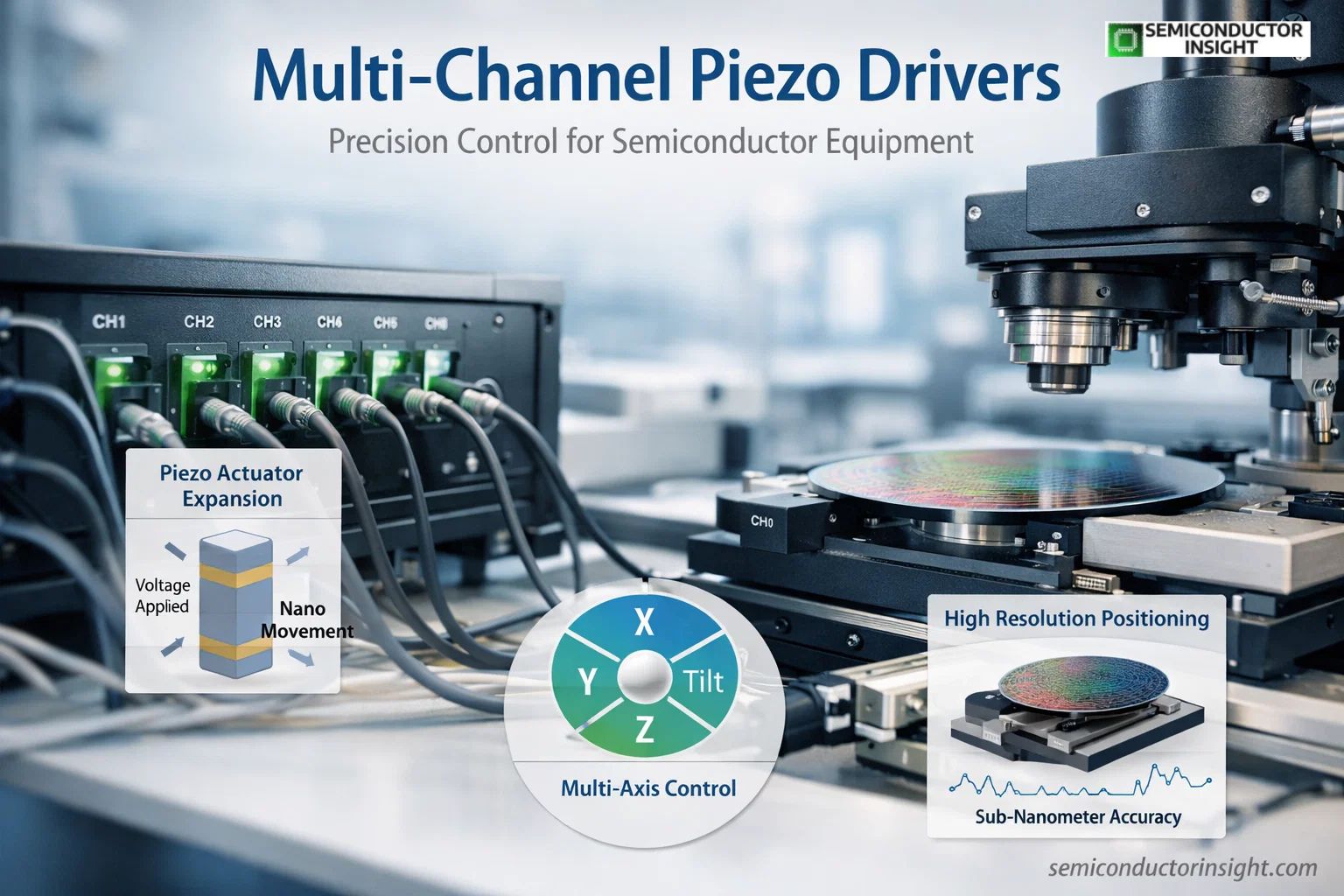
Precision Control at the Nano scale Multi-Channel Piezo Drivers Market Powering Semiconductor Innovation
In the world of semiconductor manufacturing, where features shrink to just a few nanometers, every movement must be controlled with extraordinary accuracy. Multi-channel piezo drivers serve as the advanced electronic brains behind this precision. These specialized amplifiers and controllers deliver high-voltage signals to multiple piezoelectric actuators simultaneously, enabling sub-nanometer positioning in complex multi-axis systems.
Piezo actuators work differently than regular motors. They exploit the inverse piezoelectric effect, which means that applying an electric field makes microscopic, immediate changes in the crystal structure of materials like lead zirconate titanate (PZT). Multi-channel drivers make sure that this response happens on all channels at the same time, which is important for today’s modern fabrication tools.
The Core Principle How Piezoelectric Actuators Respond to Electrical Drive
Piezoelectric materials generate mechanical strain when voltage is applied, and the reverse holds true for sensing. In practice, a typical stack actuator might expand by only 0.1 percent of its length under full voltage, yet this tiny deformation often just micrometres can be leveraged through flexure mechanisms for highly accurate positioning.
Multi-channel drivers handle the capacitive nature of these actuators, which behave like electrical capacitors that must be rapidly charged and discharged. They supply voltages ranging from tens to hundreds of volts, sometimes in bipolar configurations from -130V to +130V or higher, while managing peak currents to achieve fast response times reaching tens of kilohertz. Low-noise designs keep output ripple below a few millivolts, preserving the sub-nanometer resolution demanded in sensitive applications.
Curious about the report? Dive into our newest updated version at no cost: https://semiconductorinsight.com/report/multi-channel-piezo-driver-market/
Why Multi-Channel Designs Matter in Semiconductor Equipment
- Semiconductor processes often require coordinated motion in multiple degrees of freedom.
- A single wafer alignment system might need simultaneous control of X, Y, Z, and tilt axes. Multi-channel piezo drivers, with configurations supporting anywhere from three to 32 or more independent outputs, allow engineers to drive separate actuators or scanner tubes without interference.
For instance, in atomic force microscopy (AFM) integrated into inspection tools, a six-channel driver can control a piezo-scanner tube for precise tip positioning in three dimensions while managing additional axes for sample adjustment.
- Recent compact 6-channel designs introduced for piezo-scanner tubes and multi-axis stages have made these systems smaller and more cost-effective for integration into tight semiconductor tool footprints.
Integration with Nano positioning Stages in Wafer Processing
During photolithography and metrology steps, wafers must be positioned with extreme repeatability. Piezo-driven flexure stages paired with multi-channel drivers achieve this by offering frictionless motion and virtually unlimited resolution limited only by the control electronics. In chemical vapor deposition (CVD) chambers, piezo actuators fine-tune showerhead positioning or substrate height, ensuring uniform film growth across 300mm wafers.
Drivers with digital interfaces, such as Ethernet or USB, enable real-time closed-loop control using feedback from capacitive or strain-gauge sensors. This feedback loop compensates for hysteresis and creep inherent in piezoelectric materials, delivering linearity better than 0.01 percent in modern digital controllers.
Supporting Advanced Microscopy and Inspection Systems
High-resolution imaging remains essential for process control in chip fabrication. Multi-channel piezo drivers power sample scanners and objective positioners in scanning electron microscopes (SEM) and AFM systems used for defect review. A typical setup might employ a three- or four-channel amplifier to drive a planar scanner stage, allowing rapid raster scanning while maintaining atomic-scale stability.
In super-resolution optical techniques or correlative microscopy combining Raman and AFM, synchronized multi-axis control ensures precise overlay of different data sets. The ability to generate arbitrary waveforms and record sensor data simultaneously helps engineers optimize scan paths and reduce measurement time in high-throughput inspection lines.
Handling Complex Loads in Photonics and Silicon Photonics Alignment
- As the industry moves toward silicon photonics for faster data transfer, active alignment of optical fibers and waveguides demands nanometer-level accuracy in up to 18 axes or more.
- Multi-channel drivers facilitate this by providing independent high-bandwidth control to multiple piezo actuators arranged in parallel-kinematic configurations.
- Low-quiescent-current designs and efficient power stages minimize heat generation critical inside temperature-controlled cleanrooms.
- Some modules support bridging channels for higher voltage swings or inverting outputs, offering flexibility when driving shear actuators or benders alongside linear stacks.
Material and Electronics Synergy in Modern Driver Architectures
At the semiconductor level, driver circuits incorporate high-voltage MOSFETs or specialized amplifier topologies capable of sourcing and sinking current quickly to overcome the capacitive reactance of piezo loads.
Advanced units feature notch filters to suppress resonances and dynamic digital linearization algorithms that correct for both mechanical and electronic nonlinearities on the fly. Integration with 24-bit digital-to-analog converters provides the fine voltage steps needed for true sub-nanometer steps. Manufacturers continue to refine these systems for compatibility with vacuum environments or non-magnetic requirements sometimes found in specialized metrology tools.

Comments (0)