
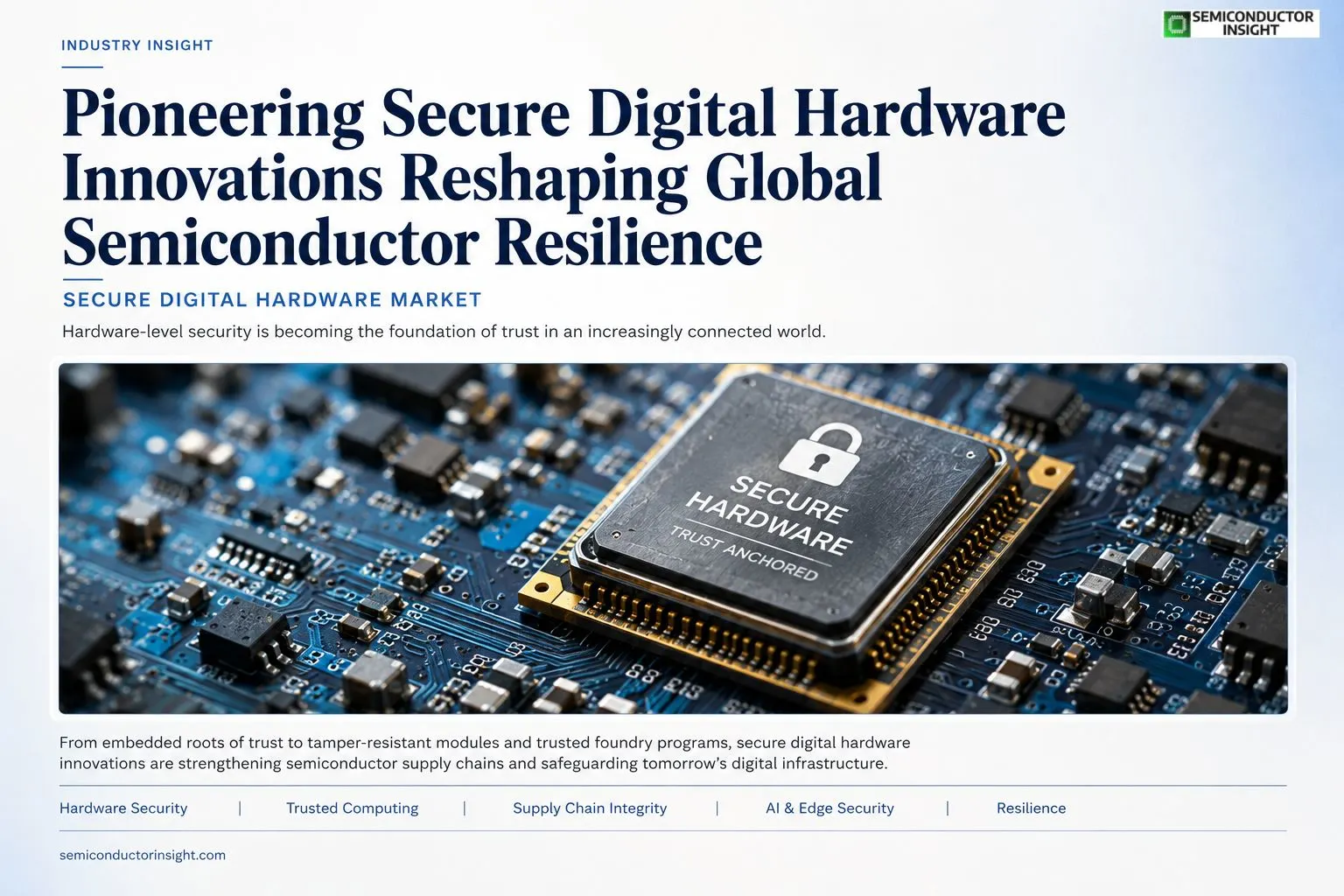
Pioneering Secure Digital Hardware Market Innovations Reshaping Global Semiconductor Resilience in 2026
Secure digital hardware market stands at the forefront of semiconductor evolution, where chips no longer simply process data but actively defend against sophisticated threats in an interconnected world.
From embedded roots of trust in everyday devices to specialized modules safeguarding national infrastructure, this domain integrates hardware-level protections that ensure integrity, confidentiality, and authenticity across supply chains and operational environments.
Roots of Trust Embedding in Modern Computing Ecosystems
· Trusted Platform Modules (TPMs) have become foundational elements in computing platforms, functioning as dedicated microcontrollers that securely store cryptographic keys and measure platform integrity from boot-up through runtime.
· Originating from industry consortium efforts in the early 2000s, TPM specifications evolved to address growing demands for verifiable hardware states, with version 2.0 introducing enhanced hierarchies and algorithm support including SHA-256 and ECC.
· These modules enable remote attestation, allowing systems to prove their configuration to remote parties without exposing sensitive details. In practice, nearly all modern PCs, laptops, and servers incorporate TPM capabilities, either as discrete chips or firmware implementations, supporting features like secure boot and disk encryption.
· Windows 11 requirements further accelerated widespread deployment, making TPM 2.0 a standard expectation for compatible devices. Government applications leverage TPMs extensively for verifying device integrity in defense networks and secure communications.
Hardware Security Modules Fortifying Critical Operations
Hardware Security Modules (HSMs) provide isolated, tamper-resistant environments for cryptographic key generation, storage, and processing at enterprise scale. Unlike broader platform solutions, HSMs excel in high-volume operations such as managing public key infrastructures (PKI), securing financial transactions, and protecting cloud data centers. They meet stringent standards like FIPS 140-2/3, offering physical and logical protections against extraction attempts.
Real-world deployments highlight their role in banking, where HSMs safeguard payment systems and digital identities, and in government sectors for encrypting classified data exchanges. Cloud providers integrate HSM-backed services to enable confidential computing, ensuring workloads run on verified hardware even in shared environments. This technology complements TPMs by handling centralized, high-assurance cryptographic workloads while endpoints rely on lighter embedded trust mechanisms.
Defense-Driven Trusted Supply Chains and Foundry Programs
ü National security imperatives have shaped dedicated programs ensuring access to trustworthy semiconductors.
ü The U.S. Department of Defense’s Trusted Foundry Program, managed through the Defense Microelectronics Activity (DMEA), accredits suppliers across design, fabrication, packaging, and testing to mitigate risks in the global supply chain.
ü As of recent updates, dozens of facilities hold accreditation, supporting both legacy and advanced nodes for mission-critical applications.
ü This initiative addresses concerns over integrity and confidentiality, providing pathways for radiation-hardened components and custom ASICs used in aerospace and defense.
ü SkyWater Technology, for instance, operates as a DMEA-accredited foundry delivering high-reliability processes for defense programs.
ü Such programs demonstrate how secure hardware extends beyond individual chips to encompass verifiable manufacturing flows, fostering resilience against tampering or counterfeiting.
You can freely browse our most recent updated report to learn more about it before scrolling further: https://semiconductorinsight.com/report/secure-digital-hardware-market/
Interplay with AI and Edge Computing Demands
As artificial intelligence workloads proliferate, secure digital hardware adapts to protect training data, model integrity, and inference endpoints. Edge devices in IoT networks increasingly embed security features to counter physical attacks and side-channel leaks, where power analysis or fault injection could reveal secrets. NIST initiatives focus on metrology for side-channel leakage and design-for-trust techniques like logic locking to quantify and mitigate vulnerabilities throughout the lifecycle.
Case examples include automotive systems using TPM-like modules for secure over-the-air updates and sensor data protection, alongside industrial control systems relying on HSMs for command authentication. These integrations highlight growing volumes of secure chips deployed in non-traditional computing, with billions of connected devices demanding hardware roots of trust to maintain system reliability amid expanding attack surfaces.
Innovations in Post-Quantum and Supply Chain Assurance
Ø Emerging threats drive advancements toward quantum-resistant algorithms embedded in hardware. Standards bodies and research programs explore new primitives that withstand future cryptographic breaks, while supply chain visibility tools use hardware attestation to track component provenance. DARPA and NIST efforts emphasize layered defenses, from firmware security ontologies to reference datasets for vulnerability testing.
Ø Global efforts, including CHIPS Act investments in domestic manufacturing, bolster these capabilities by expanding trusted production capacity. Taiwan’s semiconductor ecosystem, contributing significantly to global output, exemplifies concentrated expertise in advanced nodes that increasingly incorporate security features from the design stage.
Practical Impacts across Industries and Policy Landscapes
In healthcare, secure hardware protects electronic records and connected medical devices. Financial institutions deploy HSMs for transaction signing and compliance with data privacy regulations.
Defense applications ensure operational technology remains uncompromised in contested environments. These use cases underscore measurable outcomes: reduced breach risks through hardware isolation, streamlined compliance via certified modules, and enhanced system availability via trusted boot processes.
ü Policy frameworks worldwide prioritize hardware security in critical infrastructure protection, encouraging collaboration between government agencies, manufacturers, and standards organizations.
ü Open-source TPM implementations and reference architectures further democratize access, enabling smaller players to integrate robust protections without prohibitive costs.
Secure digital hardware market continues to evolve as a cornerstone of resilient semiconductor ecosystems. By weaving protection mechanisms directly into silicon, stakeholders across public and private sectors build systems capable of withstanding current and anticipated threats.
Ongoing research into metrics, testing methodologies, and integrated solutions promises even stronger foundations for the digital infrastructure powering global progress.

Comments (0)