Hardware Security Module (HSM) Semiconductor Market Insights
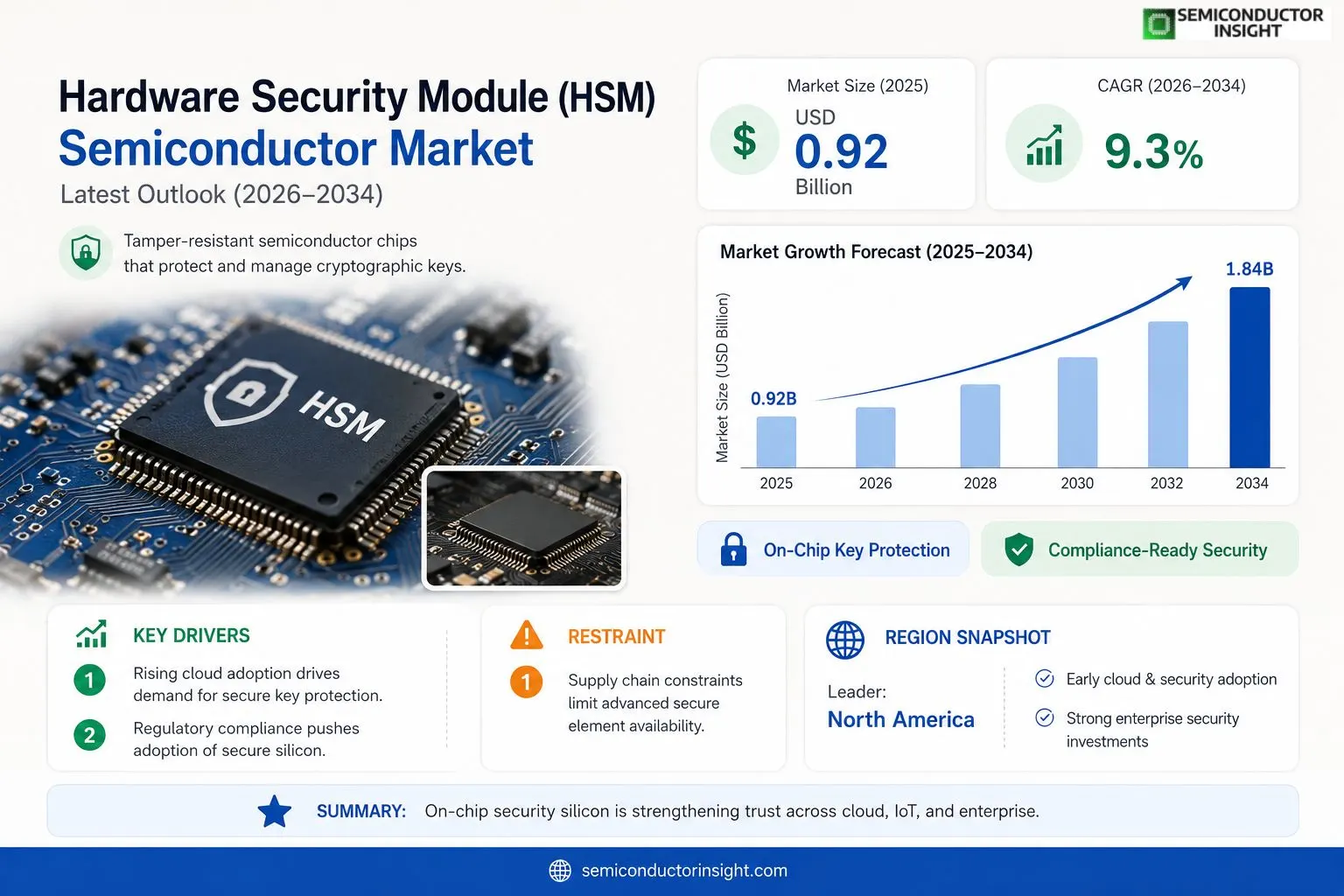
Global hardware security module semiconductor market size was valued at USD 0.92 billion in 2025. The market is projected to grow from USD 0.92 billion in 2025 to USD 1.84 billion by 2034, exhibiting a CAGR of 9.3% during the forecast period.
Hardware security modules are tamper‑resistant integrated circuits designed to generate, protect, and manage cryptographic keys within a secure enclave on a semiconductor die. These devices provide cryptographic processing, secure key storage, and authentication services while meeting stringent standards such as FIPS 140‑2 Level 3 and Common Criteria EAL 4+. By embedding HSM functionality directly into silicon, manufacturers reduce latency and enhance physical security compared with external appliances.The market is accelerating because cloud providers demand on‑chip key protection for multi‑tenant workloads, financial institutions seek compliance‑ready encryption solutions, and IoT devices require lightweight yet robust cryptography. Moreover, rising regulatory pressure around data privacy drives enterprises toward dedicated silicon‑based security modules rather than software‑only approaches. Leading vendors,including Thales Group, Utimaco GmbH, IBM Corp., Amazon Web Services (AWS CloudHSM), and Microchip Technology,are expanding their portfolios through advanced process nodes and integration with emerging technologies such as confidential computing.
MARKET DRIVERS
Increasing Cloud Adoption
The rapid shift of enterprise workloads to public and hybrid clouds is creating a strong demand for dedicated cryptographic processors. Organizations are deploying Hardware Security Module (HSM) Semiconductor Market solutions to protect keys in multi‑tenant environments, driving revenue growth for chip manufacturers.
Regulatory Compliance Pressure
Stringent data‑privacy regulations such as GDPR, CCPA, and emerging fintech standards require immutable key management. This compliance imperative is accelerating adoption of secure silicon, especially in banking and health‑care sectors.
➤ “Enterprises that integrate HSM‑grade silicon see a 30% reduction in breach‑related costs.”
Combined, these trends are pushing manufacturers to expand advanced secure‑element portfolios, positioning the sector for sustained expansion over the next five years.
MARKET CHALLENGES
High Integration Complexity
Designing systems that seamlessly embed cryptographic silicon requires deep expertise in both hardware and software stacks. Smaller vendors often lack the resources to certify and optimize these components, leading to slower market entry.
Other Challenges
Cost Sensitivity
Price‑competitive pressure from general‑purpose processors forces HSM providers to balance security features with affordable pricing, especially in emerging markets.
MARKET RESTRAINTS
Supply Chain Constraints
Global semiconductor shortages and logistics bottlenecks have limited the availability of advanced secure‑element wafers. Production delays increase lead times for customers and can dampen short‑term sales momentum.
MARKET OPPORTUNITIES
Edge Computing Expansion
The proliferation of edge devices,ranging from IoT gateways to autonomous vehicles,creates a compelling need for on‑device key management. Embedding HSM‑grade semiconductor cores at the edge offers a high‑growth avenue, especially as 5G rollout accelerates data processing locality.Furthermore, the convergence of AI workloads with stringent security requirements opens niche markets for tamper‑resistant inference accelerators, presenting additional revenue streams for innovators in Hardware Security Module (HSM) Semiconductor Market.
Hardware Security Module (HSM) Semiconductor Market Trends
Shift to On‑Chip Cryptographic Key Protection
The industry is witnessing a decisive move toward integrating cryptographic key management directly into semiconductor silicon. By embedding security functions on the same die that performs computation, latency is reduced and physical tamper resistance is heightened. Cloud service providers are prioritizing on‑chip key enclaves to isolate tenant workloads, while data‑center operators value the deterministic performance that silicon‑based modules deliver over software‑only alternatives. Financial institutions are also adopting on‑chip HSMs to meet PCI‑DSS requirements while reducing operational overhead. The reduction in key‑material exposure during transport contributes to lower breach risk, and secure firmware updates through authenticated boot processes ensure long‑term trustworthiness. As 5G deployment expands, edge data centers demand compact security modules that fit within limited board space, driving further miniaturization of semiconductor HSMs.
Other Trends
Regulatory Drivers for Silicon‑Based Security
Global data‑privacy regulations increasingly mandate hardware‑anchored protection for sensitive keys. Standards such as FIPS 140‑2 Level 3 and Common Criteria EAL 4+ have become baseline compliance checkpoints for enterprises handling payment information or personal health data. The European Union’s GDPR and emerging U.S. state‑level data‑protection statutes both reference hardware‑based key isolation as a best practice. In the payment card industry, the PCI Security Standards Council explicitly recommends tamper‑resistant, validated cryptographic modules. As auditors favour immutable, tamper‑evident storage, organizations are transitioning from legacy software HSMs to semiconductor solutions that satisfy audit trails with built‑in attestation capabilities. Procurement teams now embed compliance checks into bill‑of‑materials processes, preferring semiconductor HSMs that can be programmatically verified throughout the product lifecycle.
Vendor Innovation and Confidential Computing Integration
Leading vendors,including Thales, Utimaco, IBM, AWS CloudHSM, and Microchip,are expanding product portfolios through advanced process nodes and system‑on‑chip architectures. Recent releases feature seamless linkage with confidential computing frameworks, enabling encrypted data to be processed inside protected enclaves without decryption. Cloud platforms such as Amazon Web Services, Microsoft Azure, and Google Cloud are exposing dedicated HSM instances that map directly to underlying silicon, allowing customers to offload key lifecycle management while preserving audit trails. Silicon vendors are also collaborating with FPGA manufacturers to create hybrid security blocks that combine flexible logic with immutable key stores, offering a pathway for legacy applications to adopt modern security postures without wholesale redesign. These advancements collectively signal a maturation of Hardware Security Module (HSM) Semiconductor Market toward ubiquitous, built‑in protection across compute layers.
COMPETITIVE LANDSCAPEKey Industry Players
Strategic Positioning and Market Dynamics in Global Hardware Security Module (HSM) Semiconductor Market
Global Hardware Security Module (HSM) Semiconductor Market is characterized by a moderately consolidated competitive landscape, with a handful of dominant players commanding significant market share alongside a growing number of specialized vendors. Thales Group stands out as one of the foremost players, leveraging its extensive portfolio of tamper-resistant cryptographic hardware, FIPS 140-2 Level 3 compliant solutions, and deep integration capabilities with cloud and enterprise infrastructure. IBM Corporation maintains a strong foothold through its dedicated cryptographic coprocessors and mainframe-embedded HSM solutions, while Microchip Technology continues to expand its silicon-level security offerings targeting both industrial IoT and financial services verticals. Amazon Web Services, through its CloudHSM service, has redefined cloud-native key management by delivering dedicated HSM instances that enable multi-tenant workload isolation at scale. Utimaco GmbH, a Germany-based specialist, is widely recognized for its robust general-purpose and payment HSMs deployed across banking, government, and critical infrastructure sectors. These leading organizations are actively investing in advanced semiconductor process nodes and confidential computing integration to maintain technological differentiation and address evolving compliance mandates around data privacy and cryptographic standards such as Common Criteria EAL 4+.Beyond the tier-one players, the Hardware Security Module Semiconductor Market features several niche yet strategically significant participants driving innovation across specific application segments. Infineon Technologies AG delivers embedded security controllers and trusted platform modules widely adopted in automotive and smart card ecosystems. STMicroelectronics and NXP Semiconductors N.V. offer secure element and crypto-controller solutions optimized for IoT edge devices requiring lightweight yet robust cryptographic processing. Marvell Technology and Cavium (now part of Marvell) have contributed purpose-built security processors targeting data center acceleration workloads. Entrust Datacard Corporation and Atos SE provide HSM platforms with strong emphasis on PKI infrastructure and digital identity management. Additionally, Securosys SA and Futurex LP serve specialized sectors including fintech and payment processing with compliance-ready HSM appliances incorporating custom semiconductor components. The collective push from these players toward post-quantum cryptography readiness, hardware root-of-trust architectures, and seamless cloud integration is intensifying competitive rivalry and accelerating product development cycles across Global HSM semiconductor landscape.
List of Key Hardware Security Module (HSM) Semiconductor Companies Profiled
- Thales Group
- IBM Corporation
- Utimaco GmbH
- Amazon Web Services (AWS CloudHSM)
- Microchip Technology Inc.
- Infineon Technologies AG
- NXP Semiconductors N.V.
- STMicroelectronics
- Marvell Technology Inc.
- Entrust Datacard Corporation
- Atos SE
- Securosys SA
- Futurex LP
- Cavium Inc. (Marvell)
- Lattice Semiconductor Corporation
Segment Analysis:
| Segment Category | Sub-Segments | Key Insights |
| By Type |
|
ASIC‑based HSMs
FPGA‑based HSMs
SoC HSMs
|
| By Application |
|
Cloud Infrastructure
Financial Services
Internet of Things (IoT)
Enterprise Data Center
|
| By End User |
|
Telecommunications
Banking & Payments
Manufacturing
|
| By Integration Level |
|
Embedded Within SoC
Standalone Chip
Co‑Processor Module
|
| By Security Standard |
|
FIPS 140‑2 Level 3
Common Criteria EAL 4+
ISO/IEC 19790
|
Regional Analysis: North America
United States
The financial sector in the US is a major driver, utilizing HSMs for secure key generation, cryptographic operations, and compliance with regulations like PCI DSS. The increasing adoption of blockchain technology and digital currencies further fuels this demand, requiring robust HSMs to secure digital assets.
Government agencies and the defense sector rely on HSMs to protect classified information and secure critical communications. The need for tamper-proof key storage and secure cryptographic processing is paramount in these environments.
The healthcare industry utilizes HSMs to safeguard sensitive patient data, ensuring compliance with HIPAA and other data privacy regulations. Secure storage and cryptographic protection of electronic health records are critical.
Telecommunication providers deploy HSMs to secure network infrastructure, protect subscriber data, and ensure the integrity of communication protocols. The increasing reliance on secure mobile communications further drives demand.
Europe
Europe exhibits a steady growth trajectory in the HSM Semiconductor Market. Driven by stringent data protection regulations like GDPR, the demand for robust security solutions is consistently rising. The financial services industry in countries like Germany, France, and the UK is a key consumer, employing HSMs for secure transaction processing and key management. Government initiatives promoting cybersecurity and digital sovereignty are also fueling market growth. The adoption rate is progressively increasing across various sectors, including healthcare, telecommunications, and critical infrastructure. European HSM deployments are particularly focused on compliance with local regulatory frameworks, leading to a demand for HSMs with specific certifications and features. Several European companies are actively involved in HSM development and supply, fostering a competitive regional landscape. The emphasis on data privacy and residency requirements further shapes the market dynamics within Europe. The growing adoption of cloud services is also impacting the demand for HSMs to secure cloud-based data and applications.
Asia-Pacific
The Asia-Pacific region represents a rapidly expanding market for HSMs, driven by burgeoning digital economies and increasing cyber threats. Countries like China, Japan, and India are witnessing significant growth in demand. The financial services sector in China is a major driver, with increasing adoption of HSMs for digital payments and blockchain applications. Government initiatives promoting digital transformation and cybersecurity are also fueling market expansion. The telecommunications industry in the region is experiencing rapid growth, leading to increased demand for HSMs to secure network infrastructure and subscriber data. The growing penetration of mobile devices and the increasing reliance on cloud services are further contributing to market growth. The Asia-Pacific market is characterized by a mix of local and international HSM vendors, with a focus on cost-effective solutions. The increasing regulatory emphasis on data security and privacy is also shaping market dynamics in the region.
South America
South America demonstrates a moderate growth potential in the HSM Semiconductor Market. The increasing adoption of digital banking and e-commerce is driving demand for security solutions. The financial services sector in Brazil and Argentina is a key consumer, utilizing HSMs for secure transaction processing and key management. Government initiatives promoting cybersecurity and digital identity are also contributing to market growth. The telecommunications industry is expanding, leading to increased demand for HSMs to secure network infrastructure. The adoption rate is gradually increasing across various sectors, including government and healthcare. The market is characterized by a presence of both regional and international HSM vendors. Challenges include economic volatility and varying levels of cybersecurity awareness across different countries.
Middle East & Africa
The Middle East & Africa region represents an emerging market for HSMs, driven by increasing investments in cybersecurity and digital transformation. The financial services sector in countries like UAE and Saudi Arabia is a key consumer, utilizing HSMs for secure transaction processing and key management. Government initiatives promoting digital sovereignty and economic diversification are also fueling market growth. The telecommunications industry is expanding, leading to increased demand for HSMs to secure network infrastructure. The healthcare sector is also witnessing increasing adoption of HSMs to protect sensitive patient data. The market is characterized by a growing presence of international HSM vendors. Challenges include infrastructure limitations and varying levels of cybersecurity awareness across the region.
Report Scope
This market research report provides a comprehensive analysis of the Hardware Security Module (HSM) Semiconductor Market , covering the forecast period 2026–2034. It offers detailed insights into market dynamics, technological advancements, competitive landscape, and key trends shaping the industry.
Key focus areas of the report include:
- Market Overview: The report begins with an overview outlining its current market scenario, key growth indicators, and industry transformation drivers. It discusses macroeconomic factors, demand–supply balance, regulatory landscape, and the strategic role of semiconductors in powering advancements across industries such as automotive, telecommunications, consumer electronics, and industrial automation.
- Market Size & Forecast: Historical data and future projections for revenue, unit shipments, and market value across major regions and segments.
- Segmentation Analysis: Detailed breakdown by product type, technology, application, and end-user industry to identify high-growth segments and investment opportunities.
- Regional Insights: Insights into market performance across North America, Europe, Asia-Pacific, Latin America, and the Middle East & Africa, including country-level analysis where relevant.
- Competitive Landscape: Profiles of leading market participants, including their product offerings, R&D focus, manufacturing capacity, pricing strategies, and recent developments such as mergers, acquisitions, and partnerships.
- Technology Trends & Innovation: Assessment of emerging technologies, integration of AI/IoT, semiconductor design trends, fabrication techniques, and evolving industry standards.
- Market Drivers & Restraints: Evaluation of factors driving market growth along with challenges, supply chain constraints, regulatory issues, and market-entry barriers.
- Stakeholder Insights: Insights for component suppliers, OEMs, system integrators, investors, and policymakers regarding the evolving ecosystem and strategic opportunities.
Primary and secondary research methods are employed, including interviews with industry experts, data from verified sources, and real-time market intelligence to ensure the accuracy and reliability of the insights presented.
FREQUENTLY ASKED QUESTIONS:
What is the current market size of Hardware Security Module (HSM) Semiconductor Market?
-> Hardware Security Module (HSM) Semiconductor Market was valued at USD 0.92 billion in 2025 and is expected to reach USD 1.84 billion by 2034, reflecting a CAGR of 9.3 % during the forecast period.
Which key companies operate in Hardware Security Module (HSM) Semiconductor Market?
-> Key players include Thales Group, Utimaco GmbH, IBM Corp., Amazon Web Services (AWS CloudHSM), and Microchip Technology, among others.
What are the key growth drivers?
-> Key growth drivers include cloud providers’ demand for on‑chip key protection, financial institutions’ compliance‑driven encryption needs, IoT devices requiring lightweight robust cryptography, and increasing regulatory pressure for data privacy.
Which region dominates the market?
-> North America holds a leading position due to early adoption of cloud services and strong enterprise security investments, while Europe and Asia‑Pacific also show significant growth.
What are the emerging trends?
-> Emerging trends include integration of HSMs with confidential computing platforms, adoption of advanced process nodes for lower power consumption, and increased focus on hardware‑based root of trust for edge and IoT applications.
Get Sample Report PDF for Exclusive Insights
Report Sample Includes
- Table of Contents
- List of Tables & Figures
- Charts, Research Methodology, and more...
 Download Sample Report PDF