
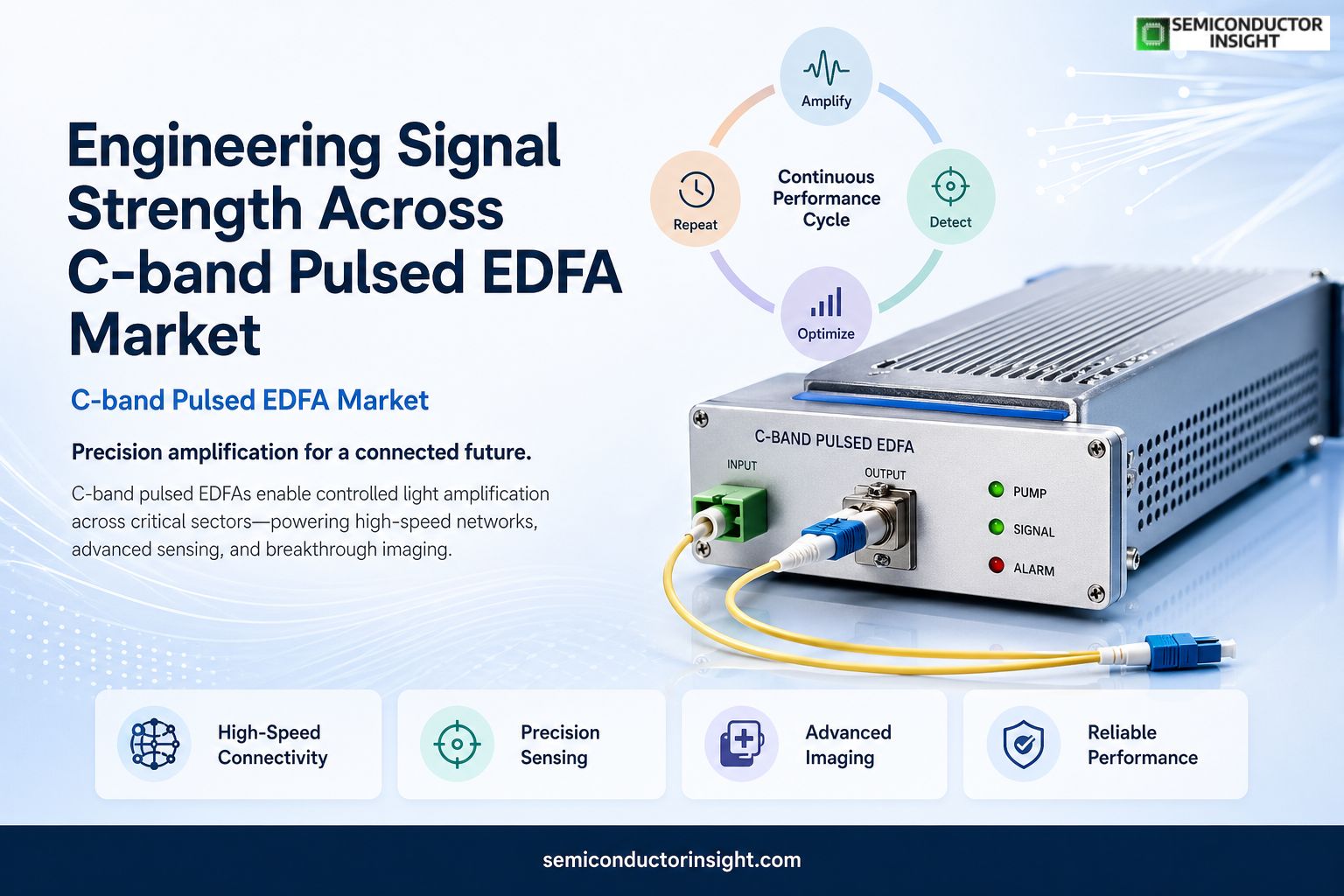
Engineering Signal Strength Across C-band Pulsed EDFA Market
C-band Pulsed EDFA Market sits at a critical junction where semiconductor photonics meets global data demand. Operating within the 1530 to 1565 nanometre wavelength range, C-band erbium-doped fibre amplifiers (EDFAs) are fundamental to long-haul optical communication systems. Their pulsed variants, in particular, are gaining traction in applications that demand controlled bursts of amplified light rather than continuous signals, including LIDAR systems, optical sensing, and high-speed test instrumentation.
Global fibre optic networks now extend beyond 5 billion kilometres of installed fibre, and a significant portion of long-distance transmission relies on EDFAs spaced approximately every 80 to 100 kilometres. Within this infrastructure, pulsed EDFAs are emerging as specialized components, especially where signal modulation and timing precision are critical.
Semiconductor Interplay in Gain Media Design
At the heart of pulsed EDFA systems lies erbium-doped silica fibre, but the semiconductor ecosystem surrounding it is equally important. Pump lasers, typically operating at 980 nm or 1480 nm, are semiconductor devices that energize erbium ions to achieve population inversion. The efficiency of this process directly impacts gain, which in modern systems can exceed 30 to 45 dB depending on configuration.
Recent developments in semiconductor laser diodes have pushed output powers beyond 500 milliwatts for pump sources, enabling stronger and more stable amplification even in pulsed mode. This is particularly relevant in high-precision applications like distributed acoustic sensing, where signal fidelity over long distances is essential.
Data Traffic Explosion Reshaping Amplification Needs
- The surge in global data consumption continues to redefine optical network requirements.
- Annual internet traffic has surpassed 4.5 zettabytes, with hyperscale data centres and 5G deployments contributing heavily to this growth.
- In such environments, pulsed EDFAs are increasingly used in testing and monitoring systems that ensure network reliability.
- Short-pulse amplification, often in the range of nanoseconds to microseconds, allows engineers to simulate real-world traffic bursts and detect anomalies in fibre links.
- This capability is becoming indispensable as networks transition toward higher modulation formats like 400G and 800G coherent transmission, where even minor signal distortions can lead to significant data loss.
Precision Applications beyond Telecom Boundaries
While telecommunications remain a dominant application, C-band Pulsed EDFA Market is expanding into other high-value domains. LIDAR systems used in autonomous vehicles and atmospheric studies rely on pulsed optical amplification to achieve longer detection ranges and higher resolution. These systems often operate with pulse repetition rates exceeding 100 kHz, requiring amplifiers that can maintain consistent gain across rapid cycles.
Medical imaging is another emerging area, particularly in optical coherence tomography (OCT). Here, pulsed EDFAs enhance signal penetration depth, enabling clearer imaging of biological tissues. Hospital deployments of OCT systems have grown steadily, with over 50,000 units installed globally, many of which integrate advanced optical amplification components.
Thermal Stability and Noise Management Challenges
One of the defining technical considerations in pulsed EDFA design is the balance between gain and noise. Amplified spontaneous emission (ASE) remains a persistent challenge, especially in high-gain systems. Modern designs aim to keep noise figures below 5 dB, ensuring signal clarity even after multiple amplification stages.
Thermal management is equally critical. Semiconductor pump lasers generate heat that can affect wavelength stability and efficiency. Advanced packaging techniques now incorporate micro-cooling systems capable of maintaining temperature variations within ±0.1°C, which is essential for consistent performance in precision applications.
Lastly, for more in-depth information, don’t forget to read our most recent exclusive report: https://semiconductorinsight.com/report/c-band-pulsed-edfa-market/
Precision in Manufacturing and Integrating Parts
- To make pulsed EDFAs, you need to carefully control the concentrations of doping, the length of the fiber, and the quality of the splicing.
- Even small changes in the concentration of erbium, which is usually around 1000 parts per million, can have a big effect on gain characteristics.
- More and more manufacturers are using automated fabrication technologies that guarantee repeatability with tolerances down to the micron level.
Integration with semiconductor control electronics is also changing. Modern EDFA modules often have digital interfaces that let you change the gain in real time, shape pulses, and run diagnostics. These systems can process feedback signals in less than a microsecond, which lets them adapt to changing situations.
The trajectory of C-band Pulsed EDFA Market reflects a broader shift toward intelligent photonic systems. As networks become faster and more complex, the demand for precise, reliable optical amplification will only intensify. Whether enabling high-speed data transmission, supporting autonomous sensing technologies, or advancing medical imaging, pulsed EDFAs represent a convergence of semiconductor innovation and optical engineering.
This section is interesting not just because it is growing, but also because it plays a role in how light is controlled, magnified, and used in many fields. As the world becomes more and more dependent on photons instead of electrons, the subtleties of pulsed amplification are becoming more and more important for technological growth.

Comments (0)