

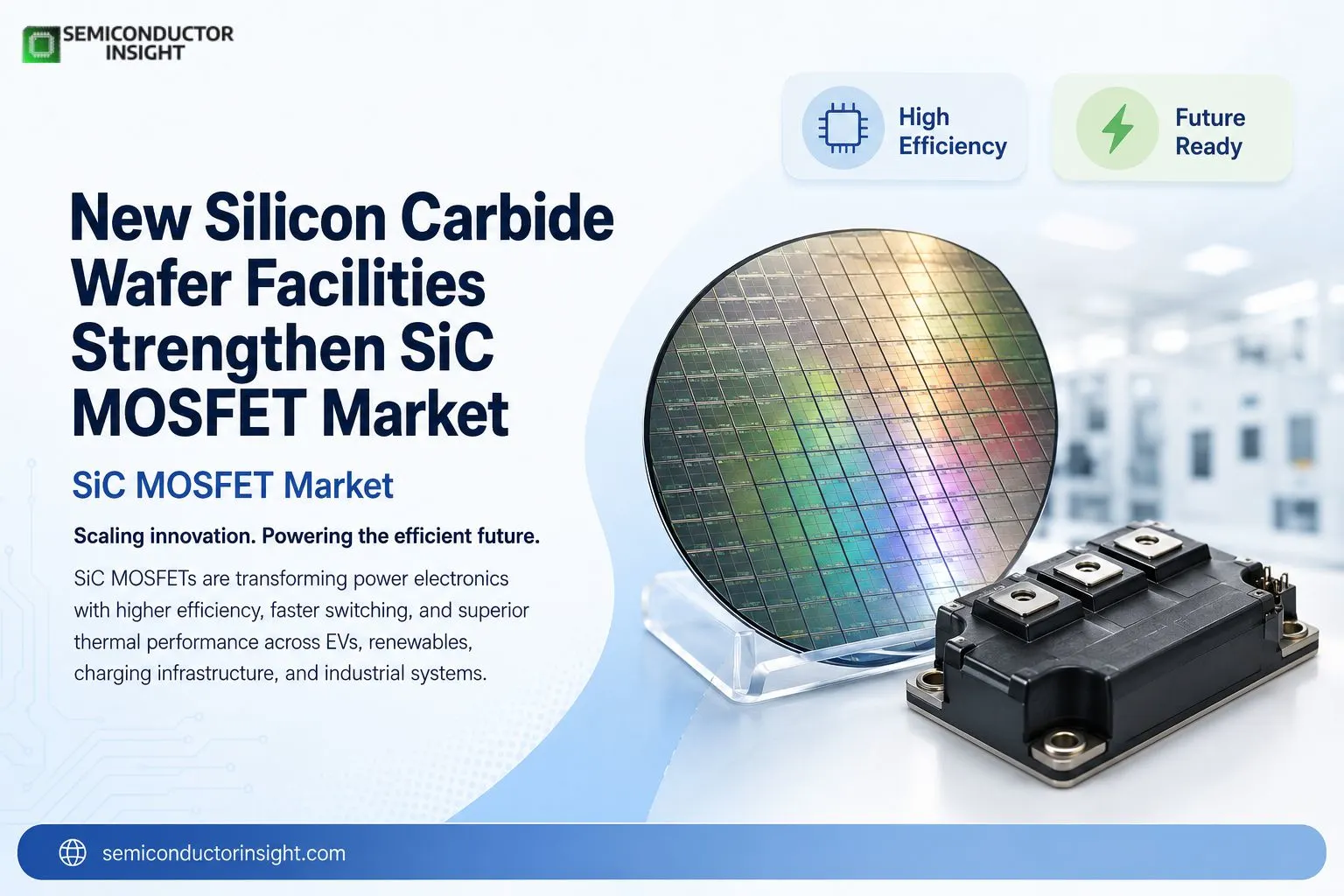
New Silicon Carbide Wafer Facilities Strengthen SiC MOSFET Market Ecosystem
The semiconductor industry is entering a new phase where efficiency is no longer a competitive advantage but a fundamental requirement. At the center of this transformation is SiC MOSFET Market, which has emerged as one of the most influential segments within power electronics. Silicon carbide metal-oxide-semiconductor field-effect transistors, commonly known as SiC MOSFETs, are enabling higher efficiency, faster switching speeds, and improved thermal performance compared to conventional silicon-based power devices.
As electric vehicles, renewable energy systems, industrial automation platforms, and high-power charging networks expand globally, demand for advanced power semiconductors is creating new opportunities for silicon carbide technologies.
The Material Changing the Rules of Power Electronics
- For decades, silicon dominated power semiconductor manufacturing. However, as power densities increased and energy efficiency targets became more demanding, engineers began seeking alternatives capable of operating under harsher electrical and thermal conditions.
- Silicon carbide offers a wider bandgap than silicon, allowing devices to function at higher voltages, higher temperatures, and higher switching frequencies. This capability reduces energy losses and enables smaller cooling systems, making it particularly attractive for modern electrification programs.
- Today, SiC MOSFETs are increasingly replacing traditional insulated-gate bipolar transistors (IGBTs) in applications where efficiency and compact design are critical.
Electric Vehicles Become the Largest Technology Showcase
One of the most visible developments in SiC MOSFET Market is its integration into electric vehicles.
Modern EV powertrains require efficient conversion of battery energy into motor power. SiC MOSFETs help reduce switching losses while improving driving range and charging performance.
According to data from the International Energy Agency (IEA), global electric car sales exceeded 17 million units in 2024. This growing vehicle base is increasing demand for advanced power electronics capable of supporting high-voltage architectures and ultra-fast charging systems.
Several leading EV manufacturers have incorporated silicon carbide power modules into traction inverters, onboard chargers, and DC-DC converters to enhance system efficiency and reduce overall vehicle weight.
The Race toward Larger Silicon Carbide Wafers
- A major shift underway involves wafer manufacturing.
- Historically, silicon carbide devices were primarily produced using 150 mm wafers. However, manufacturers are increasingly transitioning to 200 mm wafer production to improve output volumes and manufacturing economics.
- Recent investments announced by semiconductor companies in the United States, Europe, Japan, and China involve multi-billion-dollar expansions dedicated to silicon carbide substrate and wafer production. These facilities are expected to support growing demand from automotive, industrial, and energy sectors.
- The move to larger wafers represents a significant milestone because it enables more devices to be produced per wafer while improving production efficiency.
Charging Infrastructure Creates a New Demand Engine
The expansion of EV charging networks is becoming another major application area.
Ultra-fast charging stations operating at power levels of 150 kW, 350 kW, and beyond require highly efficient power conversion systems. SiC MOSFETs help reduce heat generation while improving energy transfer efficiency.
As governments continue investing in transportation electrification programs, charging infrastructure deployment is increasing across highways, urban centers, and commercial fleet networks.
The technology is therefore influencing not only vehicle design but also the broader ecosystem supporting electric mobility.
Renewable Energy Systems Move beyond Conventional Power Devices
- The transition toward renewable energy is also contributing to the market’s evolution.
- Solar inverters and energy storage systems increasingly rely on SiC MOSFETs to improve conversion efficiency and reduce operational losses. Even small efficiency improvements become valuable when applied across utility-scale installations generating hundreds of megawatts of electricity.
- Global renewable power capacity additions exceeded 580 gigawatts in 2024 according to international energy statistics, creating additional opportunities for advanced semiconductor technologies within power conversion equipment.
- As renewable projects scale, demand for high-performance switching devices continues to increase.
You Can Go Through Our Latest Updated Insights Here: https://semiconductorinsight.com/report/sic-mosfet-market/
Semiconductor Manufacturing Becomes a Strategic Priority
Governments worldwide now view advanced semiconductor production as a strategic capability.
Programs supporting domestic chip manufacturing, including investments in next-generation semiconductor fabrication facilities, have accelerated research and production of wide-bandgap materials such as silicon carbide.
Rather than being limited to a niche semiconductor category, SiC MOSFETs are becoming part of broader national strategies focused on energy security, transportation electrification, and industrial modernization.
Why Efficiency Has Become the New Competitive Metric?
The evolution of SiC MOSFET Market reflects a broader transformation occurring across global industries. Whether in electric vehicles, renewable energy systems, industrial drives, or charging infrastructure, organizations are increasingly measuring success through efficiency, energy utilization, and system performance.
As electrification expands and power requirements continue to rise, silicon carbide MOSFETs are establishing themselves as a foundational technology supporting the next generation of high-efficiency electronic systems. Their growing role demonstrates how material innovation can redefine the capabilities of modern semiconductor engineering.

Comments (0)