

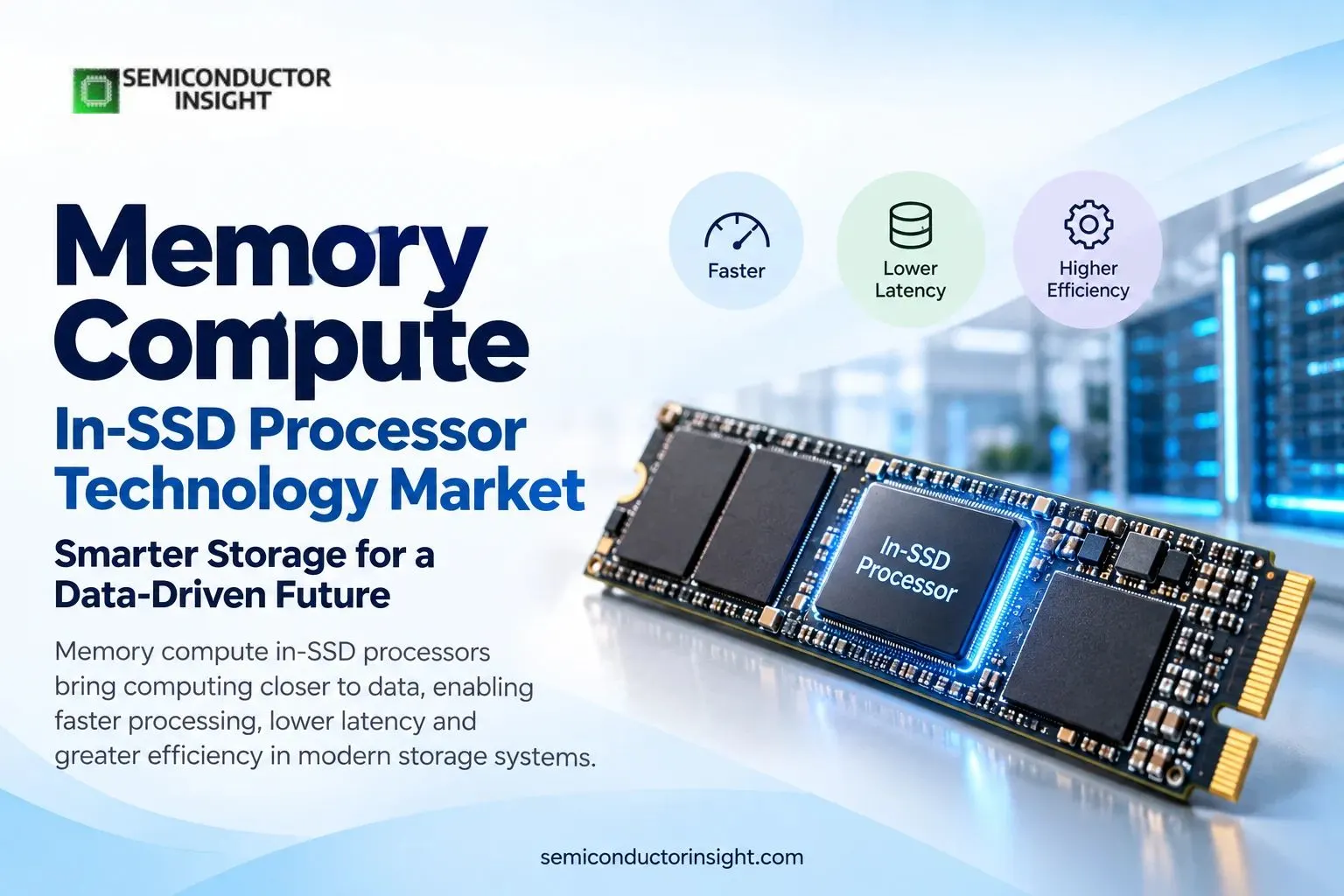
Near Memory Compute In-SSD Processor Technology Is Redefining Computational Storage in 2026. See How?
For decades, the standard computing model has treated storage primarily as a place where data waits to be retrieved. A processor requests information, the SSD supplies it, and computation happens elsewhere. The rapid growth of AI datasets, databases and high-volume analytics is exposing the cost of that movement.
Near Memory Compute (NMC) and in-SSD processing approach the problem differently. Instead of repeatedly moving large datasets from storage toward CPUs or accelerators, selected operations can be performed closer to where the data resides.
- Research published in Memories describes this broader near-data-processing approach as a response to the growing cost of data movement, with in-storage processing capable of reducing transfers between storage and host compute resources.
A Different Position in the Memory Hierarchy
NMC should not be confused with conventional processing-in-memory. Near-memory approaches place processing logic close to memory arrays, while in-storage computing pushes processing toward persistent storage.
For an SSD-based architecture, the pathway can look like:
NAND Flash → SSD Controller → Embedded Processor / Accelerator → NVMe → Host CPU / GPU
The objective is selective processing before the entire dataset crosses the host interface.
That distinction becomes important for workloads involving filtering, compression, search, encryption, database operations, video processing and portions of AI pipelines.
You can freely browse our most recent updated report to learn more about it before scrolling further: https://semiconductorinsight.com/report/near-memory-compute-nmc-in-ssd-processor-market/
NVMe Has Now Created a Standardized Path
- A major development is the maturation of standards around computational storage. NVM Express introduced its Computational Storage feature in January 2024, including the Computational Programs and Subsystem Local Memory command sets.
- The technology has continued moving forward. As of August 4, 2026, the NVMe specification set includes NVMe 2.4, while the Computational Programs Command Set has reached Revision 1.3, ratified on July 31, 2026.
- The Computational Programs framework allows programs to be discovered, loaded and executed within an NVM subsystem, providing a standardized mechanism for host-driven computational workloads.
- This matters because intelligent storage cannot scale effectively if every vendor requires a completely different software interface.
Samsung’s SmartSSD Shows the Concept in Hardware
Samsung Semiconductor’s SmartSSD CSD places processing capability directly within the SSD and targets workloads including database management, video processing, artificial intelligence and virtualization. Samsung specifically positions the architecture around reducing data movement between CPU, GPU, SSD and RAM.
The concept is straightforward:
Large Dataset → SSD-Level Processing → Smaller Result Set → Host CPU/GPU
Instead of transferring every record for host-side processing, the storage device can potentially return only the information required by the application.
The AI Connection Is Becoming Stronger
AI is increasing the amount of data that must be stored, retrieved, filtered and transformed. That makes the movement of data itself an architectural consideration.
- Current research is exploring near-memory architectures for AI inference, while Samsung has also filed patents covering near-memory computation inside storage devices.
- One Samsung patent published in 2026 describes processor-core acceleration engines and coprocessor acceleration engines executing successive operations on data within a storage device.
- Another Samsung patent application published in 2026 describes near-memory compute packages containing stacked memory and processing elements designed to accelerate matrix multiplication.
These developments show that the concept is expanding from academic research toward increasingly detailed commercial architectures.
Where In-SSD Processing Fits Best
The strongest use cases are workloads where enormous quantities of stored information must be examined but only a relatively small amount of processed information needs to reach the host.
Database queries are an obvious example. Video analytics is another, particularly where streams can be filtered or analyzed close to storage. AI systems can also benefit from preprocessing, compression, filtering and retrieval operations performed before data reaches expensive accelerators.
SNIA identifies AI, big data, content delivery, databases and machine learning among the application areas being explored for computational storage.
The Software Layer Is Becoming Just as Important
Hardware alone will not establish NMC as a mainstream architecture. Developers need APIs, programming models, runtime environments, drivers and standardized commands.
SNIA published Computational Storage Architecture and Programming Model v1.2 in April 2026, following earlier versions designed to establish recommended behavior for hardware and software supporting computational storage.
This creates an emerging software stack:
Application → API → Computational Storage Runtime → NVMe Commands → SSD Processor → NAND
The closer these layers become to existing developer workflows, the easier it becomes to deploy processing-capable SSDs without rewriting entire applications.
From Faster SSDs to Smarter SSDs
The next stage of SSD evolution is not simply about increasing sequential throughput. It is about deciding which operations should happen inside the storage path.
With NVMe computational programs standardized, SNIA advancing programming models and semiconductor companies investigating increasingly sophisticated near-memory architectures, the Near Memory Compute In-SSD Processor market is becoming part of a larger movement toward data-centric computing.
The fundamental proposition is simple: when moving data becomes expensive, move computation closer to the data instead.
That principle is increasingly relevant to AI servers, databases, analytics platforms and high-performance storage systems where every unnecessary transfer consumes bandwidth, energy and processing capacity.

Comments (0)