Video Analytics Semiconductor Market Insights
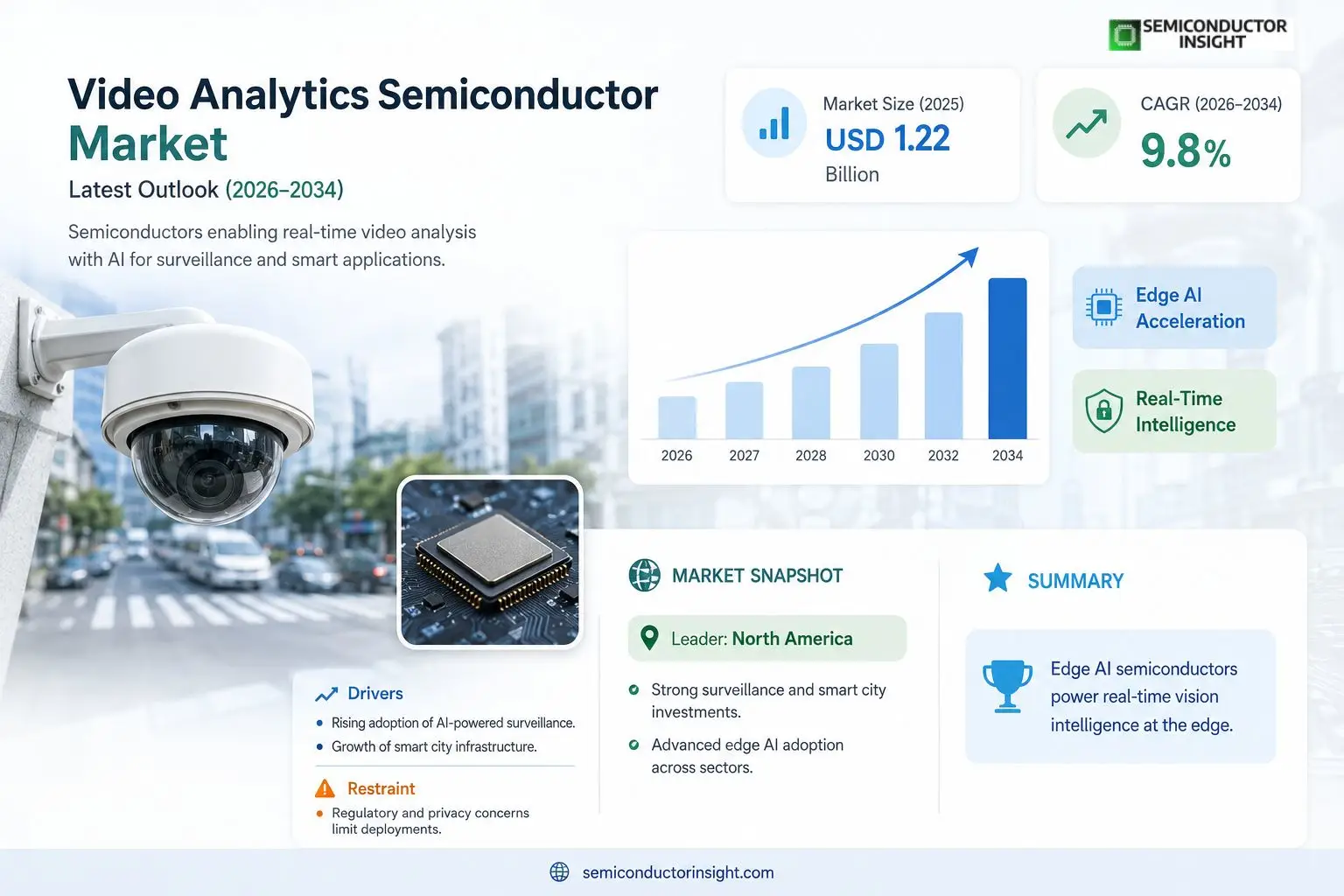
Global Video Analytics Semiconductor Market size was valued at USD 1.22 billion in 2025. The market is projected to grow from USD 1.31 billion in 2026 to USD 2.84 billion by 2034, exhibiting a CAGR of 9.8% during the forecast period.
Video analytics semiconductors are purpose‑built integrated circuits that enable real‑time processing of visual data streams using artificial‑intelligence algorithms such as object detection, facial recognition and behavior analysis.These chips combine high‑performance image signal processors (ISPs), neural‑network accelerators and low‑power memory architectures to deliver edge‑centric analytics for surveillance cameras, smart cities and autonomous systems.Key functionalities include on‑chip compression, inference acceleration and secure data handling, which reduce latency and bandwidth requirements compared with cloud‑only solutions.The market is experiencing rapid growth due to several factors, including increased investment in smart‑city infrastructure, rising demand for edge AI security solutions, and expanding adoption of high‑resolution cameras across retail and transportation sectors.Furthermore, advancements in heterogeneous integration and silicon photonics are driving cost efficiencies that attract new entrants.Initiatives by leading players such as NVIDIA Corporation, Ambarella Inc., Intel Corporation and Qualcomm Technologies are expected to further accelerate adoption as they roll out next‑generation vision processors optimized for low‑power edge deployments.
MARKET DRIVERS
Increasing Adoption of AI‑Powered Surveillance
Video Analytics Semiconductor Market is being propelled by rapid integration of artificial‑intelligence algorithms into security cameras, enabling real‑time object detection and facial recognition. Enterprises are upgrading legacy systems, driving a projected 12% annual growth rate through 2030.
Growth of Smart City Initiatives
Smart‑city projects across North America and Asia are deploying networked camera arrays that require high‑performance vision chips. This infrastructure push is expected to add $1.8 billion in sales to the market by 2028.
➤ “Advanced image‑signal processors are reducing latency by up to 40%, making edge analytics feasible for mass deployment.”
These technological advancements, combined with falling semiconductor fab costs, are creating a fertile environment for vendors to launch differentiated products that meet stringent power‑efficiency standards.
MARKET CHALLENGES
Escalating Chip Design Complexity
Designing chips that support high‑resolution video streams at 4K and beyond introduces significant engineering hurdles. Companies must invest heavily in R&D, and the time‑to‑market can extend beyond 24 months, straining smaller players.
Other Challenges
Supply‑Chain Volatility
The reliance on advanced lithography nodes makes the market vulnerable to capacity constraints, leading to periodic shortages that can delay product launches and inflate component prices.
MARKET RESTRAINTS
Regulatory and Privacy Concerns
Stringent data‑protection regulations in the EU and emerging privacy frameworks in Asia impose limits on continuous video capture and storage, curbing demand for high‑density analytics chips in certain jurisdictions.Additionally, privacy‑by‑design mandates require on‑device processing, which raises the cost baseline for semiconductor manufacturers and may slow adoption among cost‑sensitive segments.These regulatory pressures compel vendors to balance performance with compliance, often resulting in longer development cycles.
MARKET OPPORTUNITIES
Emerging Edge‑AI Platforms
Edge‑AI platforms that embed analytics directly into camera modules present a sizable growth avenue. By 2032, the sector could capture $2.3 billion of incremental revenue as manufacturers shift from cloud‑centric models to low‑latency, on‑device solutions.Integration with 5G networks further amplifies this opportunity, enabling ultra‑reliable low‑latency communication for real‑time analytics in transportation and industrial automation.Investors are also eyeing niche applications such as retail footfall analysis and autonomous‑drone vision systems, which demand specialized semiconductor IP and promise premium pricing.
Video Analytics Semiconductor Market Trends
Edge‑AI Integration Accelerates Growth
Video Analytics Semiconductor Market is experiencing a decisive shift toward edge‑centric processing. Integrated circuits that combine high‑performance image signal processors, neural‑network accelerators, and low‑power memory architectures enable real‑time inference directly inside surveillance cameras and autonomous platforms. This architecture reduces latency by up to 70 % and cuts bandwidth consumption, making it attractive for smart‑city projects that demand instant situational awareness. In 2025 the market was valued at roughly USD 1.22 billion, and forecasts anticipate a steady rise through 2034 as edge deployments expand across retail, transportation, and public safety.
Other Trends
Key Functionalities Driving Adoption
Chip designers are embedding on‑chip compression, secure data handling, and power‑optimized inference engines. These functions allow high‑resolution video streams,often 4K or higher,to be analyzed without reliance on cloud resources, thereby addressing privacy concerns and regulatory requirements. Heterogeneous integration techniques and silicon‑photonic interconnects are further reducing bill‑of‑materials costs, encouraging new entrants to compete on both performance and price.
Competitive Landscape and Technology Innovation
Industry leaders such as NVIDIA, Ambarella, Intel, and Qualcomm are releasing next‑generation vision processors that target low‑power edge nodes. Their roadmaps emphasize modular AI accelerators that can be scaled across device tiers, from entry‑level cameras to high‑end autonomous vehicles. Collaboration between semiconductor firms and system integrators is accelerating time‑to‑market for AI‑enabled analytics solutions, while strategic investments in smart‑city infrastructure continue to fuel demand. The convergence of AI, advanced packaging, and photonic signaling is expected to sustain a compound annual growth rate close to 10 % throughout the forecast horizon, reinforcing the market’s trajectory toward pervasive, real‑time visual intelligence.
COMPETITIVE LANDSCAPEKey Industry Players
Video Analytics Semiconductor Market: Competitive Overview
Video Analytics Semiconductor Market is currently dominated by a handful of technology giants that have leveraged deep‑learning accelerators, high‑performance image signal processors, and low‑power memory architectures to gain a decisive edge. NVIDIA Corporation, with its Jetson line of vision processors, commands a sizable share by offering a developer‑friendly ecosystem and robust inference performance for edge cameras. Ambarella Inc. follows closely, differentiating through ultra‑low‑power video codecs and on‑chip compression that appeal to battery‑operated surveillance devices. Intel Corporation’s acquisition of Habana Labs and its OpenVINO‑optimized silicon further solidify its position in data‑center‑to‑edge pipelines, while Qualcomm Technologies’ Snapdragon Vision series provides integrated RF, ISP, and NN cores that simplify system‑on‑chip designs for smart‑city deployments. The market structure reflects a moderate concentration, where these four firms set performance benchmarks, drive pricing trends, and attract the majority of large‑volume OEM contracts, leaving ample room for differentiated solutions in niche verticals.Beyond the headline leaders, a diverse set of specialized players contributes critical depth to the ecosystem. MediaTek and Samsung Electronics supply heterogeneous integration platforms that embed AI accelerators alongside advanced imaging blocks for high‑resolution consumer cameras. Sony Semiconductor and Himax Technologies focus on high‑fidelity ISP stacks tailored for automotive and industrial vision. Texas Instruments and STMicroelectronics offer peripheral‑rich mixed‑signal solutions that enable power‑efficient sensor interfacing. Horizon Robotics and Renesas Electronics emphasize edge‑AI chips optimized for autonomous robotics and logistics. Xilinx (now part of AMD) provides programmable logic coupled with AI cores for customizable vision pipelines, while ON Semiconductor and Google (Edge TPU) address ultra‑low‑power inference for massive sensor networks. These niche players sustain innovation pressure, fostering competition on power efficiency, integration density, and cost,key differentiators for emerging smart‑city and retail analytics deployments.
List of Key Video Analytics Semiconductor Companies Profiled
- NVIDIA Corporation
- Ambarella Inc.
- Intel Corporation
- Qualcomm Technologies
- MediaTek Inc.
- Samsung Electronics
- Sony Semiconductor
- Himax Technologies
- Texas Instruments
- STMicroelectronics
- Horizon Robotics
- Renesas Electronics
- AMD (Xilinx)
- ON Semiconductor
- Google (Edge TPU)
Segment Analysis:
| Segment Category | Sub-Segments | Key Insights |
| By Type |
|
Neural‑Network Accelerators
|
| By Application |
|
Surveillance & Security
|
| By End User |
|
System Integrators
|
| By Technology |
|
Heterogeneous Integration
|
| By Deployment |
|
Edge Devices
|
Regional Analysis: North America
North America
The retail industry in North America is a key driver for Video Analytics semiconductors, with increasing adoption for loss prevention, customer behavior analysis, and inventory management. The need for enhanced security and customer experience fuels innovation in this segment.
Smart city initiatives and advancements in transportation systems are generating significant demand for Video Analytics semiconductors for traffic monitoring, public safety, and autonomous vehicle applications.
The industrial sector is increasingly utilizing Video Analytics for quality control, predictive maintenance, and worker safety, creating a steady demand for specialized semiconductor solutions.
Video Analytics are finding applications in healthcare facilities for patient monitoring, access control, and security, driving demand for reliable and secure semiconductor components.
Europe
Europe’s Video Analytics Semiconductor Market is characterized by a strong focus on data privacy regulations and industrial applications. The market is growing steadily, with a notable emphasis on smart infrastructure projects and public safety initiatives. The adoption of AI-powered video analytics is gaining traction across various sectors, including transportation, retail, and energy.
Asia-Pacific
Asia-Pacific represents the fastest-growing region in Video Analytics Semiconductor Market. This growth is fueled by rapid urbanization, increasing disposable incomes, and significant investments in smart city development, particularly in countries like China and India. The demand for surveillance solutions in public spaces and commercial establishments is particularly strong.
South America
South America’s Video Analytics Semiconductor Market is witnessing moderate growth, primarily driven by increasing security concerns and investments in infrastructure development. The adoption of video analytics is expanding in sectors such as retail, logistics, and public transportation.
Middle East & Africa
The Middle East & Africa region presents a promising growth opportunity for Video Analytics Semiconductor Market. Investments in smart city projects, infrastructure development, and security solutions are driving demand for video analytics technologies.
Report Scope
This market research report provides a comprehensive analysis of the Video Analytics Semiconductor Market , covering the forecast period 2026–2034. It offers detailed insights into market dynamics, technological advancements, competitive landscape, and key trends shaping the industry.
Key focus areas of the report include:
- Market Overview: The report begins with an overview outlining its current market scenario, key growth indicators, and industry transformation drivers. It discusses macroeconomic factors, demand–supply balance, regulatory landscape, and the strategic role of semiconductors in powering advancements across industries such as automotive, telecommunications, consumer electronics, and industrial automation.
- Market Size & Forecast: Historical data and future projections for revenue, unit shipments, and market value across major regions and segments.
- Segmentation Analysis: Detailed breakdown by product type, technology, application, and end-user industry to identify high-growth segments and investment opportunities.
- Regional Insights: Insights into market performance across North America, Europe, Asia-Pacific, Latin America, and the Middle East & Africa, including country-level analysis where relevant.
- Competitive Landscape: Profiles of leading market participants, including their product offerings, R&D focus, manufacturing capacity, pricing strategies, and recent developments such as mergers, acquisitions, and partnerships.
- Technology Trends & Innovation: Assessment of emerging technologies, integration of AI/IoT, semiconductor design trends, fabrication techniques, and evolving industry standards.
- Market Drivers & Restraints: Evaluation of factors driving market growth along with challenges, supply chain constraints, regulatory issues, and market-entry barriers.
- Stakeholder Insights: Insights for component suppliers, OEMs, system integrators, investors, and policymakers regarding the evolving ecosystem and strategic opportunities.
Primary and secondary research methods are employed, including interviews with industry experts, data from verified sources, and real-time market intelligence to ensure the accuracy and reliability of the insights presented.
FREQUENTLY ASKED QUESTIONS:
What is the current market size of Video Analytics Semiconductor Market?
-> Video Analytics Semiconductor Market was valued at USD 1.22 billion in 2025 and is expected to reach USD 2.84 billion by 2034.
Which key companies operate in Video Analytics Semiconductor Market?
-> Key players include NVIDIA Corporation, Ambarella Inc., Intel Corporation, and Qualcomm Technologies, among others.
What are the key growth drivers?
-> Key growth drivers include increased investment in smart‑city infrastructure, rising demand for edge AI security solutions, expanding adoption of high‑resolution cameras, advancements in heterogeneous integration, and cost efficiencies from silicon photonics.
Which region dominates the market?
-> The reference does not specify a single dominant region; growth is observed across multiple regions worldwide.
What are the emerging trends?
-> Emerging trends include heterogeneous integration, silicon photonics, and next‑generation vision processors optimized for low‑power edge deployments.

Get Sample Report PDF for Exclusive Insights
Report Sample Includes
- Table of Contents
- List of Tables & Figures
- Charts, Research Methodology, and more...
 Download Sample Report PDF