

NAND Flash and DRAM Market Forecast Strengthens with AI, Cloud, and Edge Demand
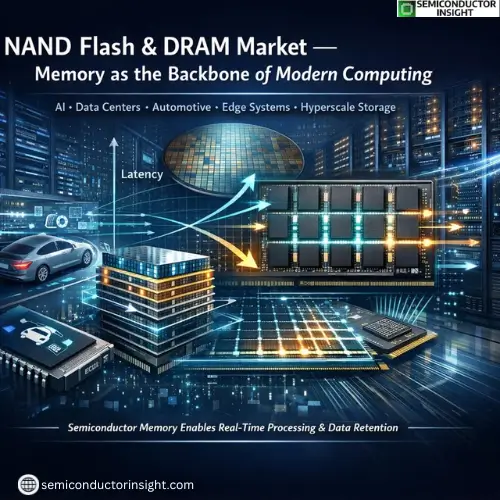
NAND Flash memory and DRAM are foundational semiconductor components that enable data storage and real-time data processing across modern electronic systems. While NAND Flash provides non-volatile storage for long-term data retention, DRAM delivers high-speed volatile memory essential for computing performance. Together, they form the backbone of digital infrastructure spanning consumer electronics, data centers, automotive systems, industrial automation, and artificial intelligence platforms.
The NAND Flash Memory and DRAM market operates within highly synchronized supply-demand cycles, influenced by capacity expansions, technology node transitions, and shifts in end-use application demand. Memory devices are no longer viewed as passive components; they are strategic enablers of system efficiency, power management, and computational scalability.
Structural Demand Drivers Reshaping the Market
The accelerating adoption of cloud computing and hyperscale data centers remains one of the most powerful forces driving demand for both NAND Flash and DRAM. Enterprises continue to migrate workloads to cloud environments, increasing requirements for high-density storage solutions and low-latency memory modules.
Simultaneously, artificial intelligence and machine learning workloads are altering memory usage patterns. AI models require massive parallel processing and rapid data access, pushing demand for advanced DRAM architectures with higher bandwidth and lower power consumption. NAND Flash, particularly in solid-state drives, is experiencing rising adoption as data storage moves away from traditional hard disk technologies.
Consumer electronics also continue to influence shipment volumes. Smartphones, tablets, gaming consoles, and wearable devices increasingly rely on higher memory configurations to support advanced applications, multimedia processing, and on-device intelligence.
Before Proceeding, Feel Free to Overlook Our Updated Report:
https://semiconductorinsight.com/report/nand-flash-memory-and-dram-market/
Technology Progress and Node Migration Trends
- Technology scaling remains central to competitiveness in the NAND Flash and DRAM market.
- Manufacturers are aggressively transitioning toward smaller process nodes, enabling higher memory density while controlling cost per bit.
- In NAND Flash, the shift toward 3D NAND architectures has significantly increased storage capacity by stacking memory cells vertically rather than expanding chip footprint.
- In DRAM, innovation is focused on improving cell efficiency, reducing leakage, and enhancing bandwidth.
- Advanced lithography techniques and materials engineering are helping manufacturers extend scaling while maintaining yield stability.
- These advancements are essential as the industry balances rising capital expenditure with the need to remain cost-competitive.
Supply Chain Dynamics and Capacity Management
Memory markets are highly sensitive to capacity planning decisions. Overexpansion can lead to pricing pressure, while underinvestment risks supply shortages. Manufacturers are increasingly adopting disciplined capacity expansion strategies, aligning wafer starts with long-term demand signals rather than short-term price fluctuations.
Geopolitical considerations and regional manufacturing policies are also influencing supply chains. Diversification of fabrication locations and investment in domestic semiconductor ecosystems are shaping future production strategies, particularly for memory-intensive applications tied to national infrastructure and defence systems.
End-Use Segmentation and Application Evolution
Data centers represent the largest and fastest-growing end-use segment, driven by continuous server upgrades and expanding storage architectures. Automotive electronics are emerging as a critical growth area, with electric vehicles and advanced driver-assistance systems requiring reliable memory for real-time processing and data logging.
Industrial automation and edge computing applications are also contributing to demand growth. These systems rely on memory solutions that balance durability, performance, and energy efficiency, reinforcing the need for application-specific memory configurations.
Pricing Behavior and Market Cyclicality
- NAND Flash and DRAM market is inherently cyclical, with pricing influenced by inventory levels, capital investment timing, and macroeconomic conditions.
- Recent market behavior reflects cautious recovery, as demand stabilizes across key sectors while manufacturers maintain disciplined output levels.
- Long-term pricing trends are increasingly shaped by technology complexity rather than pure volume expansion.
- Advanced nodes and higher-layer 3D NAND structures involve greater manufacturing complexity, supporting a more balanced pricing environment compared to earlier commodity-driven cycles.
Regulatory, Sustainability, and Energy Considerations
Environmental and regulatory pressures are becoming more prominent in memory manufacturing. Fabrication facilities are energy-intensive, prompting increased focus on water recycling, energy-efficient equipment, and sustainable materials sourcing.
Compliance with regional trade regulations and export controls is also influencing market strategies, particularly for high-performance memory products used in advanced computing systems.
The NAND Flash Memory and DRAM market is transitioning from volume-led expansion to value-driven optimization. Memory is now central to system performance, data efficiency, and computational intelligence, making it a strategic investment area rather than a commoditized segment.
As AI adoption accelerates, data generation increases, and connected systems multiply, the role of memory technologies will continue to expand. The market’s future will be shaped by innovation discipline, supply chain resilience, and the ability to align memory solutions with evolving application demands.

Comments (0)