
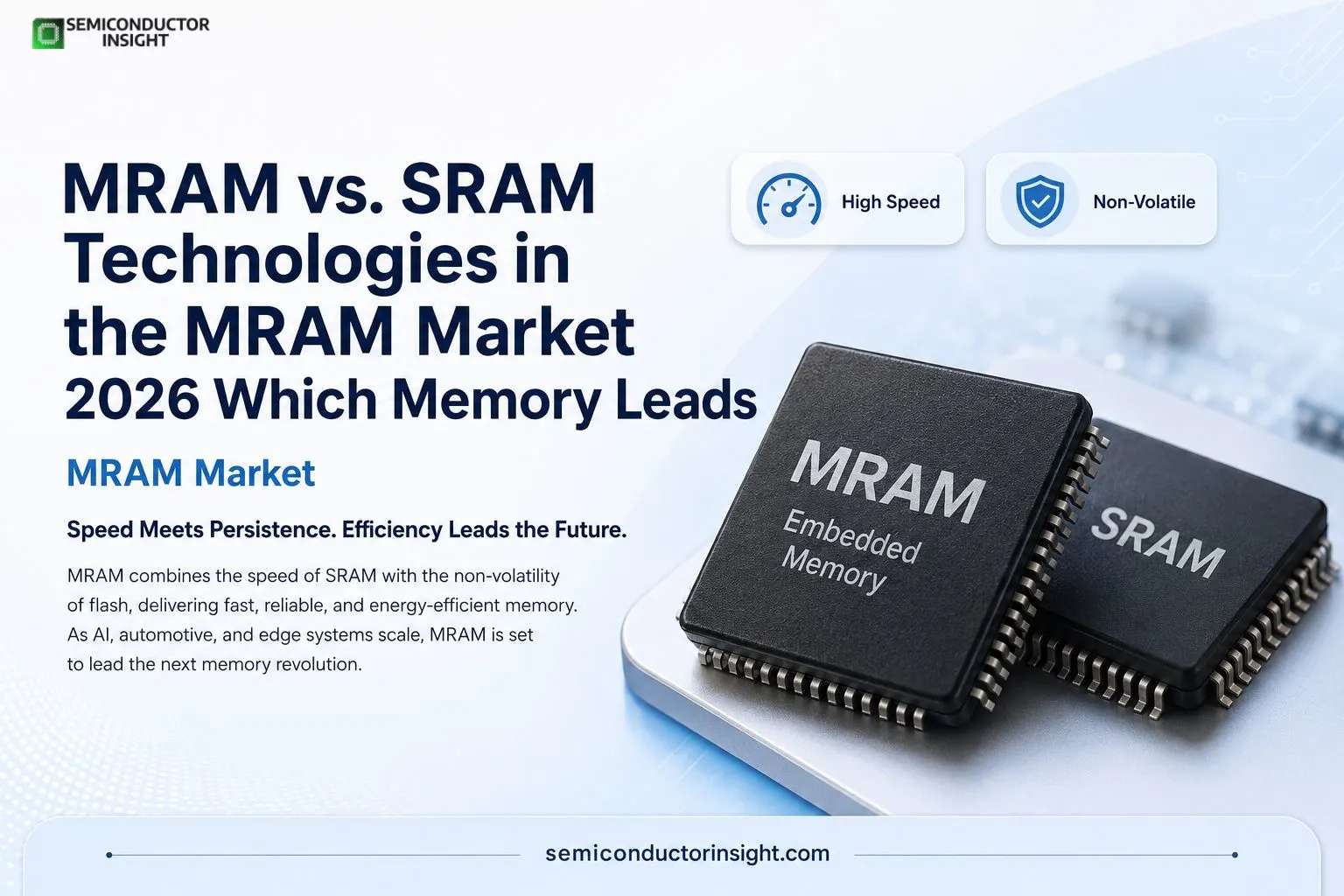
MRAM vs. SRAM Technologies in the MRAM Market 2026 Which Memory Leads
For decades, semiconductor engineers have pursued a single goal: creating memory that is fast, energy efficient, and capable of retaining data without power. Magnetoresistive Random Access Memory, commonly known as MRAM, is increasingly being viewed as one of the closest technologies to achieving this vision. Combining the speed of SRAM with the persistence of flash memory, MRAM is emerging as a strategic technology for artificial intelligence, automotive systems, industrial automation, and edge computing.
MRAM uses magnetic states to store information, in contrast to traditional memory technologies that rely on electrical charges. This special mechanism is especially useful in data-intensive applications because it provides high endurance, low latency, and non-volatility.
From Spintronics to Silicon A New Memory Journey
MRAM operates using spintronics, a field of electronics that exploits the intrinsic spin of electrons in addition to their charge. At the heart of modern MRAM lies Magnetic Tunnel Junction (MTJ) technology, where magnetic layers separated by an insulating barrier determine binary states.
The transition from laboratory research to commercial production has accelerated over the past decade. Semiconductor manufacturers are integrating embedded MRAM into microcontrollers and system-on-chip designs, reducing dependence on external memory components.
Memory Evolution Flow
DRAM Era
↓
Flash Memory Expansion
↓
Spintronic Innovation
↓
MRAM Integration
↓
AI and Edge Computing Applications
This progression highlights how memory architectures continue to evolve in response to increasing computational demands.
Why AI Hardware Is Looking Beyond Traditional Memory?
Artificial intelligence workloads generate enormous volumes of data that must be processed quickly and efficiently. Conventional memory hierarchies often create bottlenecks due to latency and energy consumption.
MRAM is increasingly being explored for:
- AI accelerators
- Edge computing devices
- Neuromorphic processors
- Autonomous vehicles
- Industrial Internet of Things systems
Recent demonstrations by semiconductor companies have shown embedded MRAM integrated into low-power processors designed for machine learning applications at the edge.
As AI systems become more distributed, memory technologies capable of balancing performance and efficiency are gaining strategic importance.
Automotive Electronics Demand Reliable Memory
Modern vehicles contain dozens of electronic control units responsible for safety, infotainment, and battery management. Automotive environments require memory that can withstand extreme temperatures and maintain data integrity during power interruptions.
MRAM’s resistance to radiation and temperature variations has attracted attention for advanced driver-assistance systems and aerospace electronics. Several automotive semiconductor suppliers have begun incorporating embedded MRAM into next-generation designs to support real-time decision-making capabilities.
Automotive Data Path
Sensors
↓
Embedded Processor
↓
MRAM Storage
↓
AI Decision Engine
↓
Vehicle Response
This architecture enables rapid access to critical data while minimizing power requirements.
Energy Efficiency Is Becoming a Semiconductor Priority
Data centers currently account for a significant portion of global electricity consumption. According to the International Energy Agency, improving chip-level energy efficiency remains essential for sustainable computing infrastructure.
MRAM offers potential benefits because it eliminates the need for constant refresh operations required by DRAM. Reduced energy consumption may contribute to lower operational costs in servers, networking equipment, and cloud computing systems.
Researchers are also investigating MRAM for space applications, where power efficiency and radiation tolerance are especially valuable.
Lastly before we wrap up, don’t forget to look at our most recent exclusive report for in-depth insights: https://semiconductorinsight.com/report/mram-semiconductor-market/
Emerging Frontiers in Embedded Intelligence
The next generation of electronics is expected to integrate sensing, computing, and memory more closely than ever before. Embedded MRAM is increasingly being positioned as an enabling technology for smart factories, wearable devices, robotics, and intelligent sensors.
Advances in perpendicular magnetic anisotropy and spin-transfer torque technologies continue to improve performance while reducing manufacturing complexity. As semiconductor design moves toward heterogeneous integration, MRAM is steadily transitioning from a niche memory technology into a foundational component of intelligent computing systems.
For decades, semiconductor engineers have pursued a single goal: creating memory that is fast, energy efficient, and capable of retaining data without power. Magnetoresistive Random Access Memory, commonly known as MRAM, is increasingly being viewed as one of the closest technologies to achieving this vision. Combining the speed of SRAM with the persistence of flash memory, MRAM is emerging as a strategic technology for artificial intelligence, automotive systems, industrial automation, and edge computing.
MRAM uses magnetic states to store information, in contrast to traditional memory technologies that rely on electrical charges. This special mechanism is especially useful in data-intensive applications because it provides high endurance, low latency, and non-volatility.
From Spintronics to Silicon A New Memory Journey
MRAM operates using spintronics, a field of electronics that exploits the intrinsic spin of electrons in addition to their charge. At the heart of modern MRAM lies Magnetic Tunnel Junction (MTJ) technology, where magnetic layers separated by an insulating barrier determine binary states.
The transition from laboratory research to commercial production has accelerated over the past decade. Semiconductor manufacturers are integrating embedded MRAM into microcontrollers and system-on-chip designs, reducing dependence on external memory components.
Memory Evolution Flow
DRAM Era
↓
Flash Memory Expansion
↓
Spintronic Innovation
↓
MRAM Integration
↓
AI and Edge Computing Applications
This progression highlights how memory architectures continue to evolve in response to increasing computational demands.
Why AI Hardware Is Looking Beyond Traditional Memory?
Artificial intelligence workloads generate enormous volumes of data that must be processed quickly and efficiently. Conventional memory hierarchies often create bottlenecks due to latency and energy consumption.
MRAM is increasingly being explored for:
- AI accelerators
- Edge computing devices
- Neuromorphic processors
- Autonomous vehicles
- Industrial Internet of Things systems
Recent demonstrations by semiconductor companies have shown embedded MRAM integrated into low-power processors designed for machine learning applications at the edge.
As AI systems become more distributed, memory technologies capable of balancing performance and efficiency are gaining strategic importance.
Automotive Electronics Demand Reliable Memory
Modern vehicles contain dozens of electronic control units responsible for safety, infotainment, and battery management. Automotive environments require memory that can withstand extreme temperatures and maintain data integrity during power interruptions.
MRAM’s resistance to radiation and temperature variations has attracted attention for advanced driver-assistance systems and aerospace electronics. Several automotive semiconductor suppliers have begun incorporating embedded MRAM into next-generation designs to support real-time decision-making capabilities.
Automotive Data Path
Sensors
↓
Embedded Processor
↓
MRAM Storage
↓
AI Decision Engine
↓
Vehicle Response
This architecture enables rapid access to critical data while minimizing power requirements.
Energy Efficiency Is Becoming a Semiconductor Priority
Data centers currently account for a significant portion of global electricity consumption. According to the International Energy Agency, improving chip-level energy efficiency remains essential for sustainable computing infrastructure.
MRAM offers potential benefits because it eliminates the need for constant refresh operations required by DRAM. Reduced energy consumption may contribute to lower operational costs in servers, networking equipment, and cloud computing systems.
Researchers are also investigating MRAM for space applications, where power efficiency and radiation tolerance are especially valuable.
Lastly before we wrap up, don’t forget to look at our most recent exclusive report for in-depth insights: https://semiconductorinsight.com/report/mram-semiconductor-market/
Emerging Frontiers in Embedded Intelligence
The next generation of electronics is expected to integrate sensing, computing, and memory more closely than ever before. Embedded MRAM is increasingly being positioned as an enabling technology for smart factories, wearable devices, robotics, and intelligent sensors.
Advances in perpendicular magnetic anisotropy and spin-transfer torque technologies continue to improve performance while reducing manufacturing complexity. As semiconductor design moves toward heterogeneous integration, MRAM is steadily transitioning from a niche memory technology into a foundational component of intelligent computing systems.

Comments (0)