MRAM Semiconductor Market Insights
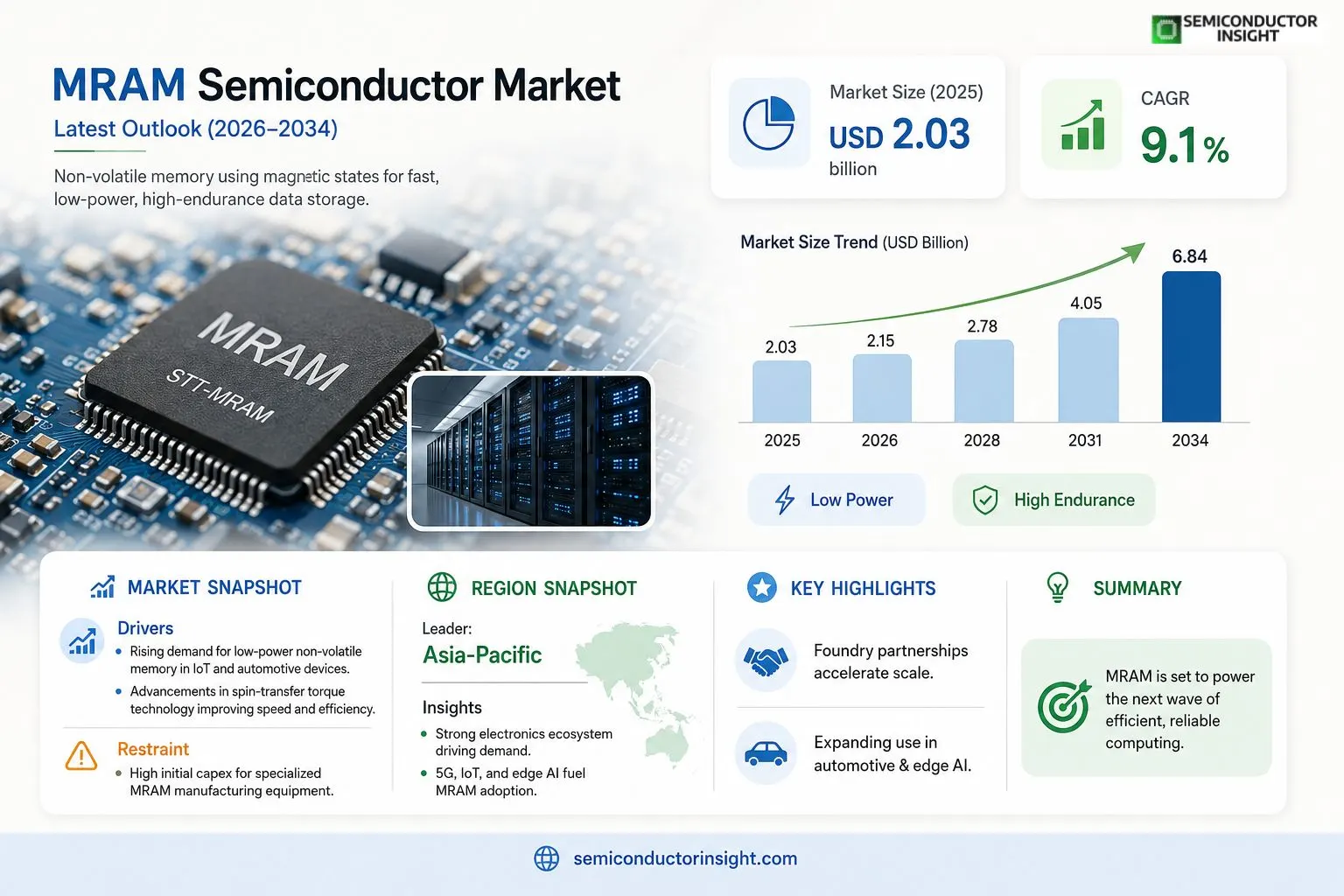
Global MRAM semiconductor market size was valued at USD 2.03 billion in 2025. The market is projected to grow from USD 2.15 billion in 2026 to USD 6.84 billion by 2034, exhibiting a CAGR of 9.1% during the forecast period.
Magnetoresistive Random‑Access Memory (MRAM) is a non‑volatile memory technology that stores data using magnetic states rather than electric charge. By leveraging spin‑transfer torque (STT) or voltage‑controlled magnetic anisotropy (VCMA), MRAM delivers fast read/write speeds, high endurance, and near‑zero standby power, making it suitable for automotive electronics, edge AI devices, and enterprise storage.The market is experiencing rapid growth due to several factors, including rising demand for low‑power memory in autonomous vehicles, increasing adoption of AI at the edge, and substantial investments from semiconductor giants seeking to replace legacy DRAM and flash solutions. Furthermore, recent collaborations,such as the partnership announced in March 2024 between a leading foundry and an MRAM specialist to integrate STT‑MRAM into advanced process nodes,are expected to accelerate commercialization across multiple sectors.
MARKET DRIVERS
Growing Demand for Low‑Power Non‑Volatile Memory
MRAM Semiconductor Market is being propelled by a surge in low‑power applications across IoT devices, wearables, and automotive electronics. Spin‑transfer torque MRAM offers near‑zero standby power while retaining data, making it a preferred choice for battery‑sensitive products. Recent forecasts indicate that devices requiring ultra‑low power consumption are expected to grow at double‑digit rates, directly boosting MRAM adoption.
Advancements in Spin‑Transfer Torque Technology
Technical breakthroughs in spin‑transfer torque (STT) have reduced write latency to below 10 ns and lowered the required switching current by more than 30 %. These improvements enhance the economic case for MRAM, allowing manufacturers to integrate it alongside traditional SRAM and DRAM without major redesigns. Consequently, system‑level cost efficiencies are emerging as a strong growth catalyst.
➤ Industry analysts expect MRAM capacity shipments to exceed 1.2 billion units by 2028, reflecting a compound annual growth rate of approximately 18 %.
Overall, the convergence of energy‑efficiency mandates and rapid STT innovation creates a robust demand tailwind for MRAM Semiconductor Market, positioning it as a cornerstone of next‑generation semiconductor portfolios.
MARKET CHALLENGES
Manufacturing Complexity and Yield Variability
Despite its advantages, MRAM fabrication demands precise control of magnetic layer deposition and etching, which can lead to yield fluctuations above 10 % in early production cycles. The need for specialized equipment and tight process windows raises operational risk, especially for fabs transitioning from conventional CMOS lines.
Other Challenges
Supply Chain Constraints
The limited number of vendors supplying high‑purity ferromagnetic materials and advanced lithography tools creates bottlenecks. Any disruption in this niche supply chain can delay volume production and inflate unit costs, challenging widespread market penetration.
MARKET RESTRAINTS
High Initial Capital Expenditure
Establishing MRAM production lines requires multi‑billion‑dollar investments in dedicated deposition chambers, patterning equipment, and inspection tools. For many semiconductor manufacturers, the capital outlay outweighs short‑term revenue prospects, prompting a cautious rollout strategy that restrains market velocity.
MARKET OPPORTUNITIES
Emerging Edge‑Computing Applications
Edge‑computing nodes in 5G infrastructure, autonomous vehicles, and industrial automation demand memory solutions that combine speed, endurance, and non‑volatility. MRAM’s ability to retain data without power and sustain high write cycles aligns perfectly with these use cases, opening sizable growth avenues as manufacturers seek to meet stringent latency and reliability standards.
MRAM Semiconductor Market Trends
Emerging Adoption in Autonomous Vehicles
MRAM Semiconductor Market is gaining traction as automotive manufacturers prioritize energy‑efficient, fault‑tolerant memory for autonomous driving systems. STT‑MRAM modules now support sub‑nanosecond write cycles while consuming virtually no power in standby mode, a combination that meets the stringent thermal and power budgets of modern vehicle‑level processors. Engineers report that integrating MRAM reduces overall system power draw by roughly 25 % compared with traditional DRAM, extending battery life in electric platforms and improving reliability under extreme temperature swings encountered in real‑world driving conditions. These technical advantages are prompting original equipment manufacturers to specify MRAM as the default non‑volatile cache in next‑generation sensor‑fusion architectures.
Other Trends
Edge AI Acceleration
Edge AI devices are another focal point for MRAM Semiconductor Market, as the technology’s high endurance and instant‑on capability enable continuous inference without periodic refresh cycles. By eliminating volatile memory refresh, device designers achieve up to a 30 % reduction in overall energy consumption, allowing battery‑operated edge nodes to sustain longer operational periods between charges. Additionally, MRAM’s resistance to radiation and magnetic interference makes it suitable for deployment in remote or harsh environments, expanding its applicability beyond consumer wearables to industrial IoT gateways and smart‑city sensor grids.
Strategic Partnerships Driving Scale
Recent strategic alliances between leading foundries and MRAM specialists are accelerating the transition from prototype to volume production. Joint development programs announced in early 2024 focus on integrating VCMA‑based MRAM cells into sub‑7 nm process technologies, which promises higher density and lower per‑bit cost. These collaborations also streamline supply‑chain logistics, enabling design teams to access qualified memory IP earlier in the product development cycle. As a result, MRAM Semiconductor Market is poised to expand its presence across enterprise storage, consumer electronics, and emerging computing platforms, with broader adoption expected within the next two to three years.
COMPETITIVE LANDSCAPEKey Industry Players
Strategic Rivalries and Innovation Frontiers Defining Global MRAM Semiconductor Market
Global MRAM semiconductor market is characterized by intense competition among a select group of established memory giants, specialized MRAM developers, and vertically integrated semiconductor companies. Everspin Technologies continues to hold a prominent position as one of the earliest and most commercially active MRAM manufacturers, offering a broad portfolio of Toggle MRAM and STT-MRAM products targeting industrial, automotive, and enterprise storage applications. Samsung Electronics and SK Hynix are aggressively advancing embedded STT-MRAM development, integrating the technology into advanced logic process nodes to serve AI-at-the-edge and mobile computing use cases. TSMC and GlobalFoundries have established dedicated embedded MRAM process offerings, enabling fabless chip designers to incorporate non-volatile memory into system-on-chip designs. Meanwhile, Avalanche Technology and Spin Memory are recognized for their innovations in perpendicular STT-MRAM architectures, targeting ultra-low-power and high-endurance memory applications in automotive electronics and IoT edge devices.Beyond the leading players, a growing number of niche and emerging companies are reshaping the competitive dynamics of MRAM Semiconductor Market. Crocus Technology, now operating under the Allegro MicroSystems umbrella, has leveraged its magnetic logic unit technology for sensor-integrated memory solutions. Qualcomm has filed notable MRAM-related patents, signaling interest in embedding the technology within mobile and edge AI chipsets. NXP Semiconductors and Renesas Electronics are actively exploring MRAM integration for next-generation automotive microcontrollers, where data retention, functional safety, and low-power operation are paramount. Intel has also explored MRAM within its advanced memory research programs, while Toshiba Memory (now Kioxia) continues to monitor MRAM as a potential complement to its flash memory portfolio. Collectively, these players are accelerating commercialization timelines through strategic partnerships, foundry collaborations, and targeted R&D investments across the MRAM value chain.
List of Key MRAM Semiconductor Companies Profiled
- Everspin Technologies
- Samsung Electronics
- SK Hynix
- TSMC (Taiwan Semiconductor Manufacturing Company)
- GlobalFoundries
- Avalanche Technology
- Spin Memory
- Crocus Technology (Allegro MicroSystems)
- Qualcomm Technologies
- NXP Semiconductors
- Renesas Electronics
- Intel Corporation
- Kioxia Holdings (formerly Toshiba Memory)
- STMicroelectronics
- Applied Materials
Segment Analysis:
| Segment Category | Sub-Segments | Key Insights |
| By Type |
|
STT‑MRAM
|
| By Application |
|
Automotive electronics
|
| By End User |
|
AI hardware vendors
|
| By Technology Integration |
|
Co‑packaged with logic dies
|
| By Market Trend |
|
Collaboration between foundries and MRAM specialists
|
Regional Analysis: Asia-Pacific
Asia-Pacific
China represents a significant portion of the Asia-Pacific MRAM market, driven by its massive electronics manufacturing base and government support for technological self-sufficiency. The demand for MRAM in consumer electronics, automotive applications, and industrial IoT is particularly strong.
Japan, a global leader in semiconductor technology, maintains a strong presence in the MRAM market, focusing on high-end applications such as automotive electronics, industrial control systems, and data centers. Innovation in MRAM design and reliability remains a key competitive advantage for Japanese manufacturers.
South Korea is a major player in MRAM manufacturing and R&D, with a strong focus on memory solutions for mobile devices, data centers, and automotive applications. Significant investments are being made in next-generation MRAM technologies.
Taiwan plays a crucial role in Global semiconductor supply chain, including the MRAM market. The region’s strong manufacturing capabilities and established ecosystem support the production and distribution of MRAM devices.
North America
North America is witnessing increasing adoption of MRAM, particularly in demanding applications like aerospace, defense, and high-performance computing. The region’s focus on advanced technologies and cybersecurity is driving demand for secure and reliable memory solutions. The United States is investing heavily in domestic semiconductor manufacturing, which could further boost the MRAM market in the region.
Europe
Europe’s MRAM market is steadily growing, driven by the automotive industry’s shift towards electric vehicles and autonomous driving. The increasing demand for reliable and energy-efficient memory in automotive electronics is a key driver. Government initiatives promoting digitalization and industrial automation are also contributing to market expansion.
South America
South America represents a nascent market for MRAM, with growth potential driven by the expansion of telecommunications infrastructure, the growing IoT sector, and increasing adoption of consumer electronics. The region’s economic development and increasing investments in technology are expected to fuel MRAM demand in the coming years.
Middle East & Africa
The Middle East & Africa region presents a relatively small but growing market for MRAM, primarily driven by investments in infrastructure development, smart city initiatives, and increasing demand for consumer electronics. The region’s growing technological advancements and increasing disposable incomes are expected to contribute to future MRAM market growth.
Report Scope
This market research report provides a comprehensive analysis of the MRAM Semiconductor Market , covering the forecast period 2026–2034. It offers detailed insights into market dynamics, technological advancements, competitive landscape, and key trends shaping the industry.
Key focus areas of the report include:
- Market Overview: The report begins with an overview outlining its current market scenario, key growth indicators, and industry transformation drivers. It discusses macroeconomic factors, demand–supply balance, regulatory landscape, and the strategic role of semiconductors in powering advancements across industries such as automotive, telecommunications, consumer electronics, and industrial automation.
- Market Size & Forecast: Historical data and future projections for revenue, unit shipments, and market value across major regions and segments.
- Segmentation Analysis: Detailed breakdown by product type, technology, application, and end-user industry to identify high-growth segments and investment opportunities.
- Regional Insights: Insights into market performance across North America, Europe, Asia-Pacific, Latin America, and the Middle East & Africa, including country-level analysis where relevant.
- Competitive Landscape: Profiles of leading market participants, including their product offerings, R&D focus, manufacturing capacity, pricing strategies, and recent developments such as mergers, acquisitions, and partnerships.
- Technology Trends & Innovation: Assessment of emerging technologies, integration of AI/IoT, semiconductor design trends, fabrication techniques, and evolving industry standards.
- Market Drivers & Restraints: Evaluation of factors driving market growth along with challenges, supply chain constraints, regulatory issues, and market-entry barriers.
- Stakeholder Insights: Insights for component suppliers, OEMs, system integrators, investors, and policymakers regarding the evolving ecosystem and strategic opportunities.
Primary and secondary research methods are employed, including interviews with industry experts, data from verified sources, and real-time market intelligence to ensure the accuracy and reliability of the insights presented.
FREQUENTLY ASKED QUESTIONS:
What is the current market size of MRAM Semiconductor Market?
-> MRAM Semiconductor Market was valued at USD 2.03 billion in 2025 and is expected to reach USD 6.84 billion by 2034, exhibiting a CAGR of 9.1% during the forecast period.
Which key companies operate in MRAM Semiconductor Market?
-> Key players include Everspin Technologies, Samsung Electronics, NXP Semiconductors, STMicroelectronics, and GlobalFoundries, among others.
What are the key growth drivers?
-> Key growth drivers include rising demand for low‑power memory in autonomous vehicles, increasing adoption of AI at the edge, and substantial investments from semiconductor giants seeking to replace legacy DRAM and flash solutions.
Which region dominates the market?
-> The source does not specify a single dominant region; however, strong adoption is observed in regions with advanced automotive and AI edge ecosystems.
What are the emerging trends?
-> Emerging trends include integration of STT‑MRAM into advanced process nodes, strategic collaborations between foundries and MRAM specialists, and expanding applications in automotive electronics, edge AI devices, and enterprise storage.
Get Sample Report PDF for Exclusive Insights
Report Sample Includes
- Table of Contents
- List of Tables & Figures
- Charts, Research Methodology, and more...
 Download Sample Report PDF