
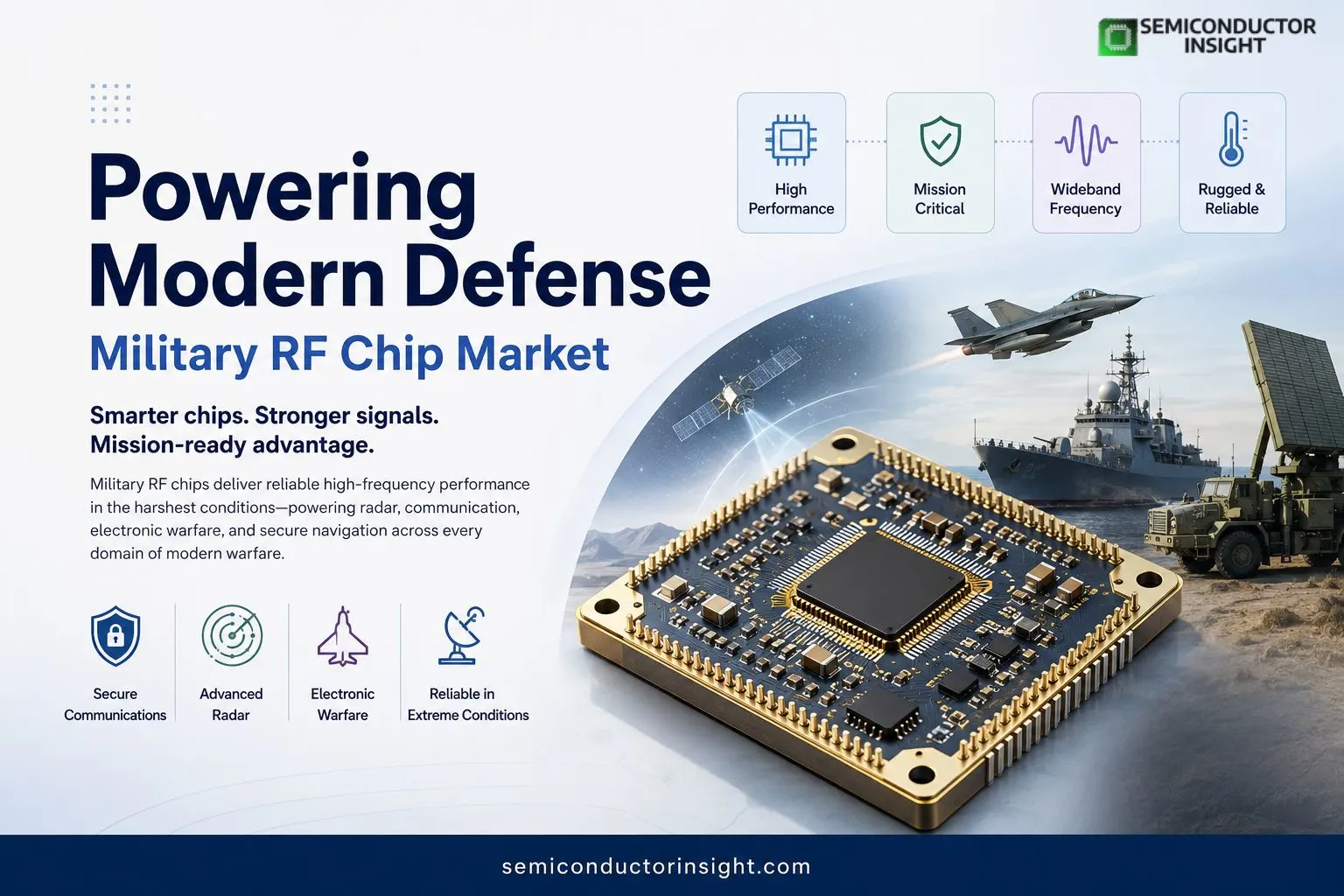
Military RF Chip Market 2026: Semiconductor Innovation Powers Modern Battlefield Communications
Military operations increasingly rely on faster sensing, secure communication, precision navigation, and electronic warfare capabilities. At the center of these systems are military RF chips, specialized semiconductor devices engineered to operate under demanding battlefield conditions while delivering reliable high frequency performance. Unlike commercial RF components, military-grade chips must withstand extreme temperatures, vibration, radiation exposure, and electromagnetic interference without compromising signal integrity.
The shift toward multi-domain warfare, where land, air, sea, cyber, and space operations function together, has significantly increased the need for advanced RF semiconductor technologies. These chips now support everything from active electronically scanned array radar and satellite communication terminals to missile guidance systems and tactical radios.
The Defense Platforms Creating the Highest RF Chip Demand
Military RF chips have moved beyond traditional radar installations and now power an expanding portfolio of defense equipment.
Modern fighter aircraft depend on RF front-end modules for radar imaging and electronic countermeasures. Naval destroyers integrate high-power RF amplifiers into surveillance and missile defense systems. Ground-based air defense platforms employ RF chips for target tracking, while military drones use compact RF transceivers to maintain secure communication links during long-range missions.
Space has become another strategic application area. Low Earth orbit defense satellites increasingly require radiation-hardened RF semiconductor solutions capable of maintaining reliable communication in harsh orbital environments.
Gallium Nitride Is Redefining RF Performance
- Gallium Nitride (GaN) has become one of the most influential semiconductor materials in military RF design.
- Compared with earlier Gallium Arsenide technologies, GaN devices operate at higher voltages, generate greater power density, and improve thermal efficiency. These characteristics enable radar systems to detect smaller objects at longer distances while reducing system size and cooling requirements.
- Several next-generation active electronically scanned array radar platforms now incorporate thousands of transmit and receive modules built around GaN RF technology, allowing faster beam steering and improved tracking accuracy.
- Defense organizations continue investing in domestic GaN fabrication capabilities to reduce dependence on overseas semiconductor supply chains.
Don’t Forget to Surf Our Updated Report for More Detailed Analysis: https://semiconductorinsight.com/report/military-rf-chip-market/
Electronic Warfare Is Becoming More Semiconductor Intensive
Electronic warfare has evolved from simple signal jamming into intelligent spectrum dominance.
Modern systems continuously scan radio frequencies, identify threats, classify emissions, and respond within milliseconds. Military RF chips support this process by enabling rapid frequency switching, signal amplification, and real-time spectrum monitoring.
Recent upgrades to airborne electronic attack aircraft, naval electronic surveillance systems, and mobile battlefield intelligence platforms illustrate how RF semiconductor performance directly influences mission effectiveness.
Artificial intelligence is also beginning to assist electronic warfare software, allowing RF hardware to adapt dynamically to changing electromagnetic environments.
Trusted Manufacturing Is Becoming a Strategic Priority
Security requirements now extend well beyond chip performance.
Governments increasingly require trusted semiconductor manufacturing processes, secure packaging, authenticated supply chains, and rigorous component traceability before RF chips are integrated into defense platforms.
The United States continues expanding domestic semiconductor production through initiatives supported by the CHIPS and Science Act, while Europe and Japan are strengthening local manufacturing ecosystems for critical electronic components. These efforts aim to improve supply resilience for defense-grade semiconductors and reduce dependence on geographically concentrated fabrication facilities.
Why Space Programs Are Expanding RF Semiconductor Innovation?
- Military communication increasingly depends on resilient satellite networks.
- Modern defense satellites require RF chips capable of maintaining stable operation despite radiation exposure, extreme temperature variations, and prolonged mission durations.
- New constellations supporting secure communications, missile warning, navigation, and intelligence gathering are accelerating demand for radiation-tolerant RF integrated circuits.
- At the same time, compact satellite architectures require smaller and lighter semiconductor packages without sacrificing signal quality or reliability.
Engineering Priorities Shaping the Next Generation of Military RF Chips
The next wave of military RF innovation focuses on performance rather than simply increasing transistor density.
Design engineers are prioritizing ultra-low signal latency, wideband frequency coverage, improved thermal management, advanced chip packaging, radiation resistance, secure hardware architecture, and compatibility with artificial intelligence-enabled defense systems. These developments are enabling military platforms to process larger volumes of battlefield data while maintaining secure and uninterrupted communications across increasingly complex operational environments.

Comments (0)