
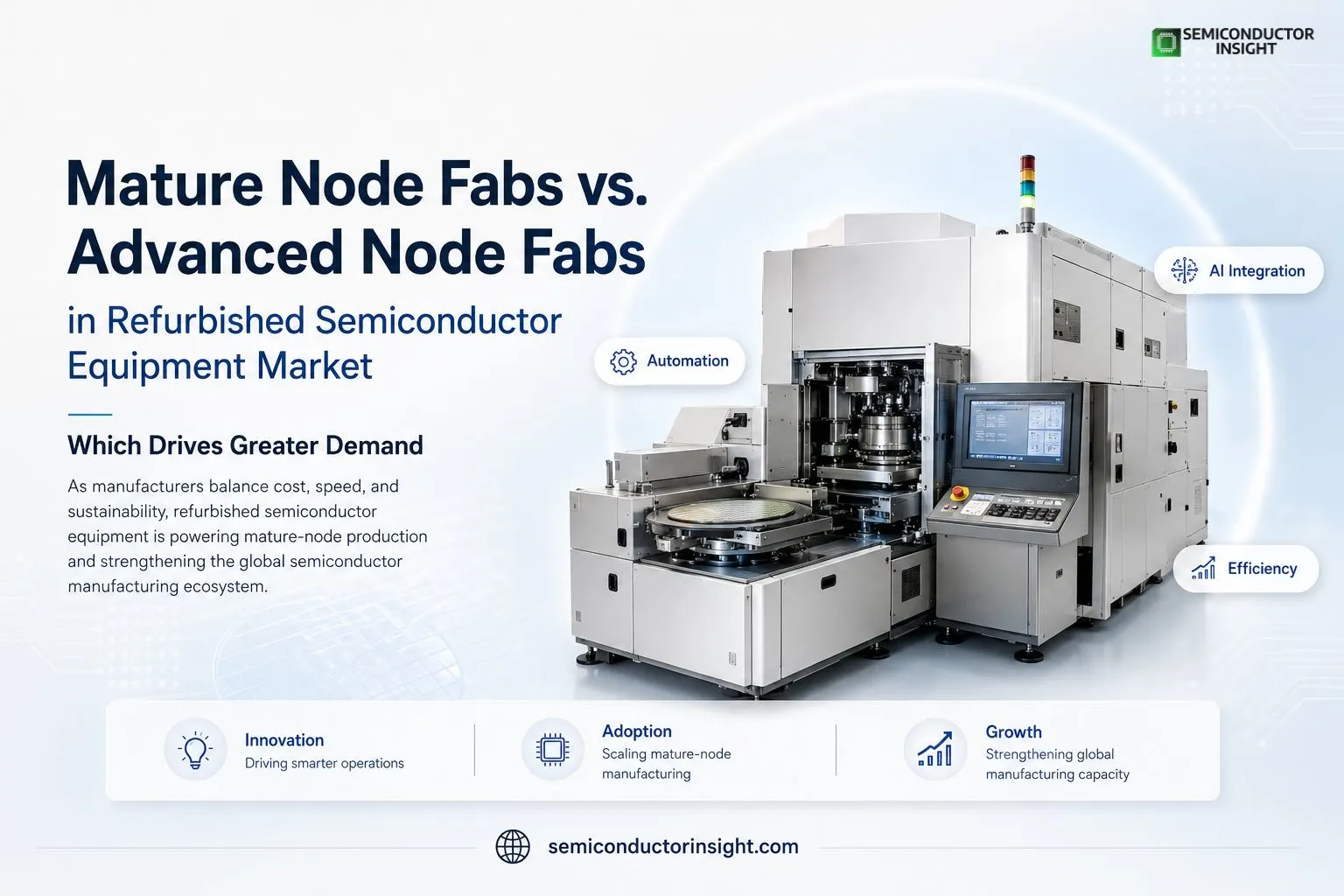
Mature Node Fabs vs. Advanced Node Fabs in Refurbished Semiconductor Equipment Market Which Drives Greater Demand
For decades, discussions surrounding semiconductor manufacturing have focused on cutting-edge lithography tools, advanced packaging technologies, and billion-dollar fabrication facilities.
Yet another segment is quietly gaining importance across the global semiconductor ecosystem: refurbished semiconductor equipment. As chip manufacturers seek cost efficiency, faster deployment timelines, and sustainable manufacturing practices, Refurbished Semiconductor Equipment Market is becoming a critical part of modern semiconductor operations.
A Different Kind of Semiconductor Growth Story
- Not every semiconductor facility is producing the most advanced 2-nanometer or 3-nanometer chips. A significant share of global electronics, automotive components, industrial controllers, medical devices, and power management systems still rely on mature process technologies ranging from 28nm to 180nm and beyond.
- For many of these applications, refurbished deposition systems, etching equipment, ion implantation tools, testing systems, and wafer handling platforms provide a practical alternative to purchasing brand-new machinery.
- Recent fab expansion projects in Southeast Asia, India, China, Europe, and North America have increased interest in equipment refurbishment programs as manufacturers balance production targets with capital expenditure constraints.
A Market Measured Through Equipment Value and Factory Demand
Rather than examining only revenue figures, the scale of this industry can be understood through manufacturing activity.
In 2025, global semiconductor industry sales exceeded USD 650 billion according to data released by the Semiconductor Industry Association. Meanwhile, semiconductor fabrication facilities worldwide continued investing in both new and refurbished production tools to support expanding demand for automotive electronics, AI infrastructure, industrial automation systems, and consumer devices.
Industry estimates from equipment vendors and semiconductor manufacturing publications indicate that refurbished tools can often cost 40% to 70% less than comparable new systems while maintaining production suitability for mature-node applications.
Thousands of previously deployed process tools remain active across fabs globally after undergoing refurbishment, recalibration, software upgrades, and component replacement.
Why Older Technology Remains Essential?
One of the most overlooked realities in the semiconductor industry is that not every chip needs cutting-edge manufacturing. Automotive microcontrollers, industrial sensors, power management integrated circuits, and smart appliance chips are often produced on mature wafer processes and established technology platforms. Since these products continue to see strong demand, manufacturers depend on reliable production equipment, even when it is not the newest available generation.
The Circular Economy Finds a Place inside Semiconductor Fabs
Refurbishment is increasingly viewed as part of a broader industrial sustainability strategy.
Equipment Life Cycle
Original Tool Deployment
↓
Production Use
↓
System Retirement
↓
Engineering Assessment
↓
Component Replacement
↓
Performance Validation
↓
Redeployment
This approach extends equipment life while reducing material waste and delaying large-scale equipment disposal.
As environmental reporting becomes increasingly important for manufacturers, refurbishment programs are gaining attention as practical examples of circular manufacturing principles.
Inside the Current Factory Expansion Wave
The semiconductor industry is seeing strong investment momentum, supported by a growing number of announced facility projects worldwide. Since the start of major supply chain expansion efforts, more than 100 semiconductor projects have been announced globally, reflecting the sector’s ongoing push to strengthen manufacturing capacity.
At the same time, multiple fabs under construction across the United States, Europe, India, Japan, and Southeast Asia are still assessing mixed equipment strategies to balance cost, speed, and production needs. Mature-node manufacturing remains especially important for automotive, industrial, and infrastructure electronics, while refurbished equipment is often helping facilities start production faster than waiting for long lead times on new systems.
Curious about the report? Dive into our newest updated version at no cost: https://semiconductorinsight.com/report/semiconductor-refurbished-equipment-market/
What Buyers Are Looking For in 2026?
The conversation around refurbished equipment has evolved significantly.
A decade ago, buyers primarily focused on acquisition costs. Today, evaluation criteria are broader:
- Process repeatability
- Software compatibility
- Yield performance
- Spare parts availability
- Energy consumption
- Equipment service history
- Integration with modern factory automation systems
This shift demonstrates how refurbishment has become a sophisticated engineering discipline rather than merely a resale activity.
The Technology Segments Generating the Most Interest
- Current activity is particularly visible across several categories:
- Lithography support equipment continues to attract attention among mature-node manufacturers.
- Etch and deposition systems remain highly sought after because of their long operational lifecycles.
- Wafer inspection and metrology tools are being upgraded with improved analytics capabilities.
- Automated material handling systems are increasingly refurbished to support smart factory initiatives.
- These segments are helping create a secondary equipment ecosystem that complements ongoing investments in advanced semiconductor manufacturing.
Why Refurbishment Is Becoming Part of Semiconductor Strategy?
The semiconductor industry’s expansion is no longer defined solely by new fabrication facilities and next-generation process nodes. Increasingly, manufacturers are recognizing the value of extending equipment lifecycles, optimizing capital deployment, and supporting sustainable manufacturing objectives.
As mature-node production continues to supply critical industries ranging from automotive electronics to industrial automation, refurbished semiconductor equipment is emerging as a practical solution that bridges operational efficiency, environmental responsibility, and manufacturing resilience. Rather than representing yesterday’s technology, refurbishment is becoming an important part of tomorrow’s semiconductor production strategy.

Comments (0)