
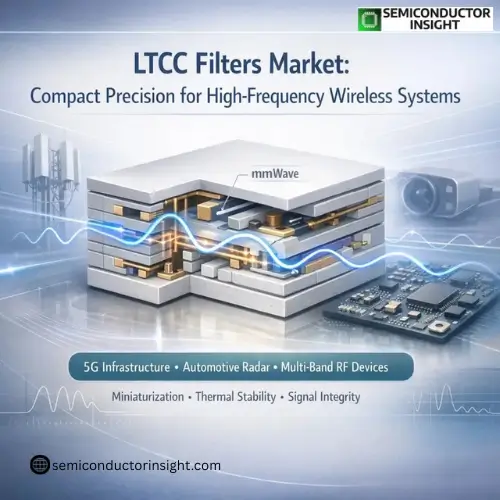
LTCC Filters Market Insights: Enabling High-Performance Signal Integrity
As wireless systems become faster, denser, and more compact, the components hidden deep inside circuit modules are taking on a new level of importance. LTCC (Low-Temperature Co-Fired Ceramic) filters fall squarely into this category. Though rarely visible to end users, these filters quietly determine signal clarity, stability, and reliability across modern communication systems.
LTCC filters market has evolved from serving niche RF applications into a critical enabler of today’s high-frequency ecosystem. From smartphones and base stations to automotive radar and industrial IoT devices, demand for compact, high-performance filtering solutions is steadily expanding.
Please feel free to access our most recent report updates:
https://semiconductorinsight.com/report/ltcc-filters-market/
Why LTCC Technology Fits the Modern RF Era
LTCC technology offers a unique combination of material stability, multilayer integration, and miniaturization. Unlike conventional discrete filters, LTCC filters can embed multiple passive elements within a single ceramic substrate. This design flexibility allows engineers to reduce board space while maintaining precise frequency control.
In an era where devices must support multiple bands without compromising performance, LTCC filters deliver a balance that alternatives often struggle to match. Their ability to maintain consistent electrical characteristics under thermal and mechanical stress makes them especially valuable in demanding environments.
A Market Built Around High-Frequency Complexity
- The growth of the LTCC filters market is closely linked to rising frequency complexity in modern electronics.
- Smartphones now support dozens of frequency bands. 5G infrastructure relies on precise filtering to avoid interference.
- Automotive radar systems demand stable performance at millimetre-wave frequencies.
- These requirements push manufacturers toward filtering technologies that offer predictability at scale.
- LTCC filters meet this demand by combining reproducible manufacturing processes with tight tolerance control, allowing consistent performance across high-volume production.
Telecom and 5G: The Core Growth Engine
Telecommunications remains the single most influential sector for LTCC filters. The global rollout of 5G networks has significantly increased demand for compact RF components capable of handling higher frequencies and wider bandwidths.
Unlike earlier generations, 5G architecture relies on dense antenna arrays and advanced radio units. LTCC filters play a key role in suppressing noise, managing adjacent channel interference, and ensuring signal integrity. Their small footprint allows more components to be packed into limited space, which is critical for modern base stations and small-cell deployments.
Automotive Electronics Add a New Dimension
Beyond telecom, the automotive sector is emerging as a strong secondary driver. Advanced driver-assistance systems, vehicle-to-everything communication, and in-car connectivity all depend on reliable RF performance.
LTCC filters are increasingly specified for automotive electronics because of their thermal stability and resistance to vibration. As vehicles integrate more radar and communication modules, demand for robust, space-efficient filtering solutions continues to rise.
Manufacturing Discipline Shapes Market Leadership
The LTCC filters market is not defined by rapid entry or low barriers. It requires deep materials expertise, precision manufacturing, and long qualification cycles. Automotive and telecom customers expect consistency over years, not months.
This environment favors manufacturers with vertically integrated processes and strong quality control. Once a filter design is qualified, suppliers often remain locked into production for extended periods, creating long-term relationships rather than transactional sales.
Miniaturization without Performance Trade-Offs
One of the most notable trends in the LTCC filters market is the ability to shrink component size without sacrificing electrical performance. As consumer electronics become thinner and more complex, component designers are under constant pressure to do more with less space.
LTCC’s multilayer structure enables compact designs while maintaining sharp frequency selectivity. This makes it particularly attractive for wearable devices, smart home products, and industrial sensors where space and power efficiency are equally critical.
Limited Snapshot: What Engineers Prioritize
While product specifications vary by application, purchasing decisions often revolve around a few shared priorities:
- Frequency stability across temperature ranges
- Compatibility with high-density PCB layouts
- Long-term reliability under continuous operation
These considerations reinforce the preference for LTCC technology in mission-critical RF paths.
Regional Manufacturing and Supply Dynamics
Asia-Pacific continues to dominate LTCC filter production, driven by strong semiconductor manufacturing ecosystems in Japan, South Korea, Taiwan, and China. These regions combine materials expertise with high-volume production capabilities.
Meanwhile, North America and Europe focus more on high-value applications, including automotive electronics, aerospace systems, and advanced telecom infrastructure. This regional specialization keeps the global market balanced between scale and specialization.
The Market’s Trajectory Is Precision-Led Growth
The LTCC filters market is not shaped by short-term cycles or sudden disruptions. Its expansion follows the steady rise of wireless complexity. Each new generation of connectivity increases the importance of reliable signal filtering, reinforcing long-term demand.
Rather than being replaced, LTCC filters continue to evolve alongside system architectures. Their adaptability ensures relevance even as frequencies rise and integration levels deepen.
Wrapping Up By:
LTCC filters market reflects a broader truth about modern electronics: performance is increasingly defined by what happens at the component level. As wireless systems grow more sophisticated, the role of compact, stable, and precise filtering solutions becomes indispensable. LTCC filters are not just supporting innovation they are enabling it, quietly and consistently, across the global semiconductor landscape.

Comments (0)