MARKET INSIGHTS
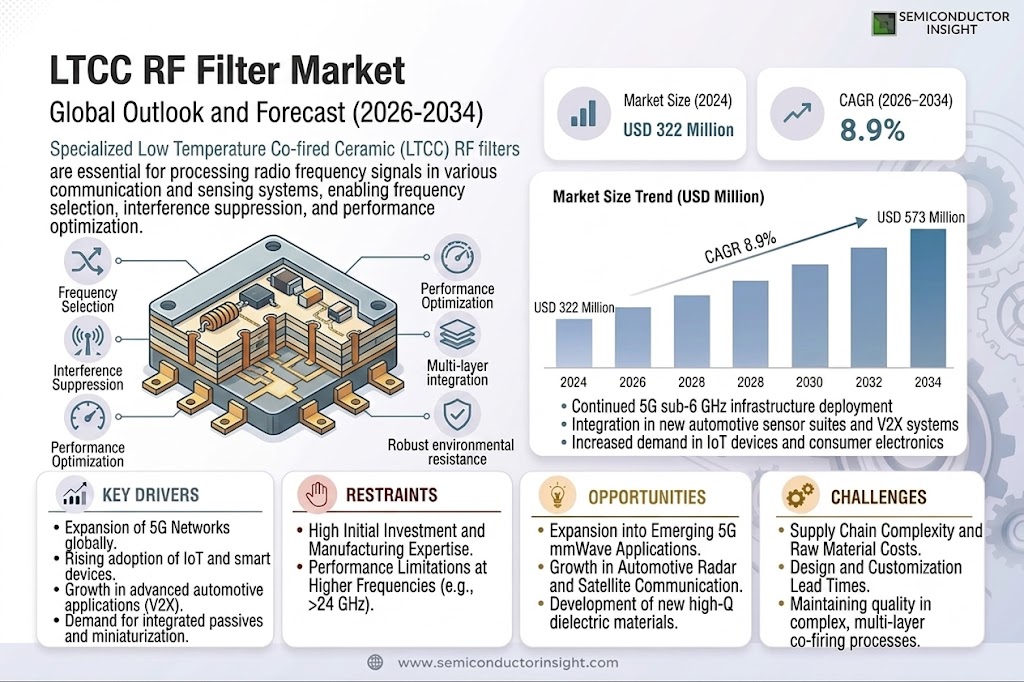
Global LTCC RF Filter Market was valued at USD 322 million in 2024 and is projected to reach USD 573 million by 2032, exhibiting a CAGR of 8.9% during the forecast period.
Low-temperature co-fired ceramic (LTCC) technology is an important technology for miniaturization and high-frequency RF devices. Multi-layer RF filters based on LTCC technology are widely used in RF and wireless interactive systems in 5G communication, functional mobile phones, and the Internet of Things. LTCC filters have excellent electrical performance and good reliability.
This report studies the LTCC RF filters, covering the Band Pass Filters (BPF), Low Pass Filters (LPF), and High Pass Filters (HPF). Global key players of LTCC RF Filter include Murata, TDK Corporation, Walsin Technology, Yageo (Chilisin), Shenzhen Sunlord Electronics, and others. The top five players hold a share of about 72%. China is the world’s largest market for LTCC RF Filter and holds a share of about 44%, followed by North America and Europe, with shares of about 13% and 11%, respectively. In terms of product type, Band Pass Filters (BPF) is the largest segment, accounting for a share of about 49%. In terms of application, Consumer Electronics & 5G Base Station is the largest field with a share of about 71%.
We have surveyed the LTCC RF Filter manufacturers, suppliers, distributors, and industry experts on this industry, involving the sales, revenue, demand, price change, product type, recent development and plan, industry trends, drivers, challenges, obstacles, and potential risks. This report aims to provide a comprehensive presentation of the global market for LTCC RF Filter, with both quantitative and qualitative analysis, to help readers develop business/growth strategies, assess the market competitive situation, analyze their position in the current marketplace, and make informed business decisions regarding LTCC RF Filter.
MARKET DRIVERS
Proliferation of 5G Infrastructure and Devices
The global rollout of 5G networks is a primary catalyst for the LTCC RF filter market. These filters are essential components in 5G base stations, small cells, and user equipment to manage signal integrity and prevent interference across multiple frequency bands, including the new millimeter-wave spectrum. The high-frequency requirements of 5G technology favor LTCC’s ability to provide miniaturized, high-performance filtering solutions.
Increasing Demand for Miniaturization in Consumer Electronics
The relentless trend towards smaller, thinner, and more powerful consumer electronics, particularly smartphones, wearables, and IoT devices, drives demand for LTCC RF filters. Their inherent advantages in integration and compact size allow manufacturers to save valuable board space while incorporating complex filtering functions for Wi-Fi, Bluetooth, and cellular connectivity.
➤ The automotive sector’s evolution towards connected and autonomous vehicles represents a significant growth vector, requiring robust RF filtering for V2X communication, GPS, and radar systems, where LTCC technology offers reliability and performance under harsh operating conditions.
Furthermore, the expansion of the Internet of Things (IoT) across industrial, smart home, and healthcare applications creates sustained demand. LTCC filters are well-suited for these applications due to their durability, temperature stability, and ability to be integrated into modules alongside other components.
MARKET CHALLENGES
Intense Competition from Alternative Technologies
The LTCC RF filter market faces stiff competition from other filter technologies, notably Surface Acoustic Wave (SAW) and Bulk Acoustic Wave (BAW) filters. While LTCC excels in power handling and integration, BAW filters often offer superior performance for high-frequency applications, particularly in premium smartphones, creating pricing and performance pressure.
Other Challenges
Supply Chain Complexity and Raw Material Costs
The manufacturing process for LTCC components is complex, involving multiple layers of ceramic tape, screen printing, and high-temperature co-firing. Fluctuations in the prices of raw materials like glass-ceramic powders and precious metals used in electrodes can impact production costs and profitability.
Design and Customization Lead Times
The custom nature of many LTCC filter designs, tailored to specific frequency bands and performance requirements, can result in longer development cycles compared to off-the-shelf alternatives. This can be a challenge in fast-moving consumer electronics markets where time-to-market is critical.
MARKET RESTRAINTS
High Initial Investment and Manufacturing Expertise
The capital expenditure required for establishing LTCC manufacturing facilities is substantial, acting as a barrier to entry for new players. The process demands specialized equipment and significant expertise in ceramic materials science and multi-layer co-firing technology, which limits the number of capable manufacturers globally and can constrain supply.
Performance Limitations at Higher Frequencies
While LTCC technology is suitable for many sub-6 GHz 5G applications, its performance can be challenged at the higher end of the millimeter-wave spectrum (e.g., above 24 GHz). Insertion loss and quality factor (Q-factor) may not meet the stringent requirements for some advanced mmWave systems, potentially limiting its adoption in certain high-frequency segments.
MARKET OPPORTUNITIES
Expansion into Emerging 5G mmWave Applications
As 5G mmWave deployment progresses beyond initial trials, there is a significant opportunity for advancements in LTCC materials and design to capture a share of this demanding market. Developing filters with improved high-frequency performance could open up new applications in fixed wireless access and enhanced mobile broadband.
Growth in Automotive Radar and Satellite Communication
The increasing adoption of Advanced Driver-Assistance Systems (ADAS) and the emergence of Low Earth Orbit (LEO) satellite communication networks (e.g., for direct-to-device services) present substantial opportunities. LTCC’s ability to create robust, integrated passive components that withstand automotive-grade temperature ranges and environmental stress is a key advantage in these high-growth sectors.
LTCC RF Filter Market Trends
Sustained Growth Driven by 5G and IoT Expansion
The global LTCC RF Filter market is on a significant upward trajectory, with its value projected to grow from 322 million USD in 2024 to 573 million USD by 2032, representing a compound annual growth rate (CAGR) of 8.9%. This robust growth is fundamentally driven by the global rollout of 5G infrastructure and the proliferation of Internet of Things (IoT) devices. Low-temperature co-fired ceramic (LTCC) technology is critical for manufacturing miniaturized, high-frequency RF components that are essential for modern communication systems. These multi-layer filters offer excellent electrical performance and high reliability, making them the preferred choice for a wide range of wireless applications.
Other Trends
Market Concentration and Geographical Dominance
The market is characterized by a high degree of concentration, with the top five players—including Murata, TDK Corporation, and Walsin Technology—collectively holding approximately 72% of the market share. Geographically, China stands as the largest market, accounting for about 44% of the global share. This dominance is fueled by massive domestic manufacturing of consumer electronics and aggressive 5G network deployment. North America and Europe follow as significant markets, holding shares of about 13% and 11%, respectively, driven by advanced telecommunications and automotive sectors.
Product and Application Segmentation
Band Pass Filters (BPF) are the predominant product type, constituting the largest segment with a share of about 49% of the market. In terms of application, the Consumer Electronics & 5G Base Station segment is overwhelmingly the largest, holding a share of approximately 71%. The demand from this segment is powered by smartphones, wearable devices, and the essential infrastructure for 5G networks. Other key application areas include Automotive Electronics, Aerospace & Military, and Industrial & Medical sectors, each presenting unique growth opportunities as vehicle connectivity and industrial automation advance.
Competitive Landscape and Strategic Developments
The competitive environment is dynamic, with leading companies focusing on technological innovation, strategic mergers, and acquisitions to strengthen their market positions and expand their product portfolios. The comprehensive analysis of market participants, including sales and revenue shares, provides a clear view of the competitive intensity. The market’s future development is influenced by several factors, including advancements in material science, evolving 5G standards, and the potential challenges related to supply chain stability and raw material costs. The industry’s ongoing research and development efforts are focused on enhancing filter performance for next-generation communication standards.
COMPETITIVE LANDSCAPE
Key Industry Players
A Market Characterized by High Concentration and Technological Leadership
The global LTCC RF Filter market is dominated by a handful of large, established players, with the top five companies collectively holding approximately 72% of the market share. Japanese giants Murata and TDK Corporation stand as the unequivocal leaders, leveraging their deep expertise in ceramic materials, extensive R&D capabilities, and global supply chains. Their dominance is built on providing highly reliable and miniaturized components critical for 5G infrastructure, smartphones, and automotive electronics. The market structure is highly consolidated, where these leaders compete on technological innovation, product performance, and the ability to secure high-volume contracts with major OEMs, creating significant barriers to entry for new participants.
Beyond the top tier, a group of significant regional and niche players competes effectively. Taiwanese manufacturers like Walsin Technology and Yageo (through its subsidiary Chilisin) hold strong positions, particularly in the supply chain for consumer electronics. Chinese companies, including Shenzhen Sunlord Electronics, are rapidly expanding their capabilities, supported by the vast domestic market which accounts for about 44% of global consumption. Other notable participants, such as Taiyo Yuden and Samsung Electro-Mechanics, bring their own material science and manufacturing strengths, often focusing on specific application segments like aerospace or high-frequency automotive radar, thereby creating a diversified competitive environment beneath the market leaders.
List of Key LTCC RF Filter Companies Profiled
- Murata
- TDK Corporation
- Walsin Technology
- ACX Corp
- Yageo (Chilisin)
- Microgate
- Mini-Circuits
- Taiyo Yuden
- Samsung Electro-Mechanics
- Shenzhen Sunlord Electronics
- Raltron Electronics
- BDStar (Glead)
- YanChuang Optoelectronic Technology
- Fenghua Advanced Technology
- Shenzhen Zhenhuafu Electronics
Segment Analysis:
| Segment Category | Sub-Segments | Key Insights |
| By Type |
|
Band Pass Filters (BPF) are the dominant product type due to their critical function in selecting specific frequency ranges, which is essential for the clarity and efficiency of modern wireless communication systems. Their widespread adoption is driven by the demanding requirements of 5G infrastructure and consumer electronics for high-performance signal isolation and noise reduction, establishing them as the technological cornerstone for advanced RF applications. |
| By Application |
|
Consumer Electronics & 5G Base Station represents the most significant application field, propelled by the global proliferation of 5G networks and the continuous innovation in smartphones and IoT devices. The sector’s leadership is underpinned by the massive volume demand for miniaturized, high-frequency components that offer the reliability and performance necessary for next-generation connectivity solutions in both user equipment and critical network infrastructure. |
| By End User |
|
Communication Equipment Manufacturers are the leading end-user segment, as they are the primary integrators of LTCC RF filters into a vast array of products from smartphones to base stations. This dominance is fueled by their central role in the telecommunications value chain and their persistent drive to incorporate advanced filtering technologies that enhance data speed, network capacity, and device functionality in a highly competitive market. |
| By Frequency Range |
|
Sub-6 GHz is the predominant frequency range for LTCC RF filters, as this spectrum is the current foundation for widespread 5G deployment, offering an optimal balance between coverage and capacity. The maturity of applications within this band and the immediate need for filters to manage network congestion and interference solidify its leading position, although growing development focus is shifting towards millimeter wave solutions for future ultra-high-speed applications. |
| By Material Technology |
|
Standard Ceramic Substrates currently lead the market due to their proven reliability, cost-effectiveness, and suitability for a wide range of existing applications. However, the market is witnessing a significant trend towards the adoption of advanced low-loss formulations, which are critical for minimizing signal attenuation in high-frequency 5G and automotive radar systems, indicating a future where performance specifications increasingly dictate material selection. |
Regional Analysis: LTCC RF Filter Market
Asia-Pacific
Asia-Pacific’s dominance is underpinned by a mature and highly efficient electronics manufacturing ecosystem. Major OEMs and contract manufacturers are based here, leading to dense, cost-effective supply chains for raw materials, substrates, and component assembly. This proximity minimizes logistical bottlenecks and production costs for LTCC RF filters, giving regional suppliers a significant competitive advantage in serving both local and global markets with rapid production scaling to meet fluctuating demand.
Aggressive nationwide 5G rollout plans across countries like China, South Korea, and Japan create immense demand for LTCC RF filters, which are critical components in 5G base stations and user equipment. The scale and speed of this infrastructure development are unparalleled elsewhere, compelling filter manufacturers to innovate rapidly to meet the stringent performance requirements for higher frequency bands and increased data throughput, securing the region’s position at the forefront of RF filter technology.
The region is the largest producer and consumer of smartphones, tablets, and wearable devices, which are primary applications for LTCC filters. This massive, steady demand from a vast domestic and export market drives continuous production and investment in filter technology. Consumer preference for feature-rich, compact devices pushes manufacturers to integrate more advanced, miniaturized LTCC filters, fostering a cycle of innovation and volume production that is unique to the Asia-Pacific market.
Strong government initiatives and substantial private investment in R&D centers across the region are focused on advancing ceramic and packaging technologies crucial for LTCC filters. Collaborative projects between universities, national labs, and corporations aim to improve filter characteristics like thermal stability, insertion loss, and power handling. This strong emphasis on innovation ensures that Asia-Pacific remains the source of next-generation LTCC RF filter designs, maintaining its technological leadership.
North America
North America represents a highly advanced and innovation-driven market for LTCC RF filters, characterized by strong demand from the aerospace, defense, and telecommunications sectors. The United States, in particular, is home to leading technology companies and defense contractors that require high-performance, reliable RF components for critical applications, including satellite communications, radar systems, and advanced military electronics. The early and widespread adoption of 5G technology by major carriers also fuels demand for filters in network infrastructure. The market is defined by a focus on high-value, specialized filters with superior performance specifications rather than high-volume, low-cost production. Robust intellectual property protection and significant investment in R&D from both corporate and government sources foster a cutting-edge environment for developing next-generation LTCC solutions tailored for demanding applications.
Europe
The European LTCC RF filter market is mature and steadily growing, supported by strong automotive and industrial sectors alongside ongoing telecommunications upgrades. Germany, the UK, and France are key markets, with demand driven by the automotive industry’s integration of advanced driver-assistance systems (ADAS), vehicle-to-everything (V2X) communication, and infotainment systems, all requiring robust RF filtering. The region’s strict regulatory standards for electronic emissions and signal integrity push manufacturers to produce high-quality, reliable components. European suppliers often specialize in niche, high-performance applications, collaborating closely with automotive OEMs and industrial equipment manufacturers. The gradual deployment of 5G networks across the continent provides a consistent, though less explosive, source of demand compared to Asia-Pacific, supporting a stable and technologically sophisticated market ecosystem.
South America
The South American market for LTCC RF filters is nascent but shows potential for growth, primarily driven by the gradual expansion of mobile network infrastructure and increasing smartphone penetration. Brazil is the largest market in the region, with telecommunications operators investing in network modernization to support growing data consumption. The market faces challenges, including economic volatility and less developed local manufacturing capabilities, which often lead to a reliance on imported components. Demand is primarily concentrated in consumer electronics and basic telecommunications equipment, with slower adoption in high-end industrial or automotive applications compared to more developed regions. Growth is expected to be steady as economic conditions stabilize and digital infrastructure investments increase, creating opportunities for market expansion over the long term.
Middle East & Africa
The Middle East & Africa region presents a diverse and emerging market for LTCC RF filters, with growth pockets centered around affluent Gulf Cooperation Council (GCC) countries and major urban centers in Africa. The Middle East, particularly the UAE and Saudi Arabia, is investing heavily in smart city initiatives and 5G infrastructure, driving demand for RF components in telecommunications. In Africa, the focus is on expanding basic mobile network coverage and capacity to serve a growing population, creating demand for filters in network equipment. The market is characterized by a high dependence on imports, with limited local manufacturing. While the overall market volume is smaller, strategic investments in digital transformation and telecommunications present significant future growth potential for LTCC RF filter adoption across the region.
Report Scope
This market research report provides a comprehensive analysis of the LTCC RF Filter Market , covering the forecast period 2025–2032. It offers detailed insights into market dynamics, technological advancements, competitive landscape, and key trends shaping the industry.
Key focus areas of the report include:
- Market Overview: The report begins with an overview outlining its current market scenario, key growth indicators, and industry transformation drivers. It discusses macroeconomic factors, demand–supply balance, regulatory landscape, and the strategic role of semiconductors in powering advancements across industries such as automotive, telecommunications, consumer electronics, and industrial automation.
- Market Size & Forecast: Historical data and future projections for revenue, unit shipments, and market value across major regions and segments.
- Segmentation Analysis: Detailed breakdown by product type, technology, application, and end-user industry to identify high-growth segments and investment opportunities.
- Regional Insights: Insights into market performance across North America, Europe, Asia-Pacific, Latin America, and the Middle East & Africa, including country-level analysis where relevant.
- Competitive Landscape: Profiles of leading market participants, including their product offerings, R&D focus, manufacturing capacity, pricing strategies, and recent developments such as mergers, acquisitions, and partnerships.
- Technology Trends & Innovation: Assessment of emerging technologies, integration of AI/IoT, semiconductor design trends, fabrication techniques, and evolving industry standards.
- Market Drivers & Restraints: Evaluation of factors driving market growth along with challenges, supply chain constraints, regulatory issues, and market-entry barriers.
- Stakeholder Insights: Insights for component suppliers, OEMs, system integrators, investors, and policymakers regarding the evolving ecosystem and strategic opportunities.
Primary and secondary research methods are employed, including interviews with industry experts, data from verified sources, and real-time market intelligence to ensure the accuracy and reliability of the insights presented.
FREQUENTLY ASKED QUESTIONS:
What is the current market size of LTCC RF Filter Market?
-> LTCC RF Filter Market was valued at USD 322 million in 2024 and is projected to reach USD 573 million by 2032, exhibiting a CAGR of 8.9% during the forecast period.
Which key companies operate in LTCC RF Filter Market?
-> Key players include Murata, TDK Corporation, Walsin Technology, Yageo (Chilisin), and Shenzhen Sunlord Electronics, among others. The top five players hold a share of about 72%.
What are the key growth drivers?
-> Key growth drivers include the widespread adoption of multi-layer RF filters based on LTCC technology in 5G communication, functional mobile phones, and the Internet of Things. The excellent electrical performance and good reliability of LTCC filters are also significant factors.
Which region dominates the market?
-> China is the world’s largest market for LTCC RF Filter and holds a share of about 44%, followed by North America and Europe, with shares of about 13% and 11%, separately.
What are the emerging trends?
-> Emerging technology trends are centered on the use of Low-temperature co-fired ceramic technology for miniaturization and high-frequency RF devices, which is critical for advanced applications.
Get Sample Report PDF for Exclusive Insights
Report Sample Includes
- Table of Contents
- List of Tables & Figures
- Charts, Research Methodology, and more...