

Lens Antenna Market Size 2026: 5G Millimeter-Wave Deployment, LEO Satellite Gateways, and the Multi-Beam Revolution
Lens antennas are moving into a more important position as wireless systems operate at increasingly higher frequencies. A lens may control the phase and direction of the outgoing wave, creating a smaller and more focused beam, in contrast to a traditional antenna that mainly uses its radiating structure to shape the electromagnetic wave.
This matters particularly at millimeter-wave and sub-terahertz frequencies, where free-space propagation losses increase and highly directional links become increasingly valuable. Recent research is therefore connecting dielectric lenses, metasurfaces, antenna-in-package technology and advanced semiconductor packaging.
The 28 GHz Benchmark Has Already Become a Practical Testbed
- The 28 GHz band remains an important development point for lens antenna research because it sits within the millimeter-wave range used for 5G applications.
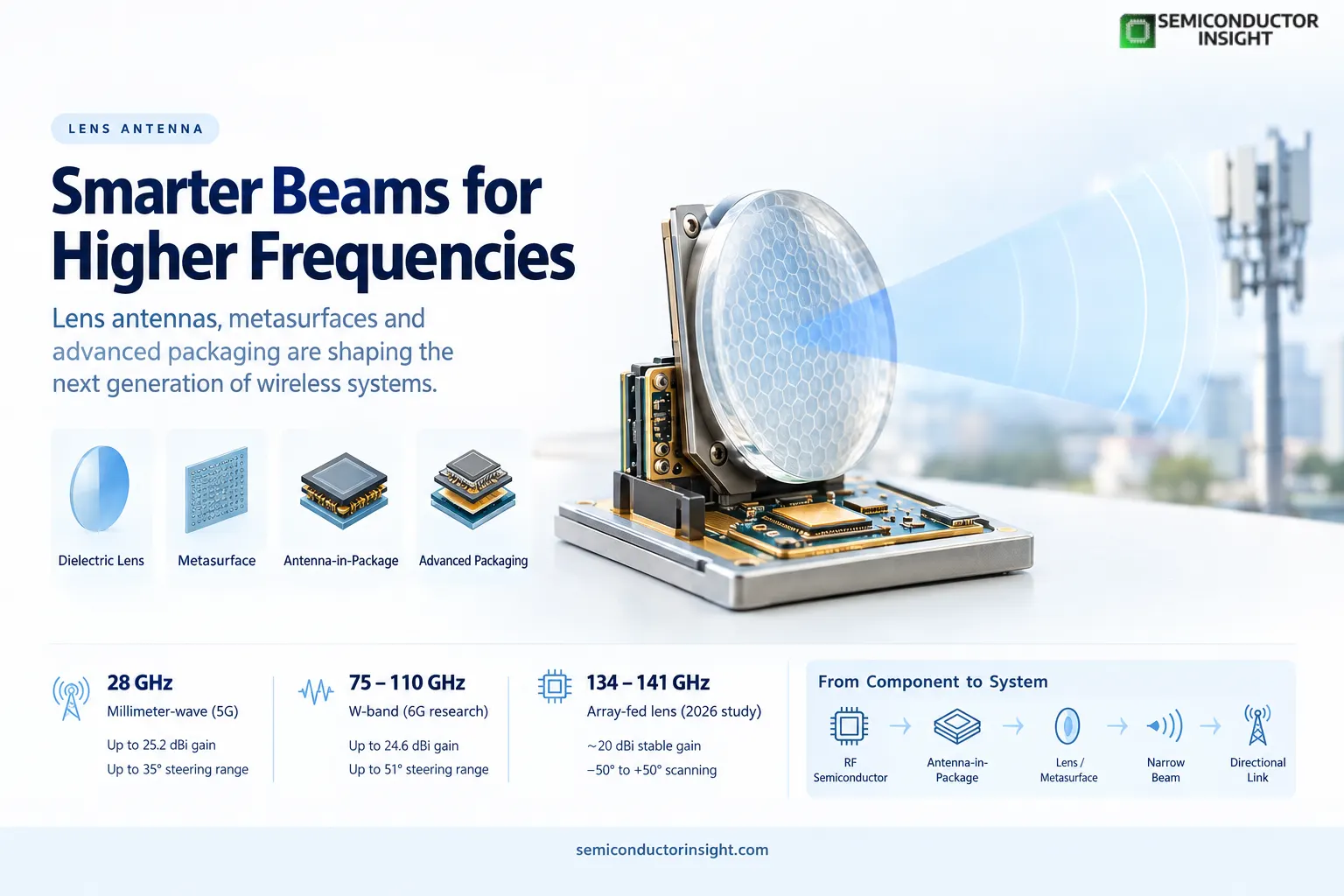
- A published 3D-printed dielectric-lens study demonstrated flat and stepped lens configurations operating at 28 GHz, with measured peak realized gains of 25.2 dBi and 24.8 dBi respectively.
- The same work demonstrated steering ranges reaching 20° and 35°, depending on the configuration.
- Another GRIN dielectric lens design was evaluated across 26 to 30.5 GHz, demonstrating how engineered refractive-index structures can be integrated with microstrip antennas for wideband millimeter-wave operation.
From Solid Dielectrics to Engineered Electromagnetic Surfaces
One of the most interesting changes is that the word “lens” no longer necessarily means a conventional curved dielectric object. Researchers are increasingly using flat lenses, gradient-index structures and metasurfaces to reproduce the focusing behaviour of traditional lenses while reducing physical thickness.
A 6G-oriented digital metasurface lens demonstrated the potential of this approach at W-band frequencies between 75 and 110 GHz. The 28 × 28 × 5 mm structure achieved a reported maximum gain of 24.6 dBi and beam steering of 51° at 110 GHz. The design used 3-bit quantized unit cells manufactured through additive techniques.
This combination of compact geometry, digital control and high-frequency operation is creating a new design path for future wireless hardware.
140 GHz Marks a Significant Research Step
A particularly current development comes from a 2026 IEEE study of an array-fed lens antenna operating across 134 to 141 GHz. The prototype combined an elliptical plastic lens with an antenna-in-package feed and demonstrated approximately 20 dBi stable gain across a scanning range from −50° to +50°. The reported design also used cavity-backed double-slot antenna elements and artificial dielectric layers integrated into package laminate.
The significance is not simply the operating frequency. Integrating the feed with the package brings the lens antenna closer to semiconductor and RF-module manufacturing rather than treating the antenna as a separate component.
The Beam Is Becoming the Product
The development pathway can be visualised as:
RF semiconductor → antenna-in-package feed → dielectric or metasurface lens → phase manipulation → narrow beam → directional wireless link
This architecture can be particularly useful where conventional wide-angle radiation is inefficient or where highly controlled beams are required for high-capacity communication and sensing.
Metasurface antenna research is also increasingly being discussed for 5G base stations, satellite communications and WLAN applications, while emerging 6G architectures are examining much larger electromagnetic apertures and more sophisticated beam management.
To find out more, feel free to browse our latest updated report: https://semiconductorinsight.com/report/global-lens-antenna-market/
Additive Manufacturing Is Changing the Physical Design Equation
- 3D printing is becoming more relevant because lens antennas often require geometries that are difficult or expensive to manufacture using conventional machining.
- Research demonstrated stereolithography-based fabrication of 28 GHz dielectric lens antennas, showing that complex lens topologies can be manufactured while maintaining high-frequency performance.
- This opens possibilities for lightweight structures, customised electromagnetic surfaces and rapid prototyping. It also makes material engineering increasingly important because dielectric constant, loss tangent, surface accuracy and dimensional stability directly influence antenna behaviour.
The Semiconductor Connection Is Moving Closer
The strongest technology shift is occurring where antennas, packaging and RF electronics are designed as one system. The 2026 140 GHz research is an example of this direction, with the antenna array integrated into package laminate and used to illuminate the lens.
At lower millimeter-wave frequencies, metasurface-inspired antenna structures are also demonstrating substantial bandwidth and gain. One 2025 study reported a four-port 28 GHz MIMO configuration covering 23.8 to 32.25 GHz, with 18.5 dBi peak gain and more than 55 dB isolation.
What Is Changing Inside the Lens Antenna Market?
The technology is gradually moving through several distinct stages:
Conventional dielectric lens → Flat/GRIN lens → Metasurface lens → Array-fed lens → Antenna-in-package lens → Dynamically controlled electromagnetic aperture
Each step reduces the separation between antenna engineering and semiconductor engineering.
For 5G, the immediate emphasis remains on high-gain millimeter-wave links and compact beamforming. For emerging 6G research, attention is extending toward W-band, sub-terahertz frequencies, intelligent surfaces and increasingly integrated RF architectures. The latest 140 GHz work illustrates how lens antennas are becoming compatible with the packaging technologies needed for these higher-frequency systems.
The lens antenna market is therefore developing around a broader transformation in wireless hardware: the antenna is no longer simply the final RF component attached to a device. It is increasingly being designed together with the semiconductor package, feed network, electromagnetic surface and beam-control architecture.

Comments (0)