
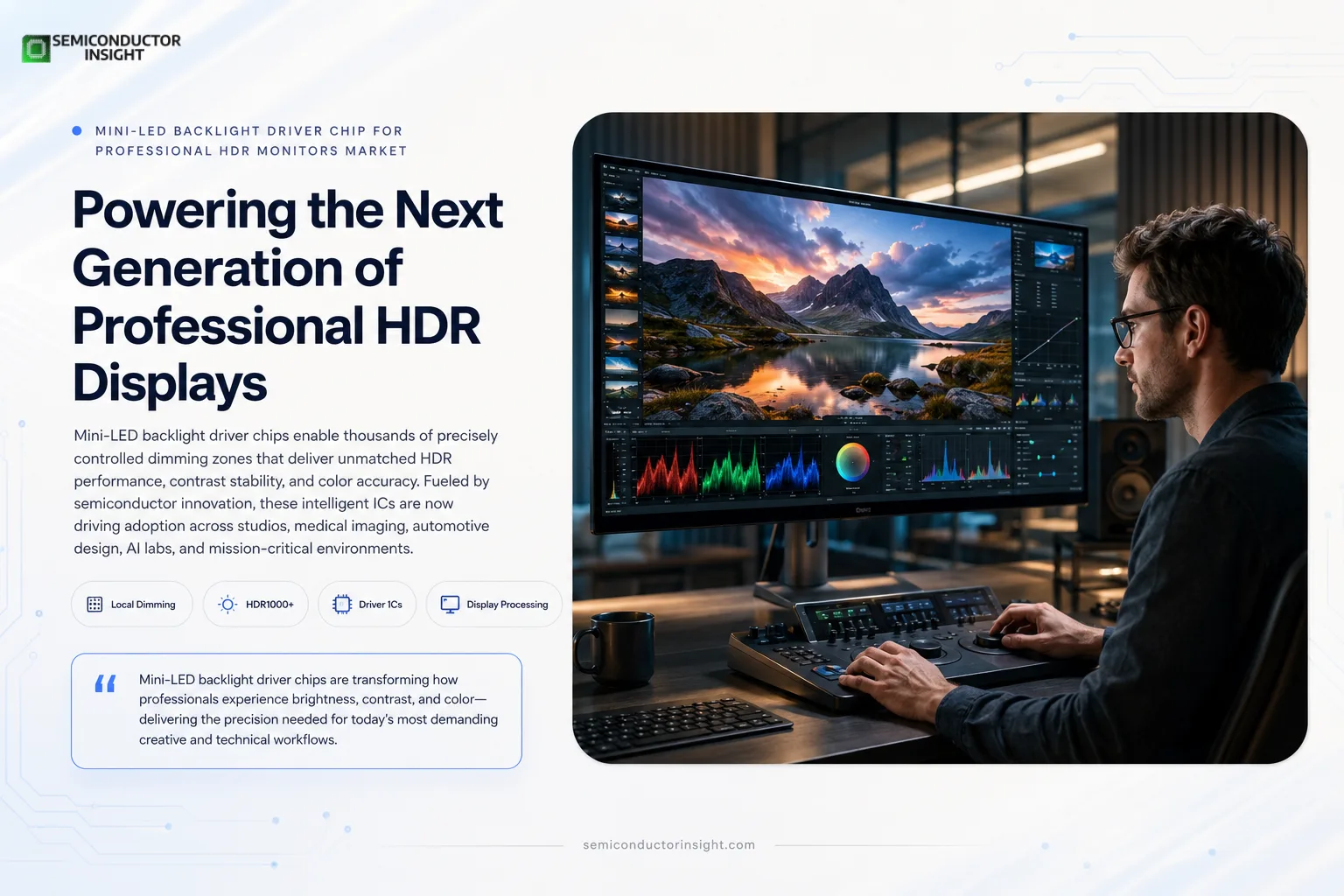
Is Mini-LED Backlight Driver Chip for Professional HDR Monitors Market Redefining Professional Color Accuracy?
Professional display technology has entered a new phase where image quality is measured not only by resolution but also by luminance precision, local dimming accuracy, contrast stability, and color fidelity. At the center of this transition is Mini-LED Backlight Driver Chip for Professional HDR Monitors Market, a semiconductor segment enabling thousands of individually controlled backlight zones that deliver exceptional HDR performance.
From film production studios and medical imaging centers to automotive design laboratories and artificial intelligence development environments, these driver chips have become essential for displays that require consistent brightness, deep blacks, and accurate color reproduction under demanding workflows.
Mini-LED backlight driver chips, in contrast to traditional LCD controllers, use complex current regulation and dimming algorithms to simultaneously manage hundreds to thousands of LEDs. Professional HDR monitors increasingly feature 1,152, 2,304, or more than 5,000 local dimming zones, allowing creators to visualize high-contrast scenes with minimal blooming effects. According to the Video Electronics Standards Association (VESA), DisplayHDR certification requires progressively higher peak luminance levels, with premium professional displays reaching 1,000 to 1,400 nits or beyond while maintaining stringent black-level performance.
To find out more, feel free to browse our latest updated report: https://semiconductorinsight.com/report/mini-led-backlight-driver-chip-for-professional-hdr-monitors-market/
Professional Display Performance Snapshot
Current premium display systems are measured against strong performance standards across brightness, color accuracy, and responsiveness. HDR peak brightness typically ranges from 1,000 to 1,400+ nits, while premium monitors often feature 1,152 to 5,000+ local dimming zones for better contrast and detail. Creator-focused displays commonly support 120 to 240 Hz refresh rates, along with 10-bit native color depth and color gamut coverage of up to 99% Adobe RGB or 99% DCI-P3, ensuring highly accurate and vivid visual output.
The importance of these driver chips extends beyond brightness management. Every Mini-LED array requires synchronized control over thousands of LEDs, ensuring uniform illumination without excessive heat generation or power fluctuations. Advanced driver ICs dynamically adjust current output in microseconds, balancing luminance, thermal efficiency, and energy consumption. This capability has become particularly valuable as monitor manufacturers continue increasing panel sizes while reducing power requirements.
Signal Processing Architecture
Image Processing Engine
│
▼
HDR Tone Mapping Processor
│
▼
Mini-LED Driver Chip
│
▼
Thousands of Local Dimming LEDs
│
▼
Professional HDR Display Panel
Recent product launches demonstrate how rapidly this ecosystem is evolving. During CES 2025, several manufacturers including ASUS, Dell, MSI, and Samsung showcased professional and creator-focused monitors integrating Mini-LED backlighting with ultra-high refresh rates and HDR capabilities. These displays target video editors, visual effects artists, AI engineers, architects, and broadcast professionals who require precise luminance control across extended production sessions. As workstation GPUs continue supporting advanced HDR workflows, demand for sophisticated driver ICs has expanded alongside monitor innovation.
Another significant trend is the integration of artificial intelligence into display processing. AI-enhanced display engines now optimize local dimming behavior based on scene recognition rather than relying solely on static algorithms. Driver chips receive predictive brightness instructions, improving shadow detail while reducing halo artifacts around bright objects. This combination of AI processing and semiconductor innovation enables more realistic HDR rendering without increasing hardware complexity.
Evolution of HDR Display Electronics
CCFL Backlighting → Edge-Lit LED → Full-Array Local Dimming → Mini-LED Backlighting → AI-Assisted Dynamic Mini-LED Control
Growing demand for AI infrastructure is also influencing professional monitor development. Engineers training large language models, semiconductor designers verifying integrated circuits, and data scientists visualizing massive datasets increasingly depend on multiple HDR displays capable of maintaining color consistency throughout extended operational periods. Mini-LED driver chips contribute by delivering stable brightness across prolonged workloads while minimizing thermal variation that could otherwise affect display uniformity.
Applications Benefiting from Mini-LED Driver Chips
- Across different professional sectors, display requirements vary depending on the type of work and the level of visual precision needed. Film and television production often requires HDR color grading, while medical imaging depends on diagnostic grayscale accuracy. In automotive design, surface visualization plays a key role, whereas semiconductor engineering relies on IC layout verification. Broadcasting teams need support for live HDR content monitoring, and AI and data science professionals often use multi-display visualization for better analysis and workflow efficiency.
- Supply chain diversification has also reshaped semiconductor manufacturing strategies. Governments in the United States, Japan, South Korea, Taiwan, and the European Union continue supporting domestic semiconductor fabrication through incentive programs designed to strengthen advanced electronics production. At the same time, display manufacturers increasingly source driver ICs from multiple fabrication partners to improve resilience against geopolitical disruptions and component shortages experienced during recent years.
- Mini-LED technology has simultaneously expanded into adjacent industries. Automotive cockpit displays, premium gaming monitors, aviation simulation systems, and industrial visualization platforms now require compact driver chips capable of supporting higher LED densities while reducing electromagnetic interference. These applications demand exceptional reliability because display failures can directly affect operational performance or decision-making environments.
Technology Integration Path
Wafer Fabrication
↓
Driver IC Packaging
↓
Display Module Assembly
↓
Mini-LED Backlight Integration
↓
Professional HDR Monitor Validation
↓
Creative and Industrial Deployment
Rather than serving merely as display control components, Mini-LED backlight driver chips have become intelligent power management and image optimization platforms. As HDR standards continue advancing, display resolutions increase, and AI-assisted visual computing becomes mainstream, semiconductor innovation within these compact ICs is quietly enabling the precision, consistency, and reliability expected from the world’s most demanding professional display environments.

Comments (0)