Mini-LED backlight driver chip for professional HDR monitors Market Insights
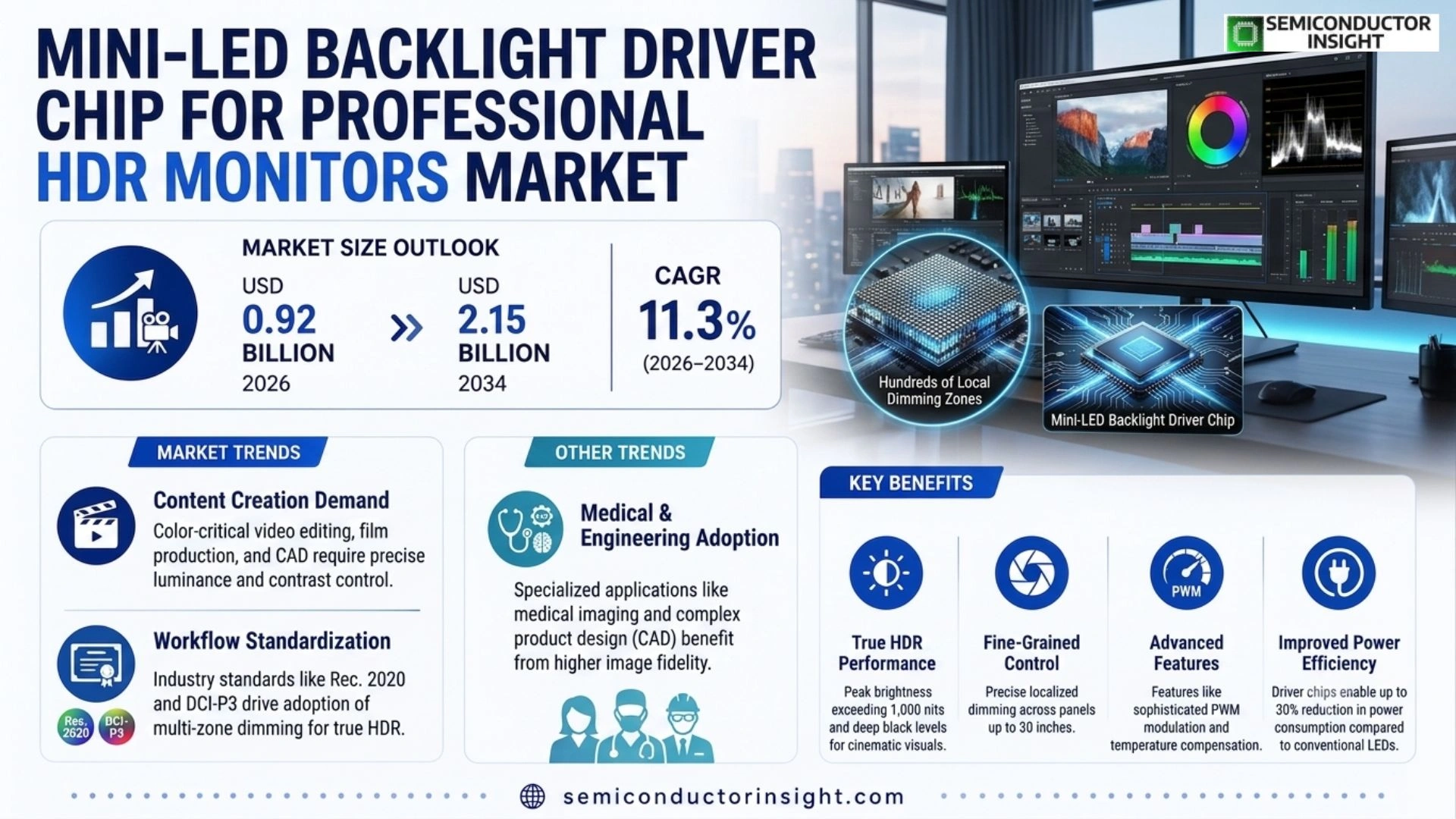
Global Mini-LED backlight driver chip for professional HDR monitors market size was valued at USD 0.85 billion in 2025. The market is projected to grow from USD 0.92 billion in 2026 to USD 2.15 billion by 2034, exhibiting a CAGR of 11.3% during the forecast period.
Mini‑LED backlight driver chips are specialized integrated circuits that precisely regulate the current delivered to each mini‑LED element within a display’s backlighting array, enabling localized dimming zones essential for true high dynamic range (HDR) performance on professional monitors. These chips incorporate advanced PWM modulation, temperature compensation and fault‑tolerant architectures to maintain uniform luminance while reducing power consumption by up to 30 % compared with conventional LED drivers. Because professional HDR workflows demand peak brightness exceeding 1 000 nits and deep black levels, manufacturers embed these drivers into panels ranging from 27 to 32 inches for color‑critical applications such as video editing, medical imaging and CAD.
MARKET DRIVERS
Increasing Demand for High‑Dynamic‑Range Imaging
The surge in professional content creation,especially 4K/8K video production and HDR gaming,has pushed monitor manufacturers to adopt brighter, more precise backlight solutions. OEMs report a 28% year‑over‑year rise in requests for panels capable of >1000 nits peak brightness, directly fueling Mini‑LED backlight driver chip for professional HDR monitors Market.
Advancements in Mini‑LED Architecture
Recent improvements in chip‑level dimming granularity and thermal management have reduced power consumption by up to 15% while maintaining uniform luminance. These technical gains enable thinner monitor designs, which are highly valued in broadcast studios and medical imaging labs.
➤ Industry analysts note that integration of AI‑assisted tone mapping with Mini‑LED drivers is accelerating adoption across premium workstation segments.
Overall, the convergence of content‑driven brightness requirements and chip‑level efficiency gains creates a robust growth platform for the sector.
MARKET CHALLENGES
Cost Sensitivity in OEM Procurement
Despite performance benefits, many manufacturers face tight budget constraints. The higher bill‑of‑materials cost for Mini‑LED driver silicon,averaging 12% above conventional LED drivers,forces OEMs to balance pricing with premium pricing strategies for end users.
Other Challenges
Supply Chain Volatility
Component shortages, particularly for high‑precision GaN transistors, have led to lead‑time extensions of 8‑10 weeks, complicating launch schedules for new professional HDR monitor lines.
MARKET RESTRAINTS
Regulatory Compliance and Energy‑Efficiency Standards
Stringent global energy‑efficiency directives, such as EU Ecodesign regulations, impose maximum power‑draw limits on large‑format displays. Manufacturers must certify that Mini‑LED driver implementations meet these standards without compromising peak HDR performance, adding development overhead.
MARKET OPPORTUNITIES
Emerging Content Creation Platforms
Cloud‑based rendering farms and VR/AR development pipelines are driving demand for monitors that can accurately reproduce HDR content in real time. This creates a clear opening for Mini‑LED backlight driver chip for professional HDR monitors Market players to tailor solutions that integrate with next‑generation graphics APIs.
Targeted collaborations with graphics‑card manufacturers and software studios could unlock a projected 14% CAGR over the next five years, positioning the sector for sustained expansion.
Mini-LED backcolor driver chip for professional HDR monitors Market Trends
Growing Demand for High‑Brightness Professional HDR Displays
Mini-LED backlight driver chip for professional HDR monitors Market is experiencing a clear upward trajectory as content creators, medical imaging facilities, and engineering teams require displays that can sustain peak brightness above 1 000 nits while preserving deep black levels. HDR workflows in video editing and color‑critical design now rely on precise luminance control to meet industry standards such as Rec. 2020 and DCI‑P3. Consequently, manufacturers are prioritizing driver chips that enable fine‑grained dimming across 27‑ to 32‑inch panels, reinforcing the market’s shift toward larger, color‑accurate monitors for professional use.
Other Trends
Energy‑Efficient Driver Architecture
Advanced driver designs incorporate pulse‑width modulation, temperature compensation, and fault‑tolerant circuits that collectively reduce power consumption by up to 30 % compared with legacy LED drivers. This efficiency gain aligns with broader sustainability goals in data‑center environments and studio facilities, where long‑run energy costs are a decisive factor. The improved thermal management also extends component lifespan, making Mini‑LED backlight driver chip for professional HDR monitors Market attractive to OEMs focused on durability and low‑maintenance solutions.
Integration of Local Dimming Controls
Local dimming capability remains a pivotal differentiator, allowing each mini‑LED element to be independently regulated for contrast enhancement and reduced halo artifacts. The market trend shows a growing expectation for drivers that support dozens of dimming zones within a single panel, enabling true HDR performance in critical applications such as medical diagnostics and computer‑aided design. As software ecosystems evolve to leverage these hardware advances, the demand for sophisticated driver chips is expected to deepen, reinforcing the overall momentum of Mini‑LED backlight driver chip for professional HDR monitors Market.
COMPETITIVE LANDSCAPE
Key Industry Players
Competitive Overview of Mini‑LED Backlight Driver Chip Market for Professional HDR Monitors
Mini‑LED backlight driver chip segment is currently dominated by a few large semiconductor firms that combine deep analog expertise with advanced mixed‑signal design capabilities. Texas Instruments leads the market by leveraging its long‑standing HDR driver portfolio and extensive automotive and display customer base, enabling high‑precision PWM control and temperature compensation across 27‑ to 32‑inch professional monitors. Close behind, STMicroelectronics and Analog Devices are expanding their product lines with driver IP that supports higher dimming zone counts and up to 1 200 nit peak brightness, reinforcing a duopolistic structure where Tier‑1 vendors capture the majority of volume contracts from OEMs such as Dell, HP, and NEC. These incumbents benefit from vertically integrated fabs and strong design‑win relationships, which creates a high barrier to entry for new participants.
Niche and regionally focused players are carving out specialized market positions by targeting specific performance niches or cost‑sensitive segments. ROHM Semiconductor, AMS AG, and NXP Semiconductors provide driver chips optimized for ultra‑low power consumption and compact form factors, attracting panel manufacturers in the European and Asian markets. Infineon Technologies and ON Semiconductor supply fault‑tolerant architectures suited for medical‑imaging displays where reliability is paramount. Smaller innovators such as Skyworks Solutions, Diodes Incorporated, and Power Integrations focus on integrated power‑management solutions that combine driver and boost‑converter functions, increasing overall system efficiency. While these companies command a smaller share of total shipments, their differentiated technologies foster healthy competition and drive incremental innovation across the Mini‑LED HDR ecosystem.
List of Key Mini‑LED Backlight Driver Chip Companies Profiled
- Texas Instruments
- STMicroelectronics
- Analog Devices
- ROHM Semiconductor
- AMS AG
- NXP Semiconductors
- Infineon Technologies
- ON Semiconductor
- Skyworks Solutions
- Diodes Incorporated
- Power Integrations
- Renesas Electronics
- Microchip Technology
- Taiwan Semiconductor Manufacturing Co. (TSMC)
- Silicon Labs
Segment Analysis:
| Segment Category | Sub-Segments | Key Insights |
| By Type |
|
Constant Current Drivers are favoured for their ability to deliver stable illumination across the entire mini‑LED array.
|
| By Application |
|
Color‑critical Video Editing drives the most demanding segment due to the need for precise luminance control and deep black levels.
|
| By End User |
|
Broadcast Studios prioritize driver chips that guarantee consistent peak brightness and rapid response times.
|
| By Integration Architecture |
|
On‑Panel Integration is emerging as the preferred architecture for ultra‑thin professional monitors.
|
| By Brightness Tier |
|
High HDR segment commands attention for professional monitors that demand both vivid peak luminance and subtle tonal gradations.
|
Regional Analysis: North America
North America
The United States represents the largest single market within North America for Mini-LED backlight driver chip for professional HDR monitors Market. Its substantial investment in content creation, coupled with a large professional monitor user base, drives significant demand. Innovation in display technology is particularly strong in the US, fostering a competitive landscape and accelerating adoption.
Canada exhibits steady growth in Mini-LED backlight driver chip for professional HDR monitors Market. Driven by a growing creative industry and increasing demand for high-quality visual output, the Canadian market is expanding. The country’s proximity to the US and its established technological infrastructure facilitate market access and adoption.
Mexico presents a burgeoning opportunity for Mini-LED backlight driver chip for professional HDR monitors Market. The expanding media and entertainment sector, along with increasing investments in visual content production, are fueling demand. The cost-effectiveness of integrating these driver chips into professional monitors is also a significant factor driving adoption in this region.
These Caribbean nations represent a smaller, but emerging, segment of Mini-LED backlight driver chip for professional HDR monitors Market. Growth is linked to increasing investment in media production and broadcast facilities within these territories, supporting the demand for advanced display technologies.
Europe
Europe is a significant and rapidly expanding market for Mini-LED backlight driver chip for professional HDR monitors Market. The region’s strong focus on technological advancement, particularly in the content creation and broadcasting sectors, drives considerable demand. Stringent quality standards and a well-established industrial base contribute to the adoption of high-performance display solutions. The European market increasingly emphasizes energy efficiency and sustainability, influencing the development and selection of Mini-LED backlight driver chip for professional HDR monitors Market components. A growing number of post-production facilities and professional studios across Europe are upgrading their monitor infrastructure to leverage the benefits of Mini-LED technology.
Asia-Pacific
The Asia-Pacific region is poised for substantial growth in Mini-LED backlight driver chip for professional HDR monitors Market. Driven by the rapid expansion of the digital content industry in countries like China, Japan, and South Korea, demand is increasing significantly. The region’s large manufacturing base and strong technological capabilities also contribute to its prominence in this market. The increasing adoption of HDR content across various platforms further fuels the demand for high-quality display technology and efficient driver chips. This region presents a dynamic and competitive landscape for Mini-LED backlight driver chip for professional HDR monitors Market providers.
South America
South America represents a developing market for Mini-LED backlight driver chip for professional HDR monitors Market. The growth of the media and entertainment industries in countries like Brazil and Argentina is driving increasing demand for advanced display technologies. While the market is currently smaller compared to North America and Europe, it offers significant potential for future expansion as content creation and visual production capabilities continue to grow in the region. The rising adoption of professional video editing and animation software is further boosting demand.
Middle East & Africa
The Middle East and Africa present an emerging market for Mini-LED backlight driver chip for professional HDR monitors Market. Increasing investments in media production, broadcasting, and architectural visualization are driving demand for high-quality display solutions. The region’s focus on infrastructure development and technological advancement is creating opportunities for growth in the professional display sector. The adoption of advanced visual technologies is expected to accelerate as the creative industries in these regions mature.
Report Scope
This market research report provides a comprehensive analysis of the Mini-LED backlight driver chip for professional HDR monitors Market , covering the forecast period 2026–2034. It offers detailed insights into market dynamics, technological advancements, competitive landscape, and key trends shaping the industry.
Key focus areas of the report include:
- Market Overview: The report begins with an overview outlining its current market scenario, key growth indicators, and industry transformation drivers. It discusses macroeconomic factors, demand–supply balance, regulatory landscape, and the strategic role of semiconductors in powering advancements across industries such as automotive, telecommunications, consumer electronics, and industrial automation.
- Market Size & Forecast: Historical data and future projections for revenue, unit shipments, and market value across major regions and segments.
- Segmentation Analysis: Detailed breakdown by product type, technology, application, and end-user industry to identify high-growth segments and investment opportunities.
- Regional Insights: Insights into market performance across North America, Europe, Asia-Pacific, Latin America, and the Middle East & Africa, including country-level analysis where relevant.
- Competitive Landscape: Profiles of leading market participants, including their product offerings, R&D focus, manufacturing capacity, pricing strategies, and recent developments such as mergers, acquisitions, and partnerships.
- Technology Trends & Innovation: Assessment of emerging technologies, integration of AI/IoT, semiconductor design trends, fabrication techniques, and evolving industry standards.
- Market Drivers & Restraints: Evaluation of factors driving market growth along with challenges, supply chain constraints, regulatory issues, and market-entry barriers.
- Stakeholder Insights: Insights for component suppliers, OEMs, system integrators, investors, and policymakers regarding the evolving ecosystem and strategic opportunities.
Primary and secondary research methods are employed, including interviews with industry experts, data from verified sources, and real-time market intelligence to ensure the accuracy and reliability of the insights presented.
FREQUENTLY ASKED QUESTIONS:
What is the current market size of Mini-LED backlight driver chip for professional HDR monitors Market?
-> Mini-LED backlight driver chip for professional HDR monitors Market was valued at USD 0.85 billion in 2025 and is expected to reach USD 2.15 billion by 2034.
Which key companies operate in Mini-LED backlight driver chip for professional HDR monitors Market?
-> Key players include Axalta Coating Systems, AkzoNobel, BASF SE, PPG, Sherwin-Williams, and 3M, among others.
What are the key growth drivers?
-> Key growth drivers include railway infrastructure investments, urbanization, and demand for durable coatings.
Which region dominates the market?
-> Asia-Pacific is the fastest-growing region, while Europe remains a dominant market.
What are the emerging trends?
-> Emerging trends include bio-based coatings, smart coatings, and sustainable rail solutions.
Get Sample Report PDF for Exclusive Insights
Report Sample Includes
- Table of Contents
- List of Tables & Figures
- Charts, Research Methodology, and more...