

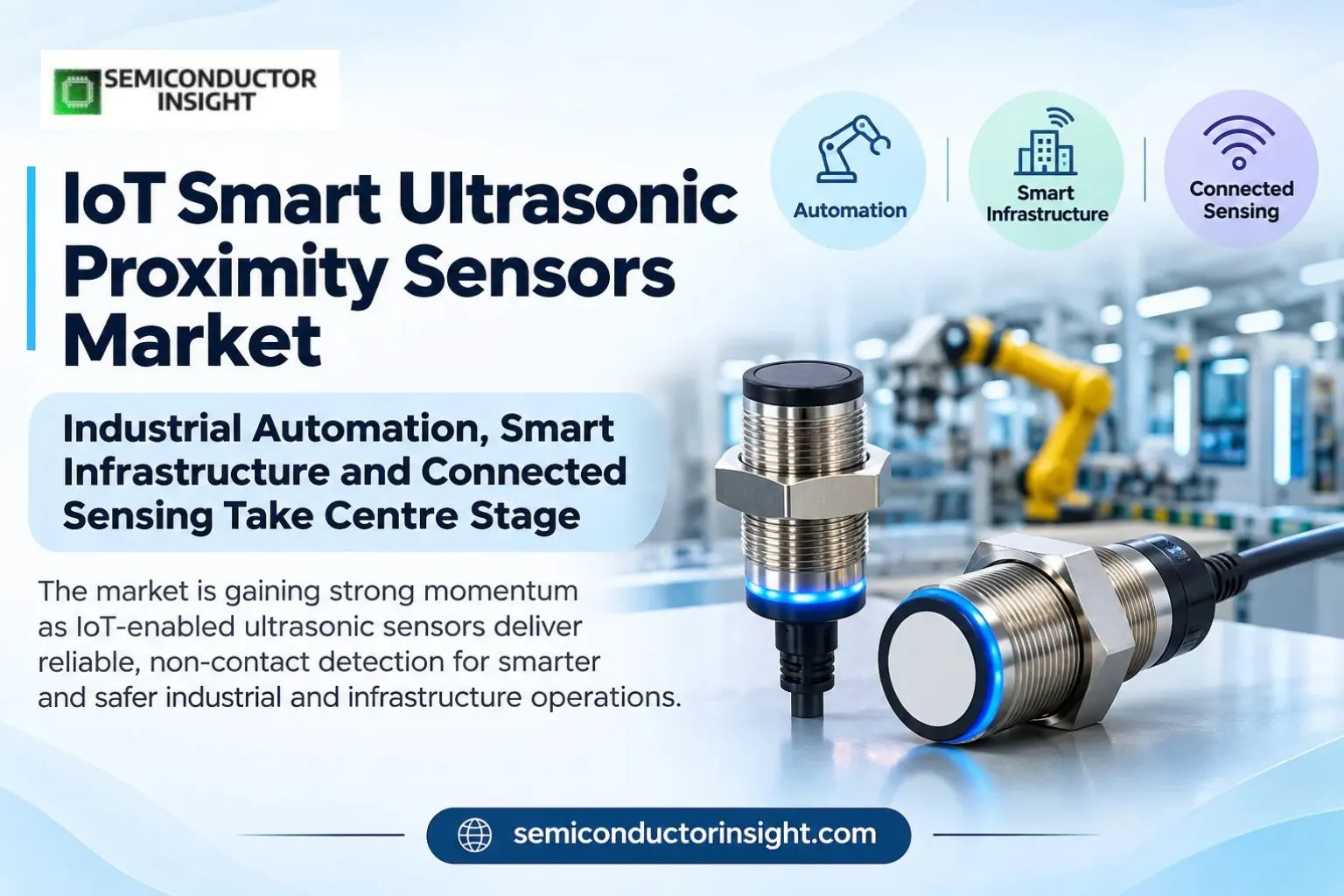
IoT Smart Ultrasonic Proximity Sensors Market in 2026: Industrial Automation, Smart Infrastructure and Connected Sensing Take Centre Stage
Ultrasonic proximity sensors are moving beyond basic object detection. Their growing integration with microcontrollers, signal-conditioning circuits, wireless communication modules and cloud-connected platforms is turning them into intelligent sensing devices for industrial and infrastructure applications. Instead of simply identifying whether an object is nearby, newer systems can measure distance, monitor changing conditions and transmit information to remote operators.
- The technology works by emitting high-frequency sound waves and measuring the time taken for the reflected signal to return.
- This makes ultrasonic sensing useful where optical detection may be affected by dust, changing surface colours or low-light conditions.
- Semiconductor components are central to this process, including piezoelectric transducer drivers, analogue front ends, timers, processors, power-management ICs and wireless connectivity chips.
Why the Sensor Architecture Is Becoming More Important?
The value of a smart ultrasonic sensor increasingly depends on how effectively its electronic components work together. A modern sensing node may combine a transducer, signal-processing circuit, microcontroller, temperature sensor, power-management unit and communication interface.
This architecture is particularly relevant for industrial installations where sensors must operate for long periods without frequent maintenance. Manufacturers are focusing on lower-power electronics, compact circuit designs, improved echo processing and more reliable wireless communication. These developments are also creating opportunities for semiconductor suppliers involved in mixed-signal ICs, embedded processors, connectivity modules and sensor-interface technologies.
LoRaWAN Is Extending the Reach of Ultrasonic Monitoring
- Wireless connectivity is changing where ultrasonic sensors can be installed. A useful example comes from C-DAC Hyderabad’s UltraSmart device, which combines ultrasonic distance measurement with a temperature sensor, a 3-axis accelerometer and LoRaWAN
- Its published specifications include a detection range of 2–800 cm, 1 mm distance resolution and an IP67-rated enclosure. The device also supports optional GNSS tracking and is designed for applications such as smart parking, waste-bin monitoring and water-level measurement. Its stated battery life can reach up to 10 years, depending on the application.
- This illustrates how ultrasonic technology is becoming part of wider IoT infrastructure. Similar architectures can support remote tank monitoring, inventory management, automated waste collection and industrial equipment supervision.
Automotive Sensing Gets a New Interface Standard
Automotive applications remain an important area for ultrasonic proximity detection, particularly in parking assistance, low-speed manoeuvring and automated parking systems. These applications require sensors to communicate reliable object-distance information to vehicle control and data-fusion systems.
A significant development arrived in June 2026, when the International Organization for Standardization published ISO 23150-14:2026. The standard defines ultrasonic-specific logical interfaces for automated-driving sensor systems, covering feature-level, advanced-detection-level and detection-level interfaces.
This is relevant to semiconductor design because consistent sensor communication requires dependable interface circuitry, embedded processing and system-level integration. It also signals that ultrasonic sensing continues to have a defined role in evolving automotive perception architectures.
Our most recent updated related study is available for free at this link: https://semiconductorinsight.com/report/iot-smart-ultrasonic-proximity-sensors-market/
Tesla’s SiC Adoption and Shift to Camera-Based Sensing
- Tesla’s Model 3 illustrates two distinct automotive technology choices: silicon carbide (SiC) power electronics and camera-based proximity sensing.
- Its traction inverter uses SiC MOSFETs to manage high-voltage power conversion between the battery and motor, with teardown findings and US National Highway Traffic Safety Administration documentation describing the technology and inverter architecture.
- SiC supports efficient power switching, whereas ultrasonic sensors use transducers and signal-processing electronics to detect nearby objects.
- In previous year, Tesla began removing ultrasonic sensors from most Model 3 and Model Y vehicles, replacing earlier configurations commonly featuring 12 sensors with camera-based Tesla Vision.
- This shift highlights differing approaches to vehicle sensing, as other automakers continue using ultrasonic technology for parking and driver assistance.
Industrial Monitoring Is Creating More Connected Use Cases
In manufacturing plants, ultrasonic sensors can detect the presence of objects on conveyors, monitor liquid levels, identify obstructions and support automated positioning. Connecting these devices to industrial networks allows measurements to be used for maintenance alerts, process adjustments and remote monitoring.
The next opportunity lies in combining ultrasonic readings with temperature, vibration and other sensor inputs. A system that detects distance changes alongside equipment movement, for example, can provide more context than a standalone proximity switch. This makes multi-sensor integration, edge processing and dependable communication important areas of semiconductor development.
The Next Design Priority Is Reliable Sensor Data
As ultrasonic sensing becomes more connected, accurate measurement alone is no longer enough. Manufacturers must also consider communication reliability, environmental interference, calibration, cybersecurity and power consumption. A 2026 SAE technical paper on automotive ultrasonic sensors specifically examines cybersecurity risks and the effects of physical manipulation on sensor measurements.
For semiconductor companies, this creates a broader design opportunity involving secure microcontrollers, protected communication interfaces, signal-processing ICs and efficient power-management components. The direction of the market is increasingly defined by how well these devices connect physical measurements with intelligent, dependable decision-making.

Comments (0)