
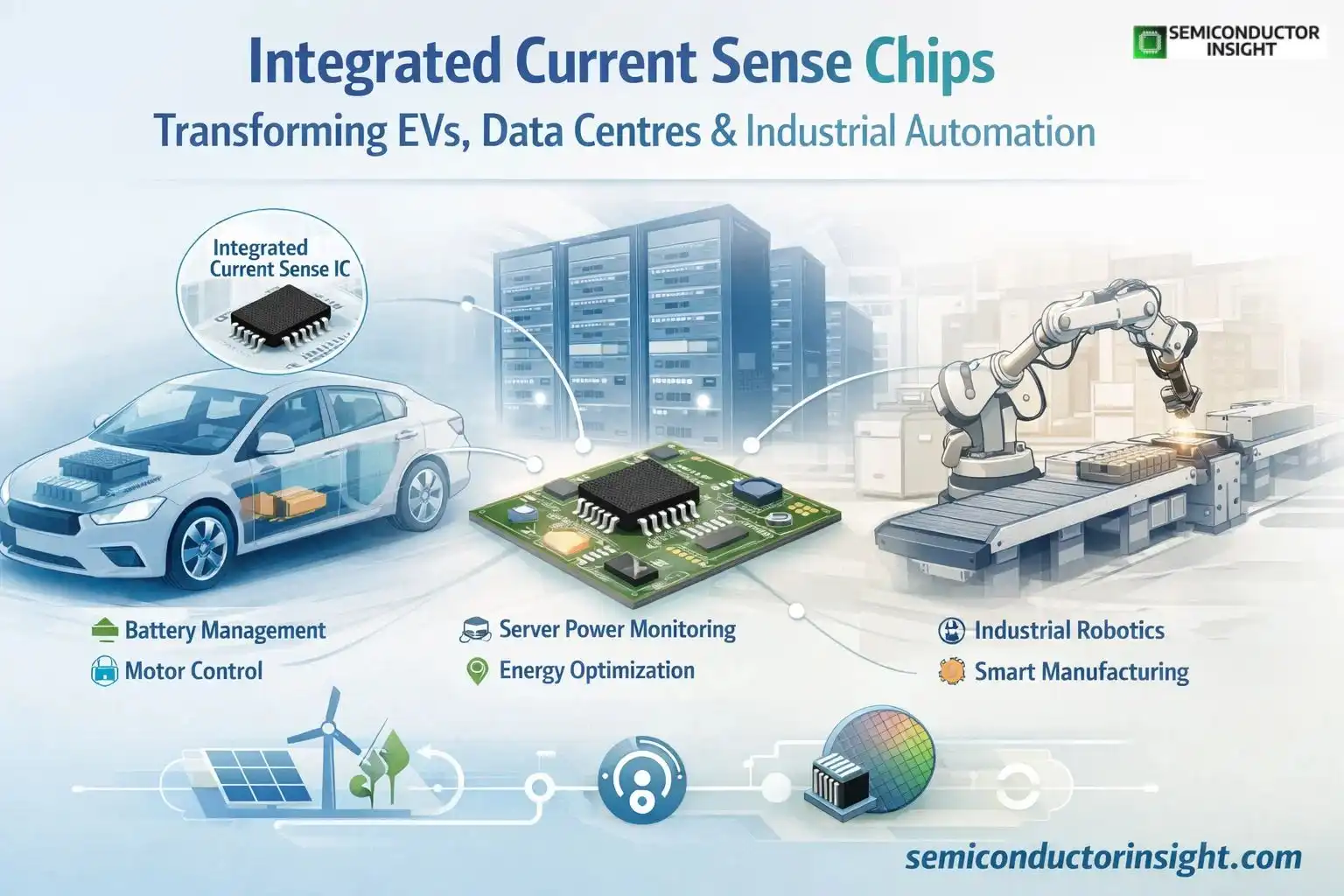
Integrated Current Sense Chip Trends Transforming EVs, Data Centres, and Industrial Automation
The modern electronics ecosystem runs on precision. From electric vehicles to hyperscale servers, power must not only be delivered it must be measured, controlled, and optimized. This is where the Integrated Current Sense Chips Market has carved out a powerful and fast-expanding position within the semiconductor landscape.
Integrated current sense ICs are different from traditional discrete shunt resistors that work with amplifiers because they put sensing elements and signal conditioning into one small package. This reduces board space, improves accuracy, and simplifies design complexity. In high-density systems where millimetres matter, this level of integration is becoming indispensable.
According to technical documentation and application notes published by leading semiconductor manufacturers and IEEE engineering articles, integrated solutions can improve measurement accuracy by up to 20% compared to discrete implementations while significantly reducing external component count.
The Shift from Discrete Components to Smart Current Monitoring
In earlier power architectures, engineers relied heavily on external shunt resistors paired with operational amplifiers. While functional, these setups introduced offset errors, thermal drift, and layout challenges. As power densities increased in electric mobility and cloud infrastructure, these limitations became more pronounced.
Today, manufacturers such as Texas Instruments and Analog Devices offer highly integrated current sense amplifiers with built-in protection features and digital interfaces. Some variants now support I²C or SPI communication, enabling direct system-level monitoring without complex analog calibration.
In electric vehicle battery management systems, precise current sensing is essential for state-of-charge estimation and thermal safety. Government-backed EV technical papers highlight that accurate current monitoring can improve battery efficiency by nearly 10% in real-world driving cycles.
Semiconductor Miniaturization Meets Energy Transparency
One of the strongest trends shaping this market is miniaturization. Consumer electronics, industrial robotics, and telecom equipment are shrinking in size while increasing in power density. Integrated sensing chips address both constraints simultaneously.
For example, in server motherboards designed for AI workloads, current must be monitored across multiple voltage rails. Data centre energy reports published by the U.S. Department of Energy indicate that servers account for roughly 40% of data centre electricity consumption. Accurate rail-level current tracking helps reduce unnecessary power draw and improves load balancing.
Integrated solutions also reduce parasitic inductance and improve signal integrity critical in high-frequency switching regulators. This level of design refinement aligns with broader semiconductor integration trends seen across advanced packaging and power IC development.
Electric Vehicles Driving Precision Demand
Electrification is one of the strongest real-world catalysts behind the Integrated Current Sense IC space. Modern EV platforms contain dozens of sensing points across battery packs, inverters, onboard chargers, and auxiliary subsystems.
Companies such as Infineon Technologies and STMicroelectronics have introduced automotive-grade current sense ICs compliant with AEC-Q100 standards. Automotive engineering case studies show that reliable current sensing directly supports overcurrent protection and functional safety compliance under ISO 26262 frameworks.
In 2023 and 2024 technical automotive publications noted that EV battery packs typically incorporate over 15 to 25 dedicated current sensing nodes depending on architecture complexity. This volume scale alone significantly amplifies semiconductor demand.
Industrial Automation and Robotics Integration
Industrial automation systems require constant monitoring of motor currents, power supplies, and programmable logic controllers. In smart factories, predictive maintenance relies heavily on current trend analysis to detect anomalies before mechanical failure.
Articles from automation-focused engineering magazines report that unplanned industrial downtime can be reduced by nearly 30% when real-time electrical monitoring systems are integrated into production lines. Integrated sensing chips play a direct role in this transformation by enabling compact, reliable current feedback loops inside motor drives and servo controllers.
The growth of Industry 4.0 infrastructure, especially in Asia-Pacific manufacturing hubs, continues to expand deployment volumes of precision sensing semiconductors.
Please Take a Look at Our Updated Report before Continuing: https://semiconductorinsight.com/report/integrated-current-sense-chip-market/
Battery Management Systems and Renewable Integration
Energy storage systems for solar and wind applications demand tight current measurement accuracy to maintain battery lifespan and prevent thermal stress. In lithium-ion battery packs, even small sensing inaccuracies can accumulate into significant state estimation errors.
Research published in renewable energy journals indicates that optimized battery monitoring can extend usable battery life cycles by up to 15%. Integrated sensing ICs reduce temperature drift and noise interference, supporting this performance improvement.
With global renewable capacity installations increasing year after year, integrated sensing technology has quietly become an enabling semiconductor building block behind grid-level storage and residential energy systems.
Packaging Innovation and Thermal Optimization
Another overlooked dimension of the market lies in packaging evolution. Integrated current sense chips often use low-resistance copper lead frames and advanced thermal pad designs to manage heat efficiently.
Semiconductor fabrication articles note that modern current sense ICs can operate reliably in temperature ranges exceeding 125°C in automotive environments. This thermal resilience directly correlates with silicon process refinement and packaging optimization.
As power electronics migrate toward wide-bandgap materials such as silicon carbide, accurate current feedback becomes even more critical. Integrated sensing solutions complement these next-generation power devices by delivering stable, low-noise measurements under high switching frequencies.
The Silent Backbone of Power-Aware Electronics
While processors and memory dominate semiconductor headlines, the Integrated Current Sense Chip market operates as a quiet yet foundational enabler of system intelligence. Every efficient EV, optimized data center rack, advanced industrial robot, and renewable battery pack relies on precise current insight.
With electrification accelerating across transport, infrastructure, and digital systems, demand for compact, reliable, and high-accuracy sensing ICs continues to expand. What was once a supporting analog component has evolved into a strategic semiconductor building block central to power transparency and system reliability.
In a world increasingly defined by energy optimization and high-density electronics, integrated current sense chips are no longer optional they are engineered into the future of intelligent power design.

Comments (0)