
Market Insights
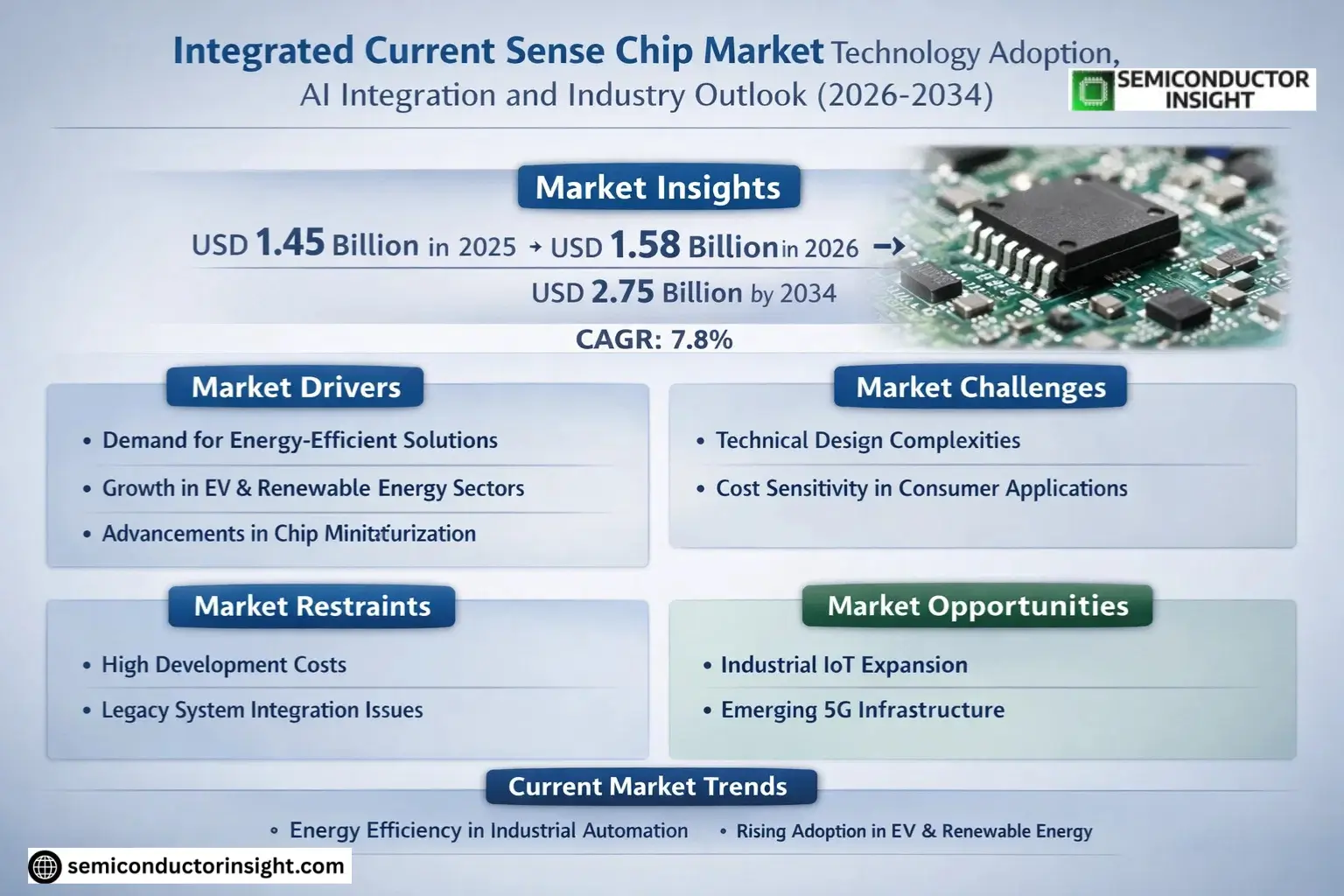
Global Integrated Current Sense Chip Market size was valued at USD 1.45 billion in 2025. The market is projected to grow from USD 1.58 billion in 2026 to USD 2.75 billion by 2034, exhibiting a CAGR of 7.8% during the forecast period.
Integrated current sense chips are semiconductor devices designed to measure and monitor electrical current flow in circuits with high precision. These components integrate sensing elements, amplifiers, and signal conditioning circuits into a single package, enabling accurate real-time current measurement in applications such as power management, motor control, and battery monitoring.
The market growth is driven by increasing demand for energy-efficient systems across industries, particularly in electric vehicles and renewable energy infrastructure. While automotive electrification presents significant opportunities, challenges persist in achieving higher accuracy at lower costs. Recent developments include Texas Instruments’ introduction of ultra-precise bidirectional current sensors with integrated shunt resistors in Q1 2024.
MARKET DRIVERS
Increasing Demand for Energy-Efficient Solutions
Global Integrated Current Sense Chip Market is experiencing significant growth due to rising demand for energy-efficient power management systems. With industries focusing on sustainability, these chips play a crucial role in optimizing power consumption across various applications.
Growth in EV and Renewable Energy Sectors
Electric vehicle adoption and renewable energy installations are driving demand for precise current monitoring solutions. Integrated Current Sense Chips are essential for battery management systems and solar inverters, with the market expected to grow at 8.2% CAGR through 2028.
Technological advancements in chip miniaturization and accuracy are further accelerating market adoption across multiple industries.
MARKET CHALLENGES
Technical Design Complexities
Developing Integrated Current Sense Chips that maintain accuracy while reducing footprint presents significant engineering challenges. Thermal management and noise immunity remain persistent issues in high-current applications.
Other Challenges
Cost Sensitivity in Consumer Applications
While industrial sectors tolerate premium-priced components, consumer electronics manufacturers demand low-cost solutions, creating pricing pressure for chip vendors.
Supply Chain Constraints
The semiconductor shortage continues to impact lead times, with Integrated Current Sense Chips facing 18-24 week delivery periods for some configurations.
MARKET RESTRAINTS
High Development Costs
The specialized nature of Integrated Current Sense Chip development requires substantial R&D investment, with new product development cycles averaging 12-18 months. This creates a significant barrier for new market entrants.
Legacy System Integration Issues
Many industrial facilities continue to use older monitoring systems that aren’t compatible with modern Integrated Current Sense Chips, slowing replacement cycles in some sectors.
MARKET OPPORTUNITIES
Expansion in Industrial IoT Applications
The growth of industrial IoT presents significant opportunities for Integrated Current Sense Chip manufacturers. Smart factories require thousands of current monitoring points, driving demand for compact, networked solutions.
Emerging 5G Infrastructure
5G base stations and network equipment require sophisticated power management, creating new applications for high-accuracy current sensing technology. The telecom sector is projected to represent 22% of new chip demand by 2026.
Integrated Current Sense Chip Market Trends
Growing Demand for Energy Efficiency in Industrial Automation
Integrated Current Sense Chip Market is experiencing significant growth due to rising demand for energy-efficient solutions in industrial automation. Manufacturers increasingly adopt these chips to monitor current flow accurately, reducing power wastage and optimizing system performance. Leading players like Texas Instruments and Analog Devices are innovating high-precision chips to meet industry requirements.
Other Trends
Expansion in New Energy Vehicle Applications
Integrated Current Sense Chips are becoming critical components in electric vehicle powertrains and battery management systems. Their ability to provide real-time current monitoring supports safer and more efficient energy usage, driving adoption among automotive OEMs and Tier-1 suppliers.
Emergence of Digital Signal Integration
The market is witnessing a gradual shift from analog to digital signal-based current sense chips, offering improved noise immunity and higher accuracy. Companies like STMicroelectronics and NXP are developing advanced digital solutions with integrated ADCs to simplify system design in complex applications.
Increasing Miniaturization Challenges
As manufacturers push for smaller form factors in electronic devices, current sense chip providers face technical challenges in maintaining accuracy while reducing footprint. This trend is accelerating R&D investments in novel packaging technologies and integrated solutions among key market players.
Regional Market Dynamics
Asia-Pacific leads the Integrated Current Sense Chip market growth due to thriving electronics manufacturing ecosystems in China and Japan. Meanwhile, North America maintains strong demand from automotive and industrial sectors, with key suppliers expanding production capacities to meet regional requirements.
COMPETITIVE LANDSCAPE
Key Industry Players
Highly Concentrated Market Dominated by Semiconductor Giants
Global Integrated Current Sense Chip Market is characterized by strong consolidation, with the top 5 players controlling approximately 40% market share. Texas Instruments leads the competitive landscape with comprehensive product portfolios across analog and digital signal variants, particularly excelling in industrial automation applications. Analog Devices and STMicroelectronics follow closely, leveraging their advanced IC manufacturing capabilities to capture significant shares in both North American and European markets.
Emerging players like Novosense Microelectronics and Runic Technology are gaining traction through niche applications in new energy vehicles and IoT devices, offering cost-competitive solutions. Japanese and Chinese manufacturers including TDK and Senko Micro-electronics are expanding their market presence through aggressive pricing strategies and localized supply chains, particularly in the APAC region.
List of Key Integrated Current Sense Chip Companies Profiled
- Texas Instruments
- Analog Devices
- STMicroelectronics
- Maxim Integrated
- Microchip Technology
- Allegro Microsystems
- On Semiconductor
- NXP Semiconductors
- TDK Corporation
- MagnTek
- Novosense Microelectronics
- Runic Technology
- Senko Micro-electronics
- Infineon Technologies
- ROHM Semiconductor
Segment Analysis:
| Segment Category | Sub-Segments | Key Insights |
| By Type |
|
Analog Signal dominates the market due to its widespread compatibility with legacy systems and cost-effectiveness. Key factors driving adoption include:
|
| By Application |
|
Industrial Automation represents the largest application segment with critical requirements:
|
| By End User |
|
Manufacturing Sector shows strongest adoption with emerging trends:
|
| By Integration Level |
|
Fully Integrated Chips are gaining rapid adoption due to:
|
| By Technology |
|
Shunt-Based Technology maintains leadership position because:
|
Regional Analysis: Asia-Pacific Integrated Current Sense Chip Market
China’s electronics manufacturing clusters in Shenzhen and Shanghai drive integrated current sense chip adoption, with particular emphasis on energy-efficient designs for IoT devices and industrial robotics. Local manufacturers prioritize chips with advanced diagnostic features for predictive maintenance applications.
Japanese manufacturers lead in deploying integrated current sense chips for high-precision instrumentation and automotive systems. The market benefits from strong R&D collaboration between semiconductor firms and automation equipment manufacturers, particularly in robotics and precision manufacturing sectors.
South Korea’s smart factory initiatives create substantial demand for integrated current sense chips with AI capabilities. Local chipmakers focus on developing solutions with embedded machine learning algorithms for real-time power optimization in manufacturing processes.
Thailand and Malaysia are seeing growing adoption in automotive electrification, while Singapore focuses on R&D for next-generation integrated current sense chips. Vietnam’s electronics manufacturing expansion creates new opportunities for basic current monitoring solutions.
North America
The North American Integrated Current Sense Chip Market thrives on advanced automotive and aerospace applications, with U.S. semiconductor companies leading in high-accuracy solutions for electric vehicles and defense systems. Silicon Valley’s focus on AI-optimized power management drives innovation in current sensing technologies. The region benefits from strong university-industry partnerships in semiconductor research and significant venture capital investment in power electronics startups. Canadian manufacturers are increasingly adopting these chips for renewable energy systems and industrial IoT applications.
Europe
Europe’s Integrated Current Sense Chip Market shows strong growth in automotive and industrial automation sectors, with German and French manufacturers at the forefront. The region emphasizes energy-efficient designs compliant with strict EU regulations. Scandinavian countries lead in applying these chips to renewable energy systems, while Italy and Spain show increasing adoption in smart building applications. European semiconductor firms differentiate through precision engineering and focus on safety-critical applications in medical devices and transportation.
Middle East & Africa
The Middle East demonstrates growing demand for integrated current sense chips in oil & gas automation and smart city infrastructure projects. UAE and Saudi Arabia lead regional adoption with smart grid deployments. African markets show nascent growth, primarily in South Africa’s industrial sector and Nigeria’s telecommunications infrastructure. The region presents opportunities for basic current monitoring solutions in off-grid renewable energy systems and mining operations.
South America
Brazil dominates South America’s Integrated Current Sense Chip Market , with applications in automotive manufacturing and industrial equipment. Argentina shows potential in agricultural automation, while Chile focuses on mining automation solutions. The region faces challenges from limited local semiconductor production but benefits from increasing technology transfer agreements with Asian and North American firms.
Report Scope
This market research report provides a comprehensive analysis of the Integrated Current Sense Chip Market, covering the forecast period 2025–2034. It offers detailed insights into market dynamics, technological advancements, competitive landscape, and key trends shaping the industry.
Key focus areas of the report include:
- Market Overview: The report begins with an overview outlining its current market scenario, key growth indicators, and industry transformation drivers. It discusses macroeconomic factors, demand–supply balance, regulatory landscape, and the strategic role of semiconductors in powering advancements across industries such as automotive, telecommunications, consumer electronics, and industrial automation.
- Market Size & Forecast: Historical data and future projections for revenue, unit shipments, and market value across major regions and segments.
- Segmentation Analysis: Detailed breakdown by product type, technology, application, and end-user industry to identify high-growth segments and investment opportunities.
- Regional Insights: Insights into market performance across North America, Europe, Asia-Pacific, Latin America, and the Middle East & Africa, including country-level analysis where relevant.
- Competitive Landscape: Profiles of leading market participants, including their product offerings, R&D focus, manufacturing capacity, pricing strategies, and recent developments such as mergers, acquisitions, and partnerships.
- Technology Trends & Innovation: Assessment of emerging technologies, integration of AI/IoT, semiconductor design trends, fabrication techniques, and evolving industry standards.
- Market Drivers & Restraints: Evaluation of factors driving market growth along with challenges, supply chain constraints, regulatory issues, and market-entry barriers.
- Stakeholder Insights: Insights for component suppliers, OEMs, system integrators, investors, and policymakers regarding the evolving ecosystem and strategic opportunities.
Primary and secondary research methods are employed, including interviews with industry experts, data from verified sources, and real-time market intelligence to ensure the accuracy and reliability of the insights presented.
FREQUENTLY ASKED QUESTIONS:
What is the current market size of Integrated Current Sense Chip Market?
-> Integrated Current Sense Chip Market size was valued at USD 1.45 billion in 2025. The market is projected to grow from USD 1.58 billion in 2026 to USD 2.75 billion by 2034, exhibiting a CAGR of 7.8% during the forecast period.
Which key companies operate in Integrated Current Sense Chip Market?
-> Key players include Texas Instruments, MagnTek, Analog Devices, Maxim Integrated, Microchip Technology, Allegro Microsystems, STMicroelectronics, On Semiconductor, Senko Micro-electronics, TDK, NXP, Novosense Microelectronics, and Runic Technology, among others. In 2025, the global top five players held approximately % market share in terms of revenue.
What are the key growth drivers?
-> Key growth drivers include increasing demand in industrial automation, advancements in new energy vehicle technologies, and the expansion of smart electronics applications.
Which region dominates the market?
-> Asia is projected to be the fastest-growing region, with China anticipated to reach USD million by 2034, while North America remains a significant market with the U.S. estimated at USD million in 2025.
What are the emerging trends?
-> Emerging trends include development of digital signal processing capabilities, integration of AI in current sensing technologies, and increasing adoption in renewable energy applications.
Get Sample Report PDF for Exclusive Insights
Report Sample Includes
- Table of Contents
- List of Tables & Figures
- Charts, Research Methodology, and more...
 Download Sample Report PDF