Market Insights
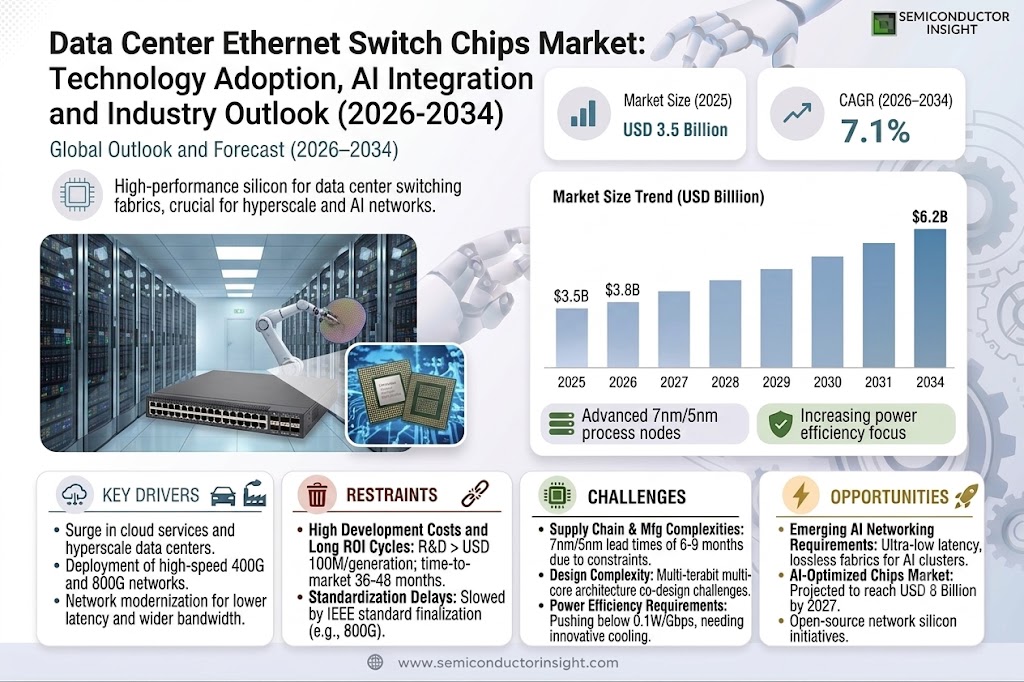
Global Data Center Ethernet Switch Chips Market size was valued at USD 3.5 billion in 2025. The market is projected to grow from USD 3.8 billion in 2026 to USD 6.2 billion by 2034, exhibiting a CAGR of 7.1% during the forecast period.
Data Center Ethernet Switch Chips are specialized integrated circuits (ICs) designed for high-performance networking within data centers. These chips facilitate the efficient switching and routing of data packets between servers, storage systems, and other networked infrastructure, ensuring low latency and high reliability for modern cloud computing and AI workloads.
The market growth is driven by increasing demand for hyperscale data centers, advancements in AI-driven networking, and the rapid adoption of cloud services. Key players such as Broadcom, Marvell, and NVIDIA are innovating with higher bandwidth solutions like 400G and 800G Ethernet switch chips to meet escalating data traffic demands. For instance, in early 2024, Broadcom unveiled its latest Tomahawk 5 series, which supports up to 51.2 terabits per second a significant leap in data center networking capabilities.
MARKET DRIVERS
Increasing Demand for High-Speed Data Transmission
Data Center Ethernet Switch Chips Market is experiencing significant growth due to rising demand for high-bandwidth networking in hyperscale data centers. With workloads requiring speeds of 400G and beyond, switch chip manufacturers are focusing on advanced silicon designs to support faster data processing and reduced latency.
Cloud Computing Expansion
Global cloud service providers are driving adoption of high-performance Ethernet switch chips, with annual investments in data center infrastructure exceeding USD 220 billion. The need for scalable networking solutions in public and private cloud environments continues to push innovation in switch chip architectures.
Emerging technologies like AI/ML workloads and 5G backhaul networks are creating additional demand for low-latency, high-throughput switching solutions.
MARKET CHALLENGES
Supply Chain and Manufacturing Complexities
Data Center Ethernet Switch Chips Market faces challenges from semiconductor supply constraints and advanced node manufacturing delays. Leading vendors report 6-9 month lead times for cutting-edge 7nm and 5nm switch chip production.
Other Challenges
Design Complexity
Developing multi-terabit switch chips requires sophisticated co-design of digital and analog circuitry, with R&D costs exceeding USD 100 million per generation.
Power Efficiency Requirements
New environmental regulations are pushing power budgets below 0.1W per Gbps, requiring innovative cooling and power delivery architectures.
MARKET RESTRAINTS
High Development Costs and Long ROI Cycles
The capital-intensive nature of switch chip development creates barriers to entry, with only a handful of companies capable of competing at the cutting edge. Average time-to-market for new switch chip designs has extended to 36-48 months due to increasing technical complexity.
Standardization Delays
The Ethernet switch chip market faces occasional slowdowns due to extended IEEE standardization processes for new speed grades, with 800G standardization still completing final specifications.
MARKET OPPORTUNITIES
Emerging AI Networking Requirements
Data Center Ethernet Switch Chips Market growth is being propelled by specialized requirements for AI/ML clusters, which demand ultra-low latency and lossless fabric connections. The market for AI-optimized switch chips is projected to reach USD 8 billion by 2027.
Edge Data Center Expansion
Distributed edge computing deployments are creating demand for power-efficient, small form factor switch chips capable of operating in constrained environments, representing a USD 3.2 billion addressable market segment.
Data Center Ethernet Switch Chips Market Trends
Growing Demand for High-Performance Networking Solutions
Data Center Ethernet Switch Chips Market is witnessing robust growth driven by increasing demand for high-speed, low-latency networking solutions. As data centers expand to support cloud computing, AI workloads, and 5G infrastructure, the need for advanced switching chips capable of handling massive data volumes continues to rise. Leading manufacturers are focusing on developing chips with higher port densities and improved energy efficiency.
Other Trends
Adoption of Advanced Fabric Architectures
Data center operators are transitioning from traditional spine-leaf architectures to more advanced fabric designs that require sophisticated Ethernet switch chips. These new architectures demand chips with higher bandwidth capabilities, improved traffic management, and better virtualization support, pushing manufacturers to innovate.
Shift Towards White Box Switching Solutions
The growing preference for white box switches in hyperscale data centers is influencing the Data Center Ethernet Switch Chips Market. This trend is driving demand for standardized, programmable switching chips that offer flexibility and cost efficiency compared to proprietary solutions.
Emerging Technologies Driving Innovation
The integration of AI and machine learning capabilities directly into Ethernet switch chips is becoming a key differentiator. Manufacturers are developing chips with built-in telemetry and analytics features to optimize network performance and enable predictive maintenance in data center environments.
Supply Chain Diversification
Following recent global disruptions, manufacturers of Data Center Ethernet Switch Chips are implementing more resilient supply chain strategies. This includes geographic diversification of production facilities and development of alternative sourcing options for critical components.
COMPETITIVE LANDSCAPE
Key Industry Players
Market Dominated by Top 5 Players Holding Over 65% Revenue Share
Broadcom leads the Data Center Ethernet Switch Chips Market with its high-performance Tomahawk and Trident series, capturing nearly 40% of global revenue. The company’s advanced 25.6Tbps and 51.2Tbps switch chips dominate hyperscale data centers. Marvell and NVIDIA follow with their innovative solutions targeting AI/ML workloads, collectively holding about 20% market share. The competitive landscape remains concentrated, with the top five manufacturers controlling over two-thirds of the market through technological leadership and strategic partnerships with hyperscalers.
Emerging players like Centec and Innovium are gaining traction in white box switch segments, while Chinese manufacturers such as Huawei and Centec are expanding their footprint in domestic markets. Intel’s acquisition of Barefoot Networks strengthened its position in programmable switch chips. Niche specialists including Arista Networks and AMD (through its Pensando acquisition) provide differentiated solutions for specific data center workloads, creating a fragmented but innovation-driven competitive environment.
List of Key Data Center Ethernet Switch Chips Companies Profiled
- Broadcom Inc.
- Marvell Technology
- NVIDIA (including Mellanox acquisitions)
- Intel Corporation
- Cisco Systems
- Huawei Technologies
- Realtek Semiconductor
- Centec Networks
- Arista Networks
- Barefoot Networks (Intel subsidiary)
- Innovium (acquired by Marvell)
- AMD (Pensando)
- Juniper Networks
- Xilinx (now part of AMD)
- Microchip Technology
Segment Analysis:
| Segment Category | Sub-Segments | Key Insights |
| By Type |
|
Commercial Chips dominate due to:
|
| By Application |
|
Brand Ethernet Switches lead with compelling advantages:
|
| By End User |
|
Cloud Service Providers drive significant demand because:
|
| By Speed |
|
40/100G remains the workhorse due to:
|
| By Architecture |
|
Fixed Configuration shows strongest adoption as:
|
Regional Analysis: North America Data Center Ethernet Switch Chips Market
North America
North American firms lead in developing cutting-edge Ethernet switch chips with features like advanced traffic management and AI-optimized packet processing. The region hosts R&D centers for all major networking silicon vendors driving architectural innovations for next-gen data centers.
Over 50% of global hyperscale data centers are concentrated in North America, creating massive demand for high-performance Ethernet switch chips. The region’s cloud providers continuously upgrade networking infrastructure to support AI/ML workloads and distributed computing paradigms.
North American data centers are at the forefront of integrating AI capabilities into Ethernet switch chips, enabling features like predictive traffic analysis and self-optimizing networks. Major tech firms collaborate with chip vendors to develop specialized AI networking solutions.
Favorable government policies for data center growth and cybersecurity investments create a conducive environment for Ethernet switch chip innovation. Initiatives like the CHIPS Act provide funding for advanced semiconductor manufacturing capabilities in the region.
Europe
Europe’s Data Center Ethernet Switch Chips Market is characterized by strong sustainability-driven investments and growing edge computing deployments. The region’s emphasis on green data centers pushes demand for energy-efficient Ethernet switch architectures. Germany, UK, and Nordic countries lead in adopting 400G solutions for hyperscale facilities. Strict data protection regulations influence networking hardware specifications, with EU-based cloud providers preferring vendors with robust security features. The growing AI ecosystem and 5G rollouts are driving investments in high-performance network switches across enterprise and telco data centers.
Asia-Pacific
Asia-Pacific is the fastest-growing region for Data Center Ethernet Switch Chips, fueled by massive cloud expansion and digital transformation initiatives. China leads in hyperscale deployments while Japan and South Korea focus on advanced network architectures for AI applications. Emerging markets like India and Southeast Asia are transitioning to higher-speed Ethernet solutions. The region benefits from local semiconductor manufacturing capabilities and increasing investments in domestic cloud infrastructure. Government digital economy programs accelerate the modernization of data center networking across APAC nations.
South America
South America’s Data Center Ethernet Switch Chips Market is experiencing steady growth with increasing cloud service adoption and colocation expansions. Brazil and Chile serve as regional hubs driving demand for upgraded networking infrastructure. The market is transitioning from traditional 100G to 400G solutions in major metro areas. Limited local manufacturing results in reliance on imported networking chips, though regional data center operators are forming strategic partnerships with global switch chip vendors. Growing digital services in banking and entertainment sectors boost demand for high-performance data center networking components.
Middle East & Africa
The Middle East & Africa region shows emerging potential in the Data Center Ethernet Switch Chips Market, led by digital transformation initiatives in Gulf countries. Smart city projects and sovereign cloud deployments drive investments in modern networking infrastructure. South Africa and UAE are establishing regional data center hubs requiring advanced Ethernet switching solutions. The market faces challenges in chip supply chain logistics but benefits from increasing hyperscale operator presence. Government support for local data center construction creates opportunities for Ethernet switch chip vendors across the region.
Report Scope
This market research report provides a comprehensive analysis of the Data Center Ethernet Switch Chips Market , covering the forecast period 2025–2034. It offers detailed insights into market dynamics, technological advancements, competitive landscape, and key trends shaping the industry.
Key focus areas of the report include:
- Market Overview: The report begins with an overview outlining its current market scenario, key growth indicators, and industry transformation drivers. It discusses macroeconomic factors, demand–supply balance, regulatory landscape, and the strategic role of semiconductors in powering advancements across industries such as automotive, telecommunications, consumer electronics, and industrial automation.
- Market Size & Forecast: Historical data and future projections for revenue, unit shipments, and market value across major regions and segments.
- Segmentation Analysis: Detailed breakdown by product type, technology, application, and end-user industry to identify high-growth segments and investment opportunities.
- Regional Insights: Insights into market performance across North America, Europe, Asia-Pacific, Latin America, and the Middle East & Africa, including country-level analysis where relevant.
- Competitive Landscape: Profiles of leading market participants, including their product offerings, R&D focus, manufacturing capacity, pricing strategies, and recent developments such as mergers, acquisitions, and partnerships.
- Technology Trends & Innovation: Assessment of emerging technologies, integration of AI/IoT, semiconductor design trends, fabrication techniques, and evolving industry standards.
- Market Drivers & Restraints: Evaluation of factors driving market growth along with challenges, supply chain constraints, regulatory issues, and market-entry barriers.
- Stakeholder Insights: Insights for component suppliers, OEMs, system integrators, investors, and policymakers regarding the evolving ecosystem and strategic opportunities.
Primary and secondary research methods are employed, including interviews with industry experts, data from verified sources, and real-time market intelligence to ensure the accuracy and reliability of the insights presented.
FREQUENTLY ASKED QUESTIONS:
What is the current market size of Data Center Ethernet Switch Chips Market?
-> Data Center Ethernet Switch Chips Market size was valued at USD 3.5 billion in 2025. The market is projected to grow from USD 3.8 billion in 2026 to USD 6.2 billion by 2034, exhibiting a CAGR of 7.1% during the forecast period.
Which key companies operate in Data Center Ethernet Switch Chips Market?
-> Key players include Broadcom, Marvell, Realtek, Centec, NVIDIA, Intel, Cisco, and Huawei, among others.
What are the key growth drivers?
-> Key growth drivers include increasing data center investments, demand for high-performance networking solutions, and advancements in cloud computing.
Which region dominates the market?
-> North America leads the market with the U.S. estimated at USD million in 2025, while Asia-Pacific is projected to be the fastest-growing region.
What are the emerging trends?
-> Emerging trends include higher-speed Ethernet adoption, AI-driven network optimization, and increasing demand for energy-efficient data center solutions.
Get Sample Report PDF for Exclusive Insights
Report Sample Includes
- Table of Contents
- List of Tables & Figures
- Charts, Research Methodology, and more...