

Inside the Expanding Role of Electric Motors Market across Smart Industries
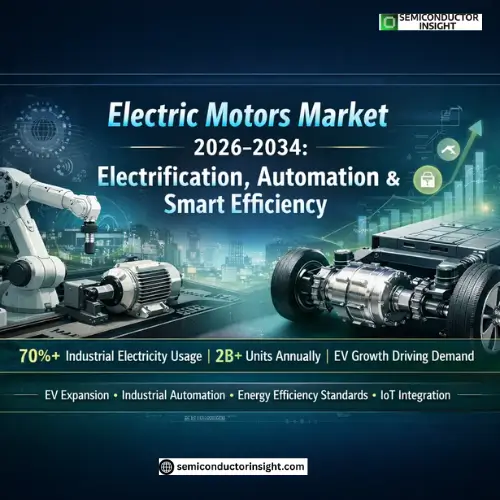
Electric motors have quietly become one of the most critical technologies powering modern economies. From household appliances to industrial robotics and electric vehicles, these machines convert electrical energy into motion with increasing precision and efficiency. Currently, over 70% of industrial electricity consumption globally is attributed to electric motor-driven systems, highlighting their central role in energy usage and optimization.
The global demand for electric motors continues to rise steadily, with annual production volumes exceeding 2 billion units worldwide, driven by automation, electrification, and infrastructure development. What makes this market particularly dynamic is its deep integration into both legacy systems and emerging technologies.
Electrification of Mobility Redefining Demand Patterns
The rapid expansion of electric mobility is significantly reshaping the electric motors landscape. Electric vehicles (EVs), including passenger cars, two-wheelers, and commercial fleets, rely heavily on advanced motor systems such as permanent magnet synchronous motors and induction motors.
In 2024 alone, global EV sales crossed 14 million units, accounting for nearly 18% of total vehicle sales, creating a massive surge in demand for high-performance motors. For instance, companies like Tesla utilize motors with efficiencies exceeding 95%, pushing industry benchmarks higher. Similarly, India’s EV sector recorded over 1.5 million electric vehicle registrations, accelerating localized motor manufacturing.
This shift is not just about volume but also performance, with a growing focus on torque density, thermal efficiency, and compact design.
Industrial Automation Driving Precision Engineering
- Manufacturing sectors are increasingly adopting automation, where electric motors serve as the backbone of robotics, conveyor systems, and CNC machinery.
- In smart factories, motors are no longer just mechanical components they are intelligent systems integrated with sensors and control software.
- Industrial motor systems now account for approximately 45% of total motor usage globally, with industries like automotive, food processing, and electronics manufacturing leading adoption.
- Servo motors and stepper motors are witnessing rapid uptake due to their ability to deliver high precision and repeatability.
- For example, robotic installations worldwide surpassed 4 million active units, each relying on multiple electric motors for movement and control. This trend is pushing innovations in compact motor designs and energy-efficient operations.
Efficiency Standards Transforming Design Priorities
Energy efficiency has become a defining factor in electric motor development. Governments and regulatory bodies worldwide are enforcing stringent efficiency standards such as IE3 and IE4 classifications, significantly influencing manufacturing practices.
High-efficiency motors can reduce energy consumption by up to 20-30% compared to standard models, making them a preferred choice across industries. In the European Union, nearly 90% of newly installed industrial motors now comply with high-efficiency standards, while India is also advancing through its Bureau of Energy Efficiency initiatives.
This transition is not only reducing operational costs but also aligning with global carbon reduction goals, making efficiency a competitive differentiator.
For More Detailed Insights You Can Surf Our Latest Report Here:
https://semiconductorinsight.com/report/electric-vehicle-motor-capacitors-market/
Integration with Smart Technologies and IoT
- The evolution of the electric motors market is closely tied to the rise of smart technologies.
- Modern motors are increasingly equipped with IoT-enabled sensors that monitor parameters such as temperature, vibration, and energy consumption in real time.
- Predictive maintenance powered by these systems can reduce downtime by 30-50%, significantly improving operational efficiency.
- Industries are leveraging this capability to shift from reactive to proactive maintenance strategies.
- For instance, large-scale manufacturing plants are now deploying connected motor systems that feed data into centralized platforms, enabling real-time performance optimization and fault detection.
The Expanding Influence of Electric Motors across Everyday Life
Beyond industrial and automotive applications, electric motors are deeply embedded in everyday life. From air conditioners and refrigerators to electric fans and washing machines, these devices rely on motors for functionality.
Household appliances alone account for nearly 30% of total motor demand, emphasizing their widespread usage. With the rise of smart homes and energy-efficient appliances, demand for compact and low-noise motors is increasing steadily.
This broad applicability ensures that the electric motors market remains resilient and continuously evolving across multiple sectors.

Comments (0)