
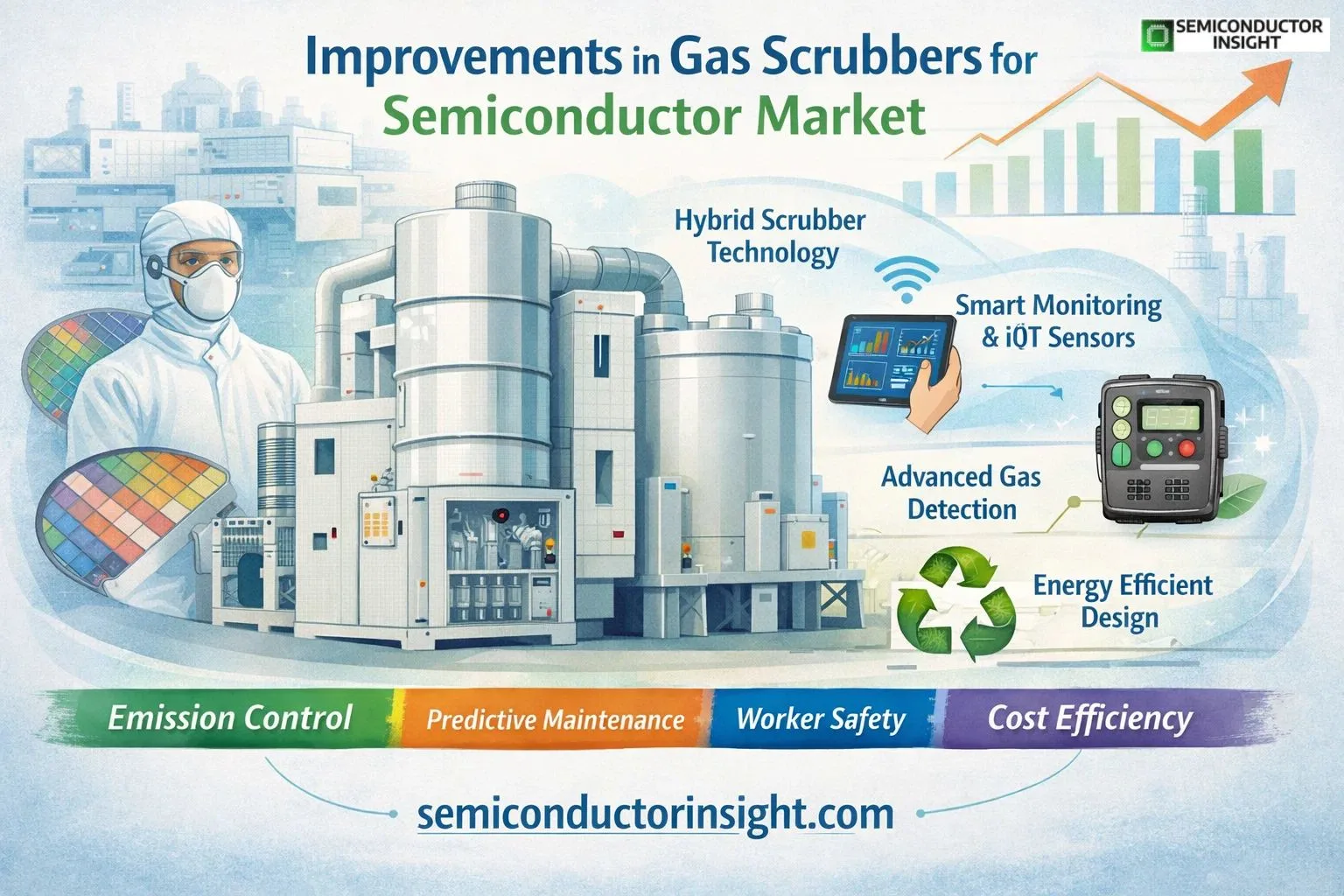
Improvements in Gas Scrubbers for Semiconductor Market for Air Quality Control
Gas scrubbers have become pivotal in making semiconductor fabrication safer, cleaner, and more compliant with environmental expectations. As fabs push towards denser, smaller nodes and expand manufacturing capacity globally, the handling of hazardous process gases has surfaced as a central concern not just for regulatory compliance but for worker safety, emission control, and operational continuity.
Understanding Gas Scrubbers in Semiconductor Fabrication
- At their core, gas scrubbers are systems designed to treat exhaust streams containing volatile chemicals, particulate matter, and reactive gases.
- In semiconductor fabs where processes like plasma etching, CVD (chemical vapor deposition), and wet cleaning release toxic by-products scrubbers ensure that harmful emissions do not enter the environment or pose risk to personnel.
- Scrubbers used in semiconductor fabrication facilities, as opposed to general industrial scrubbers, must precisely and robustly handle extremely corrosive substances such hydrogen fluoride (HF), nitrogen oxides (NOx), and halogenated compounds.
Evolution from Traditional to Advanced Scrubbing Techniques
Historically, wet scrubbers filled a majority of emission control roles in semiconductor facilities. These systems rely on liquid solutions to absorb and neutralize gas contaminants. For decades, companies like Lam Research and Applied Materials offered integrated wet scrubber modules alongside etch and deposition tools.
However, as processes evolved, so did scrubber technology. Recent industry articles in Clean Air Technology Magazine highlight the emergence of dry, regenerative, and hybrid scrubber systems that offer lower water usage, reduced waste streams, and improved capture efficiency. For example, dry adsorbent systems using activated carbon or molecular sieves now effectively target specific halogenated gases without generating liquid effluent a leap forward from conventional designs.
Let’s See, For Example Hybrid Scrubbing in High Volume Manufacturing
A notable real-world instance comes from a leading fab in South Korea, where a hybrid system combining wet and dry scrubbers reduced overall emission levels of nitrogen trifluoride (NF3) by more than 95% during plasma chamber cleaning operations. As detailed in a recent feature by Facility Management, this approach not only enhanced compliance but also cut operational water costs by 40%.
Factories integrating such hybrid solutions are now reporting not only regulatory alignment but improved operational uptime, as corrosion-related maintenance downtime has significantly dropped.
Digital Controls and Predictive Maintenance
One of the most impactful shifts in the Gas Scrubbers for Semiconductor Market is the integration of smart controls and analytics. Fabs are leveraging IoT sensors, real-time monitoring, and predictive algorithms to optimize scrubber performance.
In Semiconductor Digest, a case study highlighted a Texas fab where predictive maintenance reduced unplanned scrubber downtime by 35%. By continuously analyzing parameters like pressure differentials, gas compositions, and scrubber media saturation, the fab could schedule service before efficiency degraded a critical advantage in facilities running multi-shift, 24/7 operations.
Health and Safety Enhancements with Advanced Gas Monitoring
Gas scrubbers do more than protect the environment they protect the workforce. Traditional safety systems triggered alarms only when gas levels approached dangerous thresholds. Now, advanced scrubbers come equipped with multi-gas detection arrays that tie into building management systems.
In an article in Industrial Safety Review, an East Asian semiconductor campus deployed scrubbers with integrated gas monitoring that automatically isolated affected zones and initiated ventilation changes during maintenance activities involving HF. This shift from reactive alarms to proactive containment is enriching site safety programs and earning recognition from occupational safety boards.
Access the full Gas Scrubbers for Semiconductor Market Report to stay ahead of emerging trends: https://semiconductorinsight.com/report/gas-scrubbers-for-semiconductor-market/
Customization for Next Generation Processes
As the industry transitions to 3D stacked devices and materials like gallium nitride (GaN) and silicon carbide (SiC), gas compositions and emission profiles are changing. This demands customized scrubber solutions.
A recent industry piece from Advanced Fabrication Insights covered how an R&D cleanroom in Germany collaborated with scrubber manufacturers to design a bespoke solution capable of handling new etch chemistries involving boron trichloride (BCl3) and chlorine-rich plasmas. The success of this project underscores the market’s movement toward tailored scrubber solutions rather than one-size-fits-all systems.
Cost Efficiency and Total Cost of Ownership
An increasing number of fabs are evaluating scrubber purchases not just on purchase cost but on total cost of ownership including energy usage, waste disposal, and regulatory compliance costs. Modern scrubbers equipped with regenerative media and automated controls have been shown to deliver lower lifetime costs due to reduced media replacement, lower utility consumption, and fewer unplanned shutdowns.
A comparative analysis featured in TechFabrication Journal found that facilities adopting scrubbers with energy recovery features saw a payback period of under three years, compared to over five years for legacy wet systems.
Collaborations and Training for Optimal Use
- Finally, the Gas Scrubbers for Semiconductor Market is seeing increased collaboration between equipment makers, fab engineers, and safety professionals. Workshops, joint training programs, and shared case libraries are becoming more common helping facilities adopt best practices quickly.
- For example, TechSafety Quarterly reported on a training initiative where scrubber manufacturers partnered with a cluster of Southeast Asian fabs to standardize maintenance protocols and emergency response workflows. Participants reported a 25% improvement in scrubber efficiency within six months post-training.
Gas scrubbers are no longer just compliance equipment they are strategic assets in semiconductor manufacturing. From digital controls and sustainable designs to safety enhancements and customized solutions for next-generation processes, the market is rapidly maturing with real-world successes documented across industry publications and technical magazines.

Comments (0)