

Imae Intensgifier vs. Digital CMOS Sensors in 2026: Which Technology Fits Low Light Imaging Best?
The image intensifier is an unusual piece of imaging technology because its core job is to make extremely weak optical signals usable before a conventional camera or viewing system takes over.
Rather than simply increasing digital brightness, an image intensifier converts incoming photons into electrons, multiplies those electrons and converts them back into visible light. That architecture keeps the technology relevant across night vision, scientific cameras, spectroscopy, high-speed observation and selected medical imaging systems.
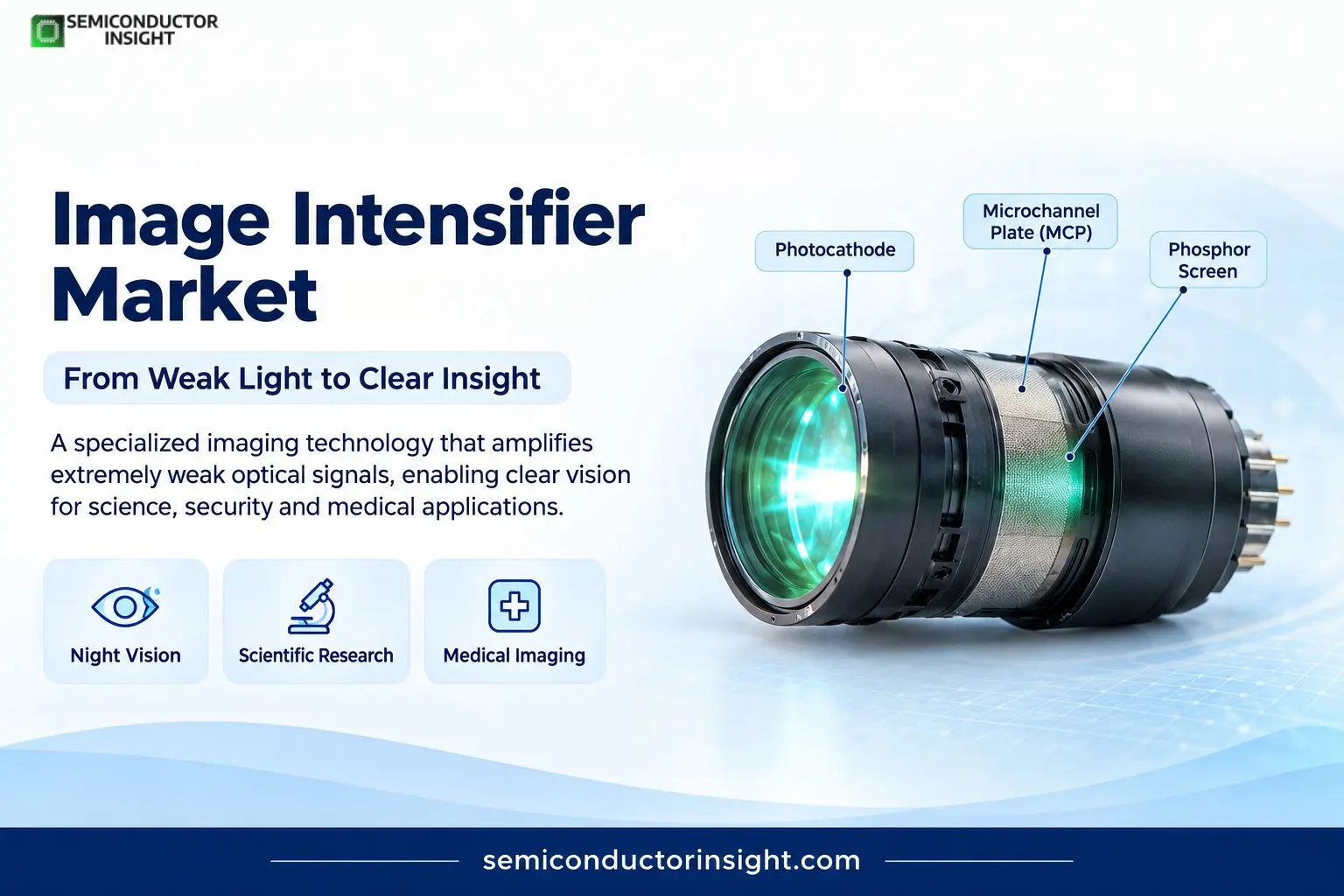
The Three-Stage Architecture behind the Image
- An image intensifier can be understood through a simple sequence: photons → photoelectrons → electron multiplication → intensified photons.
- Hamamatsu describes the core structure as a photocathode, microchannel plate and phosphor screen enclosed within an evacuated housing.
- The photocathode converts incoming light into electrons, the microchannel plate multiplies them and the phosphor screen converts the amplified electron signal back into light.
- This is where semiconductor and photonics engineering meet.
- Photocathode materials determine spectral response and quantum efficiency, while the microchannel plate controls electron multiplication and the phosphor determines how the amplified signal becomes an observable image.
From Thousands to Millions of Times More Signal
The numerical capability of modern intensifiers explains why they continue to attract specialist applications. Hamamatsu states that image intensifiers can amplify faint images by several thousand to tens of thousands of times, while particular commercial units can reach several thousand to several million times incident-light amplification.
- One current Hamamatsu unit, for example, specifies a 2.2 × 10⁴ luminous gain, 64 line pairs/mm central resolution, a 50% typical photocathode quantum efficiency, and a minimum gate-on time of just 3 nanoseconds.
- A different two-stage configuration lists 4.0 × 10⁶ luminous gain and a 5 ns minimum gate-on time.
These figures demonstrate that the technology is not defined by amplification alone. Resolution, timing, spectral sensitivity and gating are equally important when the target is a fleeting or extremely weak signal.
Why the Microchannel Plate Changed the Design?
The microchannel plate was a major step in making image intensifiers smaller and more responsive. Instead of relying on a large electron-amplification arrangement, the MCP uses enormous numbers of microscopic channels to generate secondary electrons when the initial photoelectrons strike the channel walls.
The architecture also enabled compact multi-stage systems. Hamamatsu notes that a single MCP can provide substantial multiplication, while dual-stage configurations can reach much higher electron gain.
Low light → Photocathode → MCP multiplication → Phosphor → Camera or eyepiece
That compact chain remains one of the defining engineering signatures of the image intensifier.
Curious about what’s next? Explore the full report here: https://semiconductorinsight.com/report/image-intensifier-market/
GaAs Is Keeping the Technology Competitive
Photocathode engineering is another area where the market becomes technically differentiated. Gallium arsenide and gallium-arsenide-phosphide technologies are used when high sensitivity and particular spectral responses are required.
A current Hamamatsu GaAsP unit specifies a 280-720 nm spectral response, 50% quantum efficiency, 700 μA/lm cathode luminous sensitivity and 64 Lp/mm central limiting resolution. Its specified gate operation can begin at only 3 ns, making this type of architecture particularly interesting for high-speed phenomena and weak luminescence measurements.
The significance extends beyond night vision. Faster gating allows researchers to isolate short-lived optical events that conventional sensors may struggle to capture cleanly.
Medical Imaging Is Moving the Architecture in a Different Direction
- The medical imaging story is more complicated because image intensifiers have historically played an important role in fluoroscopy, while solid-state detectors are increasingly used as replacements. The U.S. FDA classifies image-intensified fluoroscopic X-ray systems under 21 CFR 892.1650, and describes image intensifiers as systems that convert an X-ray pattern into a higher-energy-density light image.
- Current FDA records also show the transition toward digital detection. A 2020-cleared CMOS detector was specifically described as an image-intensifier replacement for legacy surgical C-arm systems, demonstrating how semiconductor-based detector technology is gradually taking over parts of the traditional architecture.
- This does not make image intensifiers obsolete across every application. Instead, it divides the technology landscape between legacy fluoroscopy, specialised low-light applications and increasingly sophisticated solid-state imaging.
The Speed Advantage Is Becoming More Valuable
High-speed observation is one area where image intensifiers remain distinctive. Modern gated units can be switched on for extremely short intervals, helping researchers isolate rapid optical events, suppress unwanted background illumination and synchronize image acquisition with another experimental system.
This capability is valuable wherever the question is not simply “Can the object be seen?” but “What happened during those few nanoseconds?”
Applications can therefore extend into scientific imaging, combustion studies, plasma research, fluorescence measurements, semiconductor inspection research and other experiments involving weak or rapidly changing optical signals.
The Market Is Moving From Brightness to Precision
The next phase of image-intensifier development is less about making an image merely brighter and more about controlling when, where and under which wavelengths amplification occurs. Modern specifications increasingly emphasize gate timing, photocathode quantum efficiency, spectral response, spatial resolution and integration with cameras.
That makes the image intensifier a specialised bridge between traditional vacuum-electron technology and modern semiconductor imaging. As CMOS and other solid-state sensors continue advancing, image intensifiers are likely to remain most valuable where extremely weak signals, ultrafast events or specialised spectral conditions make raw sensitivity and electronic gain more important than having a completely solid-state imaging chain.

Comments (0)