
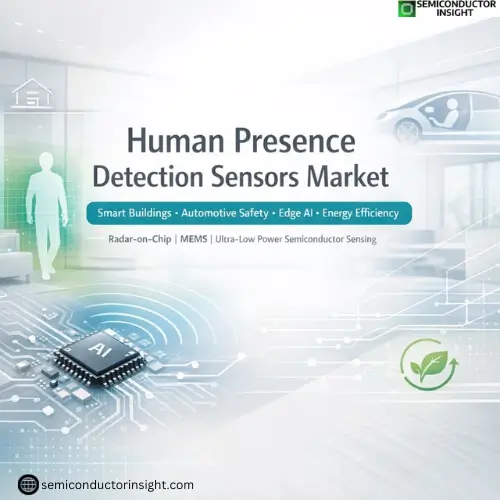
Human Presence Detection Sensor Market Analysis Highlights Sensor Fusion, AI Integration, and Industry Expansion
Human Presence Detection Sensor Market refers to the global industry focused on sensor technologies that can accurately identify whether a person is physically present within a defined space. Presence detection systems, in contrast to simple motion sensors, are made to record minute human motions, breathing patterns, and motionless occupancy.
These sensors are increasingly important in semiconductor-enabled systems, supporting smarter automation across consumer electronics, industrial environments, vehicles, and healthcare infrastructure.
Why This Market Is Gaining Strategic Importance?
Human presence detection is no longer limited to switching lights on and off. Today, it plays a growing role in how intelligent environments respond to people in real time.
In offices, it reduces wasted energy. In cars, it improves passenger safety. In smart devices, it enables personalized experiences. This shift is pushing sensor manufacturers and semiconductor firms to treat presence detection as a high-value innovation area rather than a commodity component.
Semiconductor Innovation Driving Next-Generation Sensors
The market’s expansion is strongly tied to advances in semiconductor design. Modern presence sensors rely on highly integrated chip architectures that combine:
- Low-power microcontrollers
- MEMS-based sensing structures
- Radar-on-chip modules
- AI-enabled edge processing
Semiconductor miniaturization is allowing these sensors to fit into compact consumer devices while maintaining high accuracy and ultra-low power consumption.
This is especially critical for battery-operated products such as wearable, wireless security systems, and smart home devices.
Key Technology Pathways Reshaping the Industry
Presence detection is evolving through several sensor categories, each with different semiconductor requirements:
- Radar-Based Presence Sensors: These use mmWave radar chips to detect fine human movement, even though obstacles. They are becoming popular in automotive cabins and smart buildings.
- Infrared and Thermal Sensors: Widely used for occupancy detection, especially in energy management systems.
- Vision-Based AI Sensors: Edge-enabled imaging sensors support advanced monitoring, though privacy concerns influence adoption.
- Ultrasonic and Capacitive Sensors: Often integrated into consumer electronics for proximity and interaction-based presence awareness.
Trade, Manufacturing, and Supply Chain Realities
Presence sensors depend on globally distributed semiconductor supply chains. Wafer fabrication capacity in Asia, packaging advancements in Southeast Asia, and demand growth in North America and Europe all shape pricing and availability.
Additionally, import-export flows are influenced by:
- Automotive electronics regulations
- Semiconductor localization policies
- Export controls on advanced sensing technologies
As sensor complexity rises, so does the importance of stable chip sourcing and qualified production ecosystems.
Don’t Forget to Surf Our Updated Report for More Detailed Analysis:
https://semiconductorinsight.com/report/human-presence-detection-sensor-market/
Regulatory and Safety Framework Influencing Adoption
Presence detection is increasingly tied to compliance standards, especially in automotive and healthcare use cases.
Key regulatory influences include:
- Vehicle occupant safety mandates
- Smart building energy performance requirements
- Data privacy frameworks for vision-based sensing
- Medical device monitoring certifications
This regulatory environment is pushing manufacturers toward non-camera radar solutions that balance accuracy with privacy.
Three key trends will probably influence the next stage of growth:
- Edge AI integration, allowing sensors to interpret presence context locally
- Ultra-low power semiconductor design, supporting always-on detection
- Smart infrastructure expansion, especially in connected buildings and mobility
Companies that can deliver high-accuracy sensing with minimal power and strong privacy alignment will be best positioned for long-term market leadership.
Human presence detection sensors are rapidly becoming foundational to intelligent electronics, driven by semiconductor innovation, automation demand, and safety-focused applications.
With radar-on-chip platforms, edge intelligence, and expanding smart infrastructure investments, this market is moving from a niche sensing segment into a strategic pillar of next-generation semiconductor systems.

Comments (0)