Human Presence Sensor Market Insights
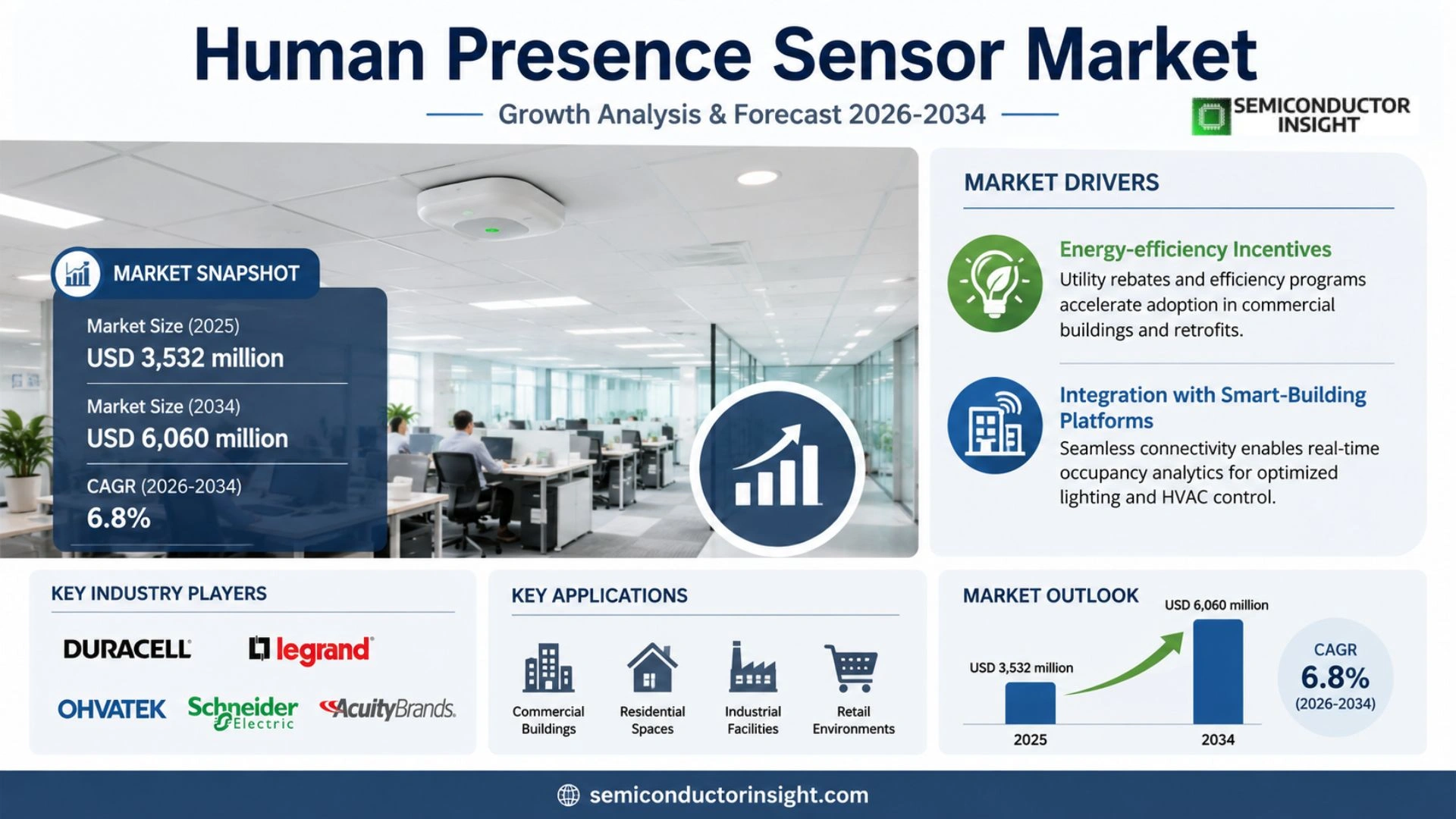
Human Presence Sensor market was valued at USD 3,532 million in 2025 and is projected to reach USD 6,060 million by 2034, exhibiting a CAGR of 6.8 % during the forecast period.
Human presence sensors are intelligent devices that detect a person’s thermal radiation, micro‑movements, respiration or morphological traits using infrared, millimeter‑wave radar, ultrasound or vision technologies. By converting these signals into electrical outputs they enable occupancy‑based control of lighting, HVAC, security and vehicle systems. In 2024 more than 50 million units were shipped worldwide; dual‑technology modules command several times the price of single‑technology solutions because they deliver higher accuracy and can recognise stationary occupants.
MARKET DRIVERS
Energy‑efficiency Incentives
Governments across North America and Europe have introduced utility rebates for low‑power occupancy detection. These programmes lower the total cost of ownership for building owners, prompting rapid adoption of advanced Human Presence Sensor Market solutions in new construction and retrofit projects.
Integration with Smart‑Building Platforms
Architects and system integrators are increasingly specifying sensors that communicate via Zigbee, Bluetooth Mesh, or Matter protocols. This connectivity enables real‑time occupancy analytics, allowing facilities managers to fine‑tune climate control and lighting schedules with unprecedented granularity.
➤ “Deploying presence detection can cut lighting electricity by up to 45 % in office spaces,” a recent case study notes.
Manufacturers are responding with modular designs that blend seamlessly into ceiling tiles or wall panels, reducing installation labor and supporting the broader push toward net‑zero building certifications.
MARKET CHALLENGES
High Initial Capital Outlay
Although long‑term savings are evident, the upfront price of sensor‑rich ecosystems remains a barrier for small‑to‑medium enterprises that lack access to bulk‑purchase discounts.
Other Challenges
Supply‑Chain Volatility
The reliance on semiconductor components subject to global shortages forces OEMs to extend lead times, which can delay project timelines and erode client confidence.
Furthermore, the absence of universally accepted performance standards complicates procurement decisions, as buyers struggle to compare sensitivity ratings and false‑alarm frequencies across vendors.
MARKET RESTRAINTS
Privacy and Data‑Security Concerns
When sensors feed occupancy data to cloud‑based analytics, regulators and end‑users voice apprehension about inadvertent surveillance, especially in public venues where personal movement patterns could be inferred.
Manufacturers must invest in end‑to‑end encryption and transparent data‑handling policies, adding to product development costs and slowing time‑to‑market for newer generations of devices.
MARKET OPPORTUNITIES
Expansion into Healthcare Facilities
Hospitals and long‑term care centers are seeking occupancy sensors that can trigger ventilation increases in patient rooms when staff are present, thereby reducing infection risk while conserving energy. The specificity of healthcare‑grade certifications creates a niche where premium pricing is justified.
Additionally, the rise of edge‑computing hardware enables on‑site processing of presence data, opening avenues for OEMs to offer bundled hardware‑software packages that deliver actionable insights without reliance on external cloud services.
Human Presence Sensor Market Trends
Shift Toward Millimeter‑Wave Radar Solutions
Adoption of millimeter‑wave radar as the preferred technology is reshaping Human Presence Sensor market. Unlike conventional infrared units, radar can sense micro‑movements and even shallow breathing, which makes it viable for applications where occupants remain stationary. Manufacturers that have incorporated dual‑band radar modules reported unit prices several times higher than single‑technology infrared sensors, yet the premium is justified by higher detection reliability and broader environmental tolerance. This technology shift is evident in the surge of sales exceeding 50 million units in 2024, reflecting customer willingness to invest in more capable sensing nodes. At the same time, smart‑home platforms and in‑vehicle occupant‑detection systems are standardizing radar‑based sensors to meet safety and convenience requirements, further reinforcing the transition.
Other Trends
Integration with Energy Management Systems
The newfound ability to discern occupancy with high fidelity is prompting building‑automation firms to embed sensors directly into HVAC and lighting control loops. By feeding real‑time presence data to a building‑management platform, systems can modulate lighting levels, temperature set‑points, and ventilation rates on a per‑zone basis. The result is a measurable reduction in energy consumption, which aligns with stricter efficiency standards adopted across commercial portfolios. Companies that have offered turnkey solutions,combining sensor hardware with cloud‑based analytics,are seeing faster procurement cycles because the value proposition is quantifiable during the design phase. Moreover, the convergence of sensor data with demand‑response programs enables utilities to optimize grid loads, creating an additional revenue stream for property owners.
Data‑Driven Spatial Intelligence Emerges
The proliferation of edge‑computing resources enables sensors to transmit raw detection signals to localized processors, where AI algorithms extract patterns related to space utilization and occupant behavior. This transition elevates the sensor from a binary trigger to a source of actionable intelligence for smart offices, retail environments, and elder‑care facilities. Privacy‑preserving designs that avoid visual capture are gaining acceptance, especially in jurisdictions tightening data‑protection regulations. As more stakeholders recognize the strategic advantage of leveraging occupancy analytics for both operational efficiency and enhanced safety, Human Presence Sensor market is likely to see increased collaboration between sensor makers, software vendors, and system integrators. Enterprises that embed these insights into predictive maintenance schedules or dynamic space‑allocation strategies will secure a competitive edge as intelligent environments become the norm.
COMPETITIVE LANDSCAPE
Key Industry Players
Competitive dynamics in Human Presence Sensor market
The market is anchored by a handful of multinational firms that combine deep sensor‑chip expertise with integrated lighting and building‑automation platforms. Signify, leveraging its extensive LED portfolio, has embedded presence‑detection modules into millions of fixtures, gaining leverage in both commercial and residential segments. Schneider Electric and Siemens follow with system‑level solutions that couple radar‑based sensors to HVAC and security networks, creating sticky revenue streams through long‑term service contracts. Honeywell’s focus on multi‑sensor fusion and its strong presence in industrial automation give it a distinct advantage in high‑precision applications, while ABB’s radar‑centric modules are favored in environments where infrared alone cannot meet reliability standards. Collectively, these leaders dominate the upper‑mid tier of the market, setting performance benchmarks and shaping procurement criteria for downstream integrators.
Beyond the global giants, a diverse set of specialists nurtures niche demand across regions. European firms such as Legrand, Crestron, and Zumtobel excel in design‑oriented installations, often bundling presence sensors with architectural lighting solutions for premium office spaces. German companies like Theben AG and Gira Giersiepen focus on configurable wall‑mounted units that cater to retrofit projects in historic buildings. Asian players, including Shenzhen Merrytek Technology, Hdl Automation, and GVS SMART, drive cost‑effective volume production, frequently targeting emerging smart‑home ecosystems in China and Southeast Asia. Smaller innovators such as Herbert Waldmann and Eelectron are pioneering ultra‑low‑power ultrasonic designs that address battery‑operated IoT devices, thereby expanding the overall addressable market.
List of Key Human Presence Sensor Companies Profiled
- Signify
- Schneider Electric
- ABB
- Siemens
- Honeywell
- Legrand
- Crestron
- Steinel Vertrieb GmbH
- B.E.G. Brück Electronic
- Theben AG
- Zumtobel
- Lutron
- Jung
- Gira Giersiepen GmbH
- Leviton
- Herbert Waldmann GmbH & Co. KG
- Hdl Automation
- Eelectron
- Shenzhen Merrytek Technology
- GVS SMART
Segment Analysis:
| Segment Category | Sub-Segments | Key Insights |
| By Type |
|
Radar‑based sensors are emerging as the dominant type because they capture micro‑movements and breathing, enabling detection of stationary occupants. ‑ They provide high reliability in diverse lighting conditions, supporting critical building‑automation scenarios. ‑ Integration with AI algorithms enhances adaptability to complex indoor environments. ‑ Manufacturers focusing on radar technology are building competitive advantage through superior sensing accuracy. |
| By Application |
|
Smart Lighting drives the most compelling adoption because presence data enables on‑demand illumination, reducing energy waste. ‑ It creates seamless user experiences by automatically adjusting light levels as occupants move. ‑ The tight coupling with lighting controls accelerates integration cycles for OEMs. ‑ Growing emphasis on sustainability reinforces the value proposition of sensor‑enabled lighting. |
| By End User |
|
Commercial Buildings represent the leading end‑user segment as they seek precise occupancy data to optimize HVAC, lighting, and space utilization. ‑ Facility managers value the continuity of detection for both active and stationary occupants. ‑ Integration with building‑management systems creates a unified control layer. ‑ The shift toward net‑zero targets makes presence sensing a strategic enabler for energy‑saving initiatives. |
| By Technology |
|
Multi‑sensor Fusion is gaining traction as it combines infrared, radar and ultrasonic data, delivering higher accuracy across varied environments. ‑ Fusion algorithms mitigate false triggers caused by pets or ventilation flows. ‑ The approach enables granular state recognition such as breathing or posture, opening pathways to advanced analytics. ‑ Vendors investing in sensor‑fusion ecosystems are positioning themselves as comprehensive solution providers. |
| By Integration Level |
|
Edge‑enabled Modules are becoming the preferred integration path because they process presence data locally, reducing latency and preserving privacy. ‑ They support real‑time actuation for lighting and HVAC. ‑ Edge intelligence allows customized scene logic without reliance on constant cloud connectivity. ‑ This trend aligns with industry concerns around data security and regulatory compliance. |
Regional Analysis: Human Presence Sensor Market
North America
Enterprises are moving beyond basic infrared detectors toward multi‑modal sensors that fuse radar, microwave, and ultrasonic data. This convergence improves detection accuracy in complex spaces, reducing false triggers and enabling finer control of lighting and climate systems.
State‑level energy codes increasingly mandate occupancy‑based lighting, creating a de‑facto requirement for presence sensors in new construction. Compliance pressures push developers to select sensor solutions that can be verified through third‑party testing.
Proximity to semiconductor fabs and component suppliers shortens lead times, allowing North American manufacturers to iterate designs rapidly and respond to niche market requests faster than competitors.
Large office campuses, university campuses, and hospital complexes consume the bulk of sensor installations, as they benefit most from the operational savings and compliance advantages offered by precise occupancy detection.
Europe
European markets exhibit a cautious yet progressive stance toward Human Presence Sensor market. Stringent EU energy directives encourage retrofitting older buildings, while capital‑intensive new builds in Scandinavia often feature integrated sensor platforms from the design phase. Regional manufacturers focus on ultra‑low‑power designs to meet EU eco‑label criteria, positioning themselves as preferred partners for sustainability‑driven projects. Cross‑border collaboration among research institutes accelerates standardisation, improving interoperability across diverse building‑automation ecosystems.
Asia‑Pacific
The Asia‑Pacific region presents a rapidly evolving landscape for human presence sensors, fueled by urbanisation and a surge in smart‑city initiatives. Governments in China, Japan, and South Korea are injecting public funds into intelligent infrastructure, where occupancy data underpins demand‑responsive lighting and ventilation. However, market fragmentation and varied regulatory frameworks create challenges for global players seeking uniform deployment strategies. Local firms capitalize on cost‑effective manufacturing, while multinational vendors differentiate through AI‑enhanced analytics that translate raw sensor data into actionable insights for facility managers.
South America
In South America, adoption of Human Presence Sensor market remains centred on large‑scale commercial projects in Brazil and Chile, where multinational corporations aim to meet global ESG commitments. Energy price volatility spurs interest in occupancy‑based control as a means to lower operational expenses. Nonetheless, limited awareness among smaller enterprises and intermittent supply‑chain reliability temper growth, prompting firms to invest in education campaigns and local partnerships to broaden market reach.
Middle East & Africa
The Middle East & Africa region showcases a mixed picture. Wealth‑driven construction in Gulf Cooperation Council countries integrates advanced sensor networks into luxury hotels and high‑rise offices, leveraging the technology to enhance guest experience and energy efficiency. Conversely, many African markets confront infrastructural constraints, with sensor deployment largely confined to multinational campus projects. Growing interest in renewable‑energy‑compatible building solutions hints at future expansion, provided that distribution channels mature and local technical expertise strengthens.
Report Scope
This market research report provides a comprehensive analysis of the Human Presence Sensor Market , covering the forecast period 2026–2034. It offers detailed insights into market dynamics, technological advancements, competitive landscape, and key trends shaping the industry.
Key focus areas of the report include:
- Market Overview: The report begins with an overview outlining its current market scenario, key growth indicators, and industry transformation drivers. It discusses macroeconomic factors, demand–supply balance, regulatory landscape, and the strategic role of semiconductors in powering advancements across industries such as automotive, telecommunications, consumer electronics, and industrial automation.
- Market Size & Forecast: Historical data and future projections for revenue, unit shipments, and market value across major regions and segments.
- Segmentation Analysis: Detailed breakdown by product type, technology, application, and end-user industry to identify high-growth segments and investment opportunities.
- Regional Insights: Insights into market performance across North America, Europe, Asia-Pacific, Latin America, and the Middle East & Africa, including country-level analysis where relevant.
- Competitive Landscape: Profiles of leading market participants, including their product offerings, R&D focus, manufacturing capacity, pricing strategies, and recent developments such as mergers, acquisitions, and partnerships.
- Technology Trends & Innovation: Assessment of emerging technologies, integration of AI/IoT, semiconductor design trends, fabrication techniques, and evolving industry standards.
- Market Drivers & Restraints: Evaluation of factors driving market growth along with challenges, supply chain constraints, regulatory issues, and market-entry barriers.
- Stakeholder Insights: Insights for component suppliers, OEMs, system integrators, investors, and policymakers regarding the evolving ecosystem and strategic opportunities.
Primary and secondary research methods are employed, including interviews with industry experts, data from verified sources, and real-time market intelligence to ensure the accuracy and reliability of the insights presented.
FREQUENTLY ASKED QUESTIONS:
What is the current market size of Human Presence Sensor Market?
-> Human Presence Sensor market was valued at USD 3,532 million in 2025 and is projected to reach USD 6,060 million by 2034, exhibiting a CAGR of 6.8 %
Which key companies operate in Human Presence Sensor Market?
-> Key players include Signify, Schneider Electric, ABB, Siemens, Honeywell, Hager, Legrand, Crestron, STEINEL VERTRIEB GMBH, B.E.G. Brück Electronic, Theben AG, ZUMTOBEL, Lutron, JUNG, Gira Giersiepen GmbH, Leviton, Herbert Waldmann GmbH & Co. KG, HDL Automation, Eelectron, Shenzhen Merrytek Technology, GVS SMART.
What are the key growth drivers?
-> Key growth drivers include increased adoption of smart lighting, smart homes, building automation, energy‑saving control, and vehicle intelligence, alongside the demand for accurate occupancy detection to boost energy efficiency.
Which region dominates the market?
-> Asia-Pacific shows the fastest growth due to rapid smart‑city deployments, while North America and Europe remain the largest revenue contributors.
What are the emerging trends?
-> Emerging trends include multi‑sensor fusion solutions, millimeter‑wave radar technology, privacy‑friendly non‑visual sensing, and deep integration with AI/edge computing for space utilization analytics.

Get Sample Report PDF for Exclusive Insights
Report Sample Includes
- Table of Contents
- List of Tables & Figures
- Charts, Research Methodology, and more...
 Download Sample Report PDF