MARKET INSIGHTS
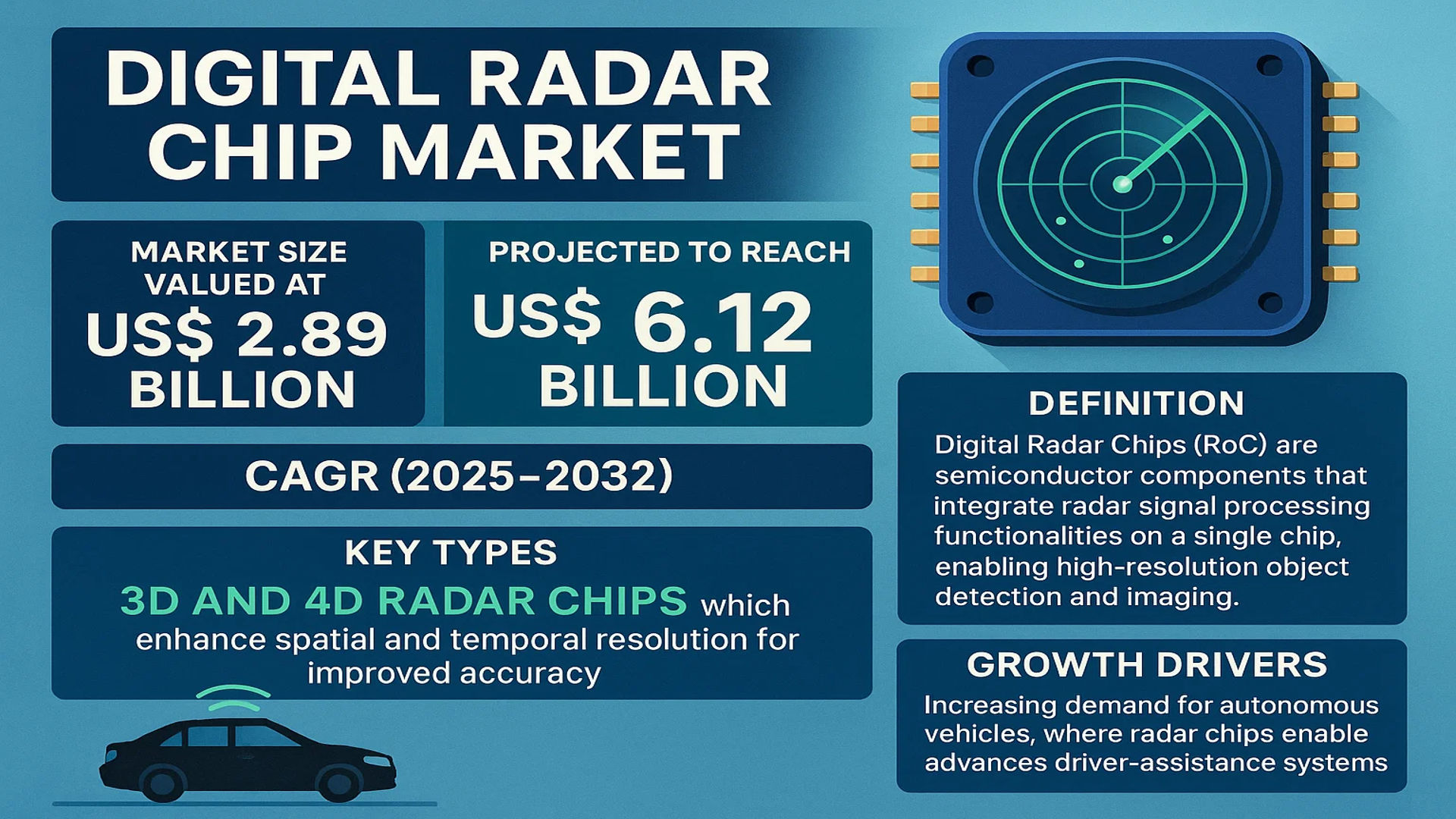
The global Digital Radar Chip market size was valued at US$ 2.89 billion in 2024 and is projected to reach US$ 6.12 billion by 2032, at a CAGR of 9.8% during the forecast period 2025-2032.
Digital Radar Chips (RoC) are semiconductor components that integrate radar signal processing functionalities on a single chip, enabling high-resolution object detection and imaging. These chips play a critical role in advanced radar systems by converting analog radar signals into digital data for processing, supporting applications such as autonomous vehicles, industrial automation, and 5G communication networks. Key types include 3D and 4D radar chips, which enhance spatial and temporal resolution for improved accuracy.
The market growth is driven by increasing demand for autonomous vehicles, where radar chips enable advanced driver-assistance systems (ADAS) for collision avoidance and adaptive cruise control. Additionally, the expansion of 5G infrastructure and smart city projects further fuels adoption. While the semiconductor industry faced a 4.4% growth slowdown in 2022 due to inflation and reduced consumer demand, segments like sensors and logic devices maintained double-digit growth, indicating resilience in specialized applications. Key players such as NXP Semiconductors and Uhnder are innovating with digital radar solutions to capture this growing market opportunity.
MARKET DYNAMICS
MARKET DRIVERS
Rising Demand for Autonomous Vehicles Fuels Adoption of Digital Radar Chips
The global push toward autonomous driving is accelerating demand for high-performance radar-on-chip (RoC) solutions. With over 30 million vehicles expected to feature Level 2+ autonomy by 2025, automakers require advanced radar technologies that offer superior object detection and environmental mapping. Digital radar chips provide significant advantages over traditional analog systems, including higher resolution, better interference immunity, and software-defined flexibility. Automotive radar accounted for nearly 40% of the overall digital radar chip market revenue in 2024, with leading manufacturers increasingly adopting 4D imaging radar solutions for next-generation ADAS applications.
Expansion of 5G Infrastructure Creates New Deployment Opportunities
The rollout of 5G networks worldwide is creating substantial growth opportunities for digital radar technologies. Millimeter-wave spectrum bands used for 5G communication share technical synergies with automotive radar frequencies, enabling dual-use applications. Telecommunications providers are investing heavily in smart infrastructure that incorporates radar sensing for traffic monitoring and network optimization. Digital radar chips capable of operating in both vehicular and communication applications could capture an estimated 25-30% of the 5G base station market by 2027. The convergence of these technologies is driving innovation in multi-functional chip designs.
Military Modernization Programs Boost Defense Applications
Defense spending on electronic warfare and surveillance systems is propelling adoption of digital radar solutions. Military agencies worldwide are upgrading legacy radar systems with advanced digital beamforming capabilities that offer enhanced threat detection and electronic countermeasure resistance. The compact form factor of RoC solutions makes them ideal for unmanned aerial vehicles and portable defense systems. Recent geopolitical tensions have accelerated procurement timelines, with digital radar chip demand from defense sectors growing at approximately 18% annually since 2022.
MARKET RESTRAINTS
High Development Costs and Complex Certification Processes Limit Market Entry
The semiconductor industry faces significant barriers to developing competitive digital radar solutions. Designing radar chips that meet automotive safety standards requires substantial R&D investment, with development costs for a single qualified RoC solution often exceeding $50 million. The certification process for automotive-grade chips can take 18-24 months, delaying time-to-market. These factors create a challenging environment for smaller players, with the market currently dominated by a handful of established semiconductor companies. The high capital requirements act as a restraint on overall market expansion.
Spectrum Regulation Limitations Impact Technology Deployment
Evolving regulatory frameworks for radar spectrum allocation pose implementation challenges across different regions. Frequency bands allocated for automotive radar vary significantly between North America, Europe, and Asia, requiring manufacturers to develop multiple chip variants. Recent spectrum reallocations for 5G networks have created interference concerns, with some jurisdictions implementing power restrictions on adjacent radar bands. These regulatory complexities increase development costs and may temporarily slow adoption rates in certain markets until standardization improves.
MARKET OPPORTUNITIES
Emerging Smart City Applications Open New Vertical Markets
Urban infrastructure projects present significant growth potential for digital radar technology. Municipalities worldwide are deploying intelligent transportation systems that utilize radar for traffic flow monitoring, pedestrian detection, and smart parking solutions. The global smart city market is projected to exceed $2.5 trillion by 2025, with sensing technologies representing a critical component. Digital radar chips offer advantages over competing technologies like lidar in terms of weather resistance and long-range capabilities, positioning them as ideal solutions for outdoor urban environments.
Advancements in Semiconductor Packaging Enable New Form Factors
Recent breakthroughs in 3D chip packaging and system-in-package (SiP) integration are creating opportunities for innovative radar solutions. Chipmakers are developing compact radar modules that combine digital processing, RF front-end, and antenna arrays in single packages. These integrated solutions reduce system footprint by up to 70% while improving thermal performance. The miniaturization trend enables radar deployment in consumer electronics, wearable devices, and industrial IoT applications that were previously impractical. Advanced packaging techniques could expand the addressable market for digital radar chips beyond traditional automotive and defense sectors.
MARKET CHALLENGES
Supply Chain Vulnerabilities Impact Production Consistency
The semiconductor industry continues to face material shortages and manufacturing capacity constraints that affect digital radar chip production. Specialized silicon germanium (SiGe) processes used for high-frequency radar chips require dedicated fabrication lines with limited global capacity. Recent geopolitical developments have further complicated supply chains, with export controls affecting certain advanced semiconductor technologies. Manufacturers must navigate these challenges while maintaining quality standards for safety-critical automotive applications, creating significant operational complexities.
Intense Competition from Alternative Sensing Technologies
Digital radar solutions face increasing competition from complementary technologies like lidar and computer vision systems. While radar offers superior performance in adverse weather conditions, lidar provides higher resolution for object classification. The convergence of sensor fusion approaches in autonomous systems creates integration challenges, with some automakers adopting multi-modal architectures that could potentially reduce radar chip volumes. Maintaining competitive advantage requires continuous innovation in resolution and object classification capabilities to justify radar’s inclusion in next-generation perception stacks.
DIGITAL RADAR CHIP (ROC) MARKET TRENDS
Advancements in Radar-on-Chip Architectures Propel Market Growth
The Digital Radar Chip (RoC) market is experiencing significant transformation due to the rapid integration of radar-on-chip technologies, which combine radar functionalities into compact semiconductor solutions. This innovation is particularly crucial for automotive radar applications, where space and power efficiency are paramount. The global market, valued at $XX million in 2024, is projected to grow at a CAGR of XX% through 2032, fueled by next-generation 77 GHz and 79 GHz radar chips. Recent breakthroughs in ultra-wideband signal processing and beamforming techniques have enabled higher resolution imaging and object detection, positioning digital radar chips as essential components in autonomous vehicles and smart infrastructure.
Other Trends
Automotive Radar Dominates Application Segment
The automotive sector accounts for over 60% of Digital Radar Chip (RoC) demand, driven by regulatory mandates for advanced driver-assistance systems (ADAS) and Level 4 autonomous vehicle development. As OEMs transition from traditional radar modules to fully digital implementations, production volumes are expected to triple by 2027. Digital radar chips offer superior interference mitigation compared to analog alternatives, enabling multiple vehicles to operate radar systems simultaneously without signal degradation. This is particularly critical in urban environments where radar congestion could compromise safety.
5G mmWave Convergence Opens New Possibilities
Beyond automotive applications, 5G mmWave infrastructure deployments are creating secondary demand for digital radar chips in communication systems. The same frequency bands used for high-speed data transmission (24-40 GHz range) can be leveraged for short-range radar sensing, enabling dual-mode base stations. This convergence is driving innovation in programmable radar chips that can dynamically switch between communication and sensing modes. Semiconductor leaders are developing chipsets with adaptive beam steering capabilities that serve both 5G beamforming and radar imaging functions, potentially reducing infrastructure costs by up to 30% for smart city implementations.
COMPETITIVE LANDSCAPE
Key Industry Players
Innovation and Strategic Partnerships Drive Market Leadership in Digital Radar Chips
The global Digital Radar Chip (RoC) market exhibits a competitive yet dynamic structure, with established semiconductor giants competing alongside specialized radar technology innovators. NXP Semiconductors currently dominates the landscape, leveraging its decades of experience in automotive semiconductors and radar solutions. The company captured an estimated 28% market share in 2024, driven by its S32R radar processor family adopted by major automakers for ADAS applications.
Emerging players like Uhnder are disrupting the market with digital coding modulation technology, achieving 30% higher resolution than conventional analog radars. Meanwhile, RFISee has gained traction in the 4D imaging radar segment, partnering with tier-1 automotive suppliers to integrate its patented interference mitigation algorithms.
The market is witnessing aggressive R&D investment cycles, with leaders allocating 15-20% of revenues to develop next-generation millimeter-wave solutions. Gapwaves recently secured $25 million in Series B funding to scale production of its waveguide-integrated RoCs, highlighting investor confidence in alternative radar architectures.
List of Key Digital Radar Chip (RoC) Companies Profiled
- NXP Semiconductors (Netherlands)
- Uhnder, Inc. (U.S.)
- RFISee Ltd. (Israel)
- Gapwaves AB (Sweden)
- Texas Instruments (U.S.)
- Infineon Technologies (Germany)
- Arbe Robotics (Israel)
- Metawave Corporation (U.S.)
Segment Analysis:
By Type
4D Digital Radar Chips Gaining Traction Due to Advanced Sensing Capabilities in Automotive Applications
The market is segmented based on type into:
- 3D Digital Radar Chip
- Subtypes: FMCW, Pulse-Doppler, and others
- 4D Digital Radar Chip
- Others
By Application
Automotive Radar Segment Leads as ADAS Adoption Accelerates Globally
The market is segmented based on application into:
- Automotive Radar
- Sub-applications: ADAS, Autonomous Vehicles, and others
- 5G Communication
- Industrial Automation
- Consumer Electronics
- Others
Regional Analysis: Digital Radar Chip (RoC) Market
North America
North America leads the global Digital Radar Chip (RoC) market, driven by strong demand from the automotive and defense sectors. The U.S. dominates with significant investments in autonomous vehicles and advanced driver-assistance systems (ADAS). In 2022, the automotive sector alone accounted for over 40% of the regional market share, with major OEMs integrating 4D radar technologies for enhanced object detection. Key players like Uhnder and established semiconductor companies are expanding production capabilities to meet demand. The region benefits from robust R&D, but high manufacturing costs and supply chain constraints pose challenges.
Asia-Pacific
Asia-Pacific is the fastest-growing market, fueled by rapid adoption of 5G and automotive radar applications. China and Japan are pivotal, with China’s semiconductor industry aggressively advancing radar-on-chip solutions to reduce dependency on imports. India’s expanding automotive sector is also contributing, albeit at a slower pace due to technology adoption barriers. While cost-effective production gives the region a competitive edge, intellectual property concerns and fluctuating raw material costs hinder scalability. The rise of smart city initiatives further accelerates demand for radar chips in traffic monitoring and industrial automation.
Europe
Europe’s market is characterized by stringent regulatory standards and a focus on innovation in automotive safety. The EU’s push for Vehicle-to-Everything (V2X) communication and ADAS mandates has spurred demand for 4D radar chips. Germany, home to leading automotive manufacturers, accounts for the largest revenue share, while Nordic countries are emerging as hubs for RF innovation. However, the region faces challenges from geopolitical tensions affecting semiconductor supply chains, alongside high compliance costs for new entrants like Gapwaves and RFISee.
South America
The market in South America remains nascent, with Brazil leading in automotive and agricultural radar applications. Limited local manufacturing forces reliance on imports, though partnerships with global players are gradually improving access. Economic instability and underdeveloped infrastructure slow adoption, but government initiatives to modernize transportation and defense systems present long-term opportunities. Argentina and Chile show early signs of growth in niche applications like drone navigation and weather monitoring.
Middle East & Africa
This region exhibits potential, particularly in defense and smart infrastructure. The UAE and Saudi Arabia are investing heavily in autonomous mobility and security systems, with partnerships with NXP Semiconductors and other global leaders. However, limited semiconductor expertise and funding gaps slow market penetration. South Africa’s mining and industrial sectors offer untapped opportunities for radar-based automation, though political and economic volatility remain hurdles.
Report Scope
This market research report provides a comprehensive analysis of the global Digital Radar Chip (RoC) market, covering the forecast period 2024–2032. It offers detailed insights into market dynamics, technological advancements, competitive landscape, and key trends shaping the industry.
Key focus areas of the report include:
- Market Size & Forecast: Historical data and future projections for revenue, unit shipments, and market value across major regions and segments.
- Segmentation Analysis: Detailed breakdown by product type (3D, 4D), application (Automotive Radar, 5G Communication, Others), and end-user industry to identify high-growth segments.
- Regional Outlook: Insights into market performance across North America, Europe, Asia-Pacific, Latin America, and the Middle East & Africa, including country-level analysis.
- Competitive Landscape: Profiles of leading market participants, including their product portfolios, R&D investments, and strategic initiatives.
- Technology Trends & Innovation: Assessment of emerging radar technologies, semiconductor advancements, and integration with AI/ML systems.
- Market Drivers & Restraints: Evaluation of factors such as autonomous vehicle adoption, 5G deployment, and semiconductor supply chain challenges.
- Stakeholder Analysis: Strategic insights for semiconductor manufacturers, automotive OEMs, telecom providers, and investors.
The analysis combines primary research with industry data from verified sources to ensure accuracy and reliability.
FREQUENTLY ASKED QUESTIONS:
What is the current market size of Global Digital Radar Chip (RoC) Market?
-> Digital Radar Chip market size was valued at US$ 2.89 billion in 2024 and is projected to reach US$ 6.12 billion by 2032, at a CAGR of 9.8% during the forecast period 2025-2032.
Which key companies operate in Global Digital Radar Chip (RoC) Market?
-> Key players include Uhnder, RFISee, NXP Semiconductors, and Gapwaves, among others.
What are the key growth drivers?
-> Primary drivers include rising demand for advanced driver assistance systems (ADAS), 5G infrastructure deployment, and military modernization programs.
Which region dominates the market?
-> North America currently leads in adoption, while Asia-Pacific is projected to grow at the fastest rate through 2032.
What are the emerging trends?
-> Emerging trends include software-defined radar systems, millimeter-wave technology adoption, and integration with edge computing platforms.

Get Sample Report PDF for Exclusive Insights
Report Sample Includes
- Table of Contents
- List of Tables & Figures
- Charts, Research Methodology, and more...
 Download Sample Report PDF