

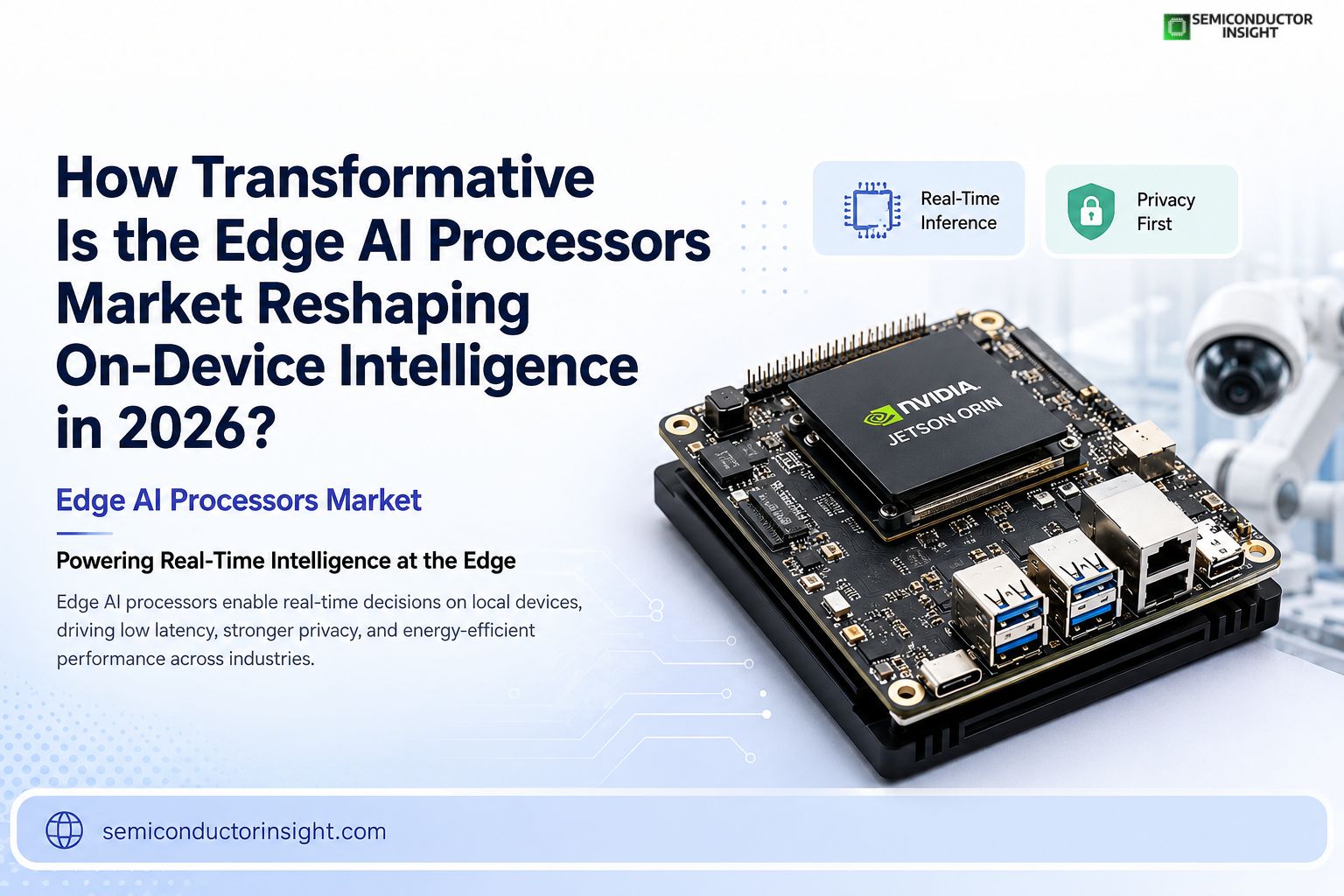
How Transformative Is the Edge AI Processors Market Reshaping On-Device Intelligence in 2026?
Edge AI processors bring computation close to data sources on local devices, enabling real-time decision-making without constant cloud reliance. These specialized chips handle inference tasks directly where sensors capture information, supporting applications from smart cameras to autonomous vehicles and wearable health monitors. This shift prioritizes low latency, enhanced privacy, and energy efficiency in everyday technology deployments worldwide.
Core Architectural Principles Defining Edge AI Processor Capabilities
Modern edge processors integrate neural processing units alongside traditional CPU and GPU elements to optimize matrix operations central to machine learning models. Designs emphasize parallel processing streams that manage tensor calculations efficiently while minimizing power draw.
For example, architectures featuring streaming hybrid vector engines allow seamless handling of varied workloads, from image recognition to natural language processing on compact silicon.
Which Companies Make AI Processors for On-Device Inference
- Several semiconductor leaders produce dedicated solutions for on-device AI inference. NVIDIA offers Jetson platforms like the Orin series, delivering substantial TOPS performance for robotics and vision systems in embedded environments.
- Apple incorporates Neural Engines in its M-series and A-series chips, powering features like on-device photo analysis and voice recognition in consumer devices.
- Qualcomm integrates Hexagon DSPs and NPUs within Snapdragon platforms, widely used in smartphones and IoT modules for efficient local processing. Intel features NPUs in Core Ultra processors for AI PCs, supporting hybrid workloads.
- AMD advances with XDNA architecture in Ryzen processors, while specialized players like Hailo provide accelerators focused on high-performance, low-power inference for cameras and industrial applications.
- Google’s Edge TPU targets lightweight IoT scenarios.
Real-Time Inference Transformations in Industrial and Automotive Settings
In manufacturing facilities, edge processors analyze video feeds instantly to detect anomalies during production runs, reducing downtime through predictive insights. Automotive systems leverage these chips for advanced driver assistance, processing sensor data locally to enable rapid obstacle avoidance and lane management even in areas with limited connectivity. Government-backed initiatives in smart infrastructure deploy similar technology in traffic monitoring cameras across urban networks, improving flow and safety through immediate pattern recognition.
Privacy-Centric Applications Enhancing Consumer and Healthcare Experiences
Wearable devices and smartphones now perform complex tasks like fall detection or personalized health trend analysis entirely on-device, keeping sensitive biometric data secure without transmission. In healthcare, portable diagnostic tools use edge processors to interpret medical imaging or vital signs in remote clinics, supporting faster clinical decisions in regions with variable network access. Case examples from research networks highlight deployments where local inference maintains compliance with strict data protection standards.
Energy Efficiency Breakthroughs Supporting Sustainable Deployments
Processor designs target low wattage operation, with some solutions achieving meaningful performance at just a few watts during active inference. This enables battery-powered drones and sensors to operate longer in field conditions, such as agricultural monitoring stations tracking crop health or environmental sensors in conservation areas. Official technical documentation emphasizes optimizations that balance computational throughput with thermal constraints in fanless enclosures.
Integration Patterns with Broader IoT Ecosystems
Edge AI processors connect seamlessly into larger networks of connected devices, allowing distributed intelligence where individual nodes contribute to collective awareness. Smart city pilots incorporate these chips in streetlights and surveillance systems for localized event detection, feeding aggregated insights to central management without overwhelming bandwidth. Academic and industry collaborations explore frameworks that standardize model deployment across heterogeneous hardware platforms.
Advances in Model Optimization for Constrained Environments
Techniques like quantization and pruning allow complex neural networks to run effectively on edge silicon with reduced memory footprints. Developers refine models to maintain accuracy while fitting within the power and size limitations of mobile or embedded systems. Resources from engineering communities document successful ports of vision and language models to these platforms, demonstrating practical viability across use cases.
Global Collaboration and Standardization Initiatives
International efforts through standards bodies and research consortia focus on compatible toolchains and security protocols for edge deployments. Universities and public research labs contribute benchmarks comparing different processor architectures under realistic workloads, informing next-generation designs.
Government programs supporting semiconductor innovation highlight edge AI as a priority for technological resilience and economic growth.
Lastly before we wrap up, don’t forget to look at our most recent exclusive report for in-depth insights: https://semiconductorinsight.com/report/edge-ai-processors-market/
Emerging Use Cases in Autonomous Systems and Beyond
Beyond current applications, edge processors enable sophisticated behaviors in humanoid robots and delivery drones, processing multimodal inputs for navigation and interaction. Ongoing projects examine their role in enhancing augmented reality experiences and real-time translation devices, pushing boundaries of what compact hardware can achieve independently.
These developments illustrate how Edge AI Processors Market momentum drives more responsive, private, and efficient intelligent systems embedded throughout daily life and critical infrastructure. Continued refinement of hardware-software co-design promises even broader adoption as capabilities expand to meet diverse operational demands globally.

Comments (0)