
How the DDR4 Register Clock Driver Market Is Shaping Memory Reliability?
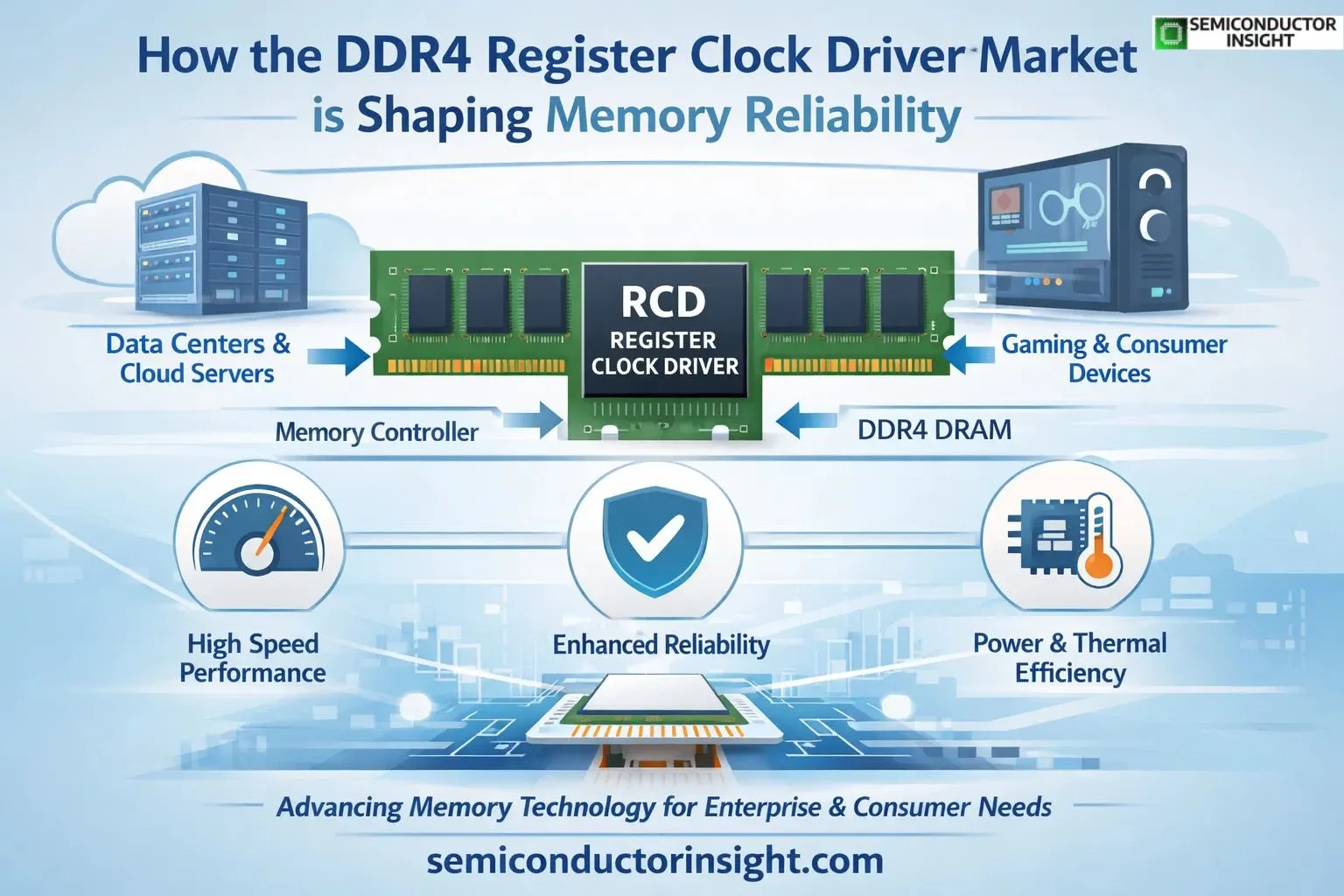
DDR4 Register Clock Driver (RCD) market plays a pivotal role in modern memory subsystem design, enabling higher speeds, greater reliability, and scalable performance across servers, consumer electronics, and compute platforms. As the semiconductor industry continues to evolve toward higher bandwidth and lower power consumption, the RCD a critical logic component sitting between the memory controller and DRAM devices has gained strategic importance.
To begin with, Redefining Memory Communication Overview
At its core, the Register Clock Driver serves to buffer, reorder, and distribute control signals to memory modules while preserving signal integrity at high speeds. RCD-equipped DIMMs offer higher frequency DDR4 operations with narrower timing margins than unbuffered variants. This makes it possible for systems in enterprise settings and data centers to push performance limits with consistent, low-latency behavior.
Design engineers increasingly rely on RCD performance to resolve challenges tied to signal skew, crosstalk, and propagation delay common roadblocks when scaling beyond 2133 MT/s in traditional DDR4 interfaces.
Evolving Architectures and Integration Approaches
Manufacturers such as Micron, Samsung, and SK Hynix have driven RCD innovations through multi-die module designs and intelligent clock network topology to meet system requirements. This has resulted in features such as adaptive timing controls and hardware-level error mitigation.
For example, designers are incorporating dynamic impedance control within RCD logic to reduce reflections on high-speed traces. Such implementations allow systems to sustain signal quality across diverse environmental conditions beneficial for densely packed server environments where heat and electrical interference can degrade signal paths.
System vendors are also exploring integration of RCD logic into memory buffer architectures to consolidate components, thus reducing overall board complexity while improving frequency scalability.
Real-World Implementations
- In 2024, several OEMs integrated enhanced RCD modules into their server platforms.
- A noteworthy case comes from an enterprise cloud provider that deployed registers with optimized clock drive topology across a fleet of analytics servers.
- The result: a quantifiable decrease in refresh latency with correlating improvements in memory access consistency for multi-tenant workloads.
- In consumer spaces, gaming motherboards leveraging premium DDR4 kits with refined RCD designs noticed improved overclocking headroom, as reported in Hardware Insights Magazine. This has made RCD considerations part of enthusiast platform build decisions, extending the component’s relevance beyond corporate IT.
You Can Freely Surf Our Latest Updated Report Here: https://semiconductorinsight.com/report/global-ddr4-register-clock-driver-market/
Efficiency, Power, and Thermal Considerations
DDR4 RCDs are not solely about performance; they influence power profiles and thermal behavior. The RCD introduces additional logic between the controller and DRAM ranks, which could increase power draw if not carefully optimized. Leading RCD solutions address this with low-power clock gating and adaptive standby circuits that lower energy use when idle.
Efficient designs matter most in mobile computing and edge devices where power budgets are tight. A current study published by Mobile Memory Quarterly showed that refined RCD implementations reduced idle power by ~12%, prolonging battery life without sacrificing responsiveness.
Differentiation through Custom Features
While basic RCD functions are standardized, market differentiation stems from feature sets such as signal equalization, temperature-compensated timing, and integration with board management systems. These advanced features cater to applications requiring rigorous performance consistency for instance, in autonomous vehicle compute modules and industrial automation controllers where faults cannot be tolerated.
Moreover, smart telemetry within some RCD circuits now provides system health feedback, enabling predictive maintenance and continuous performance tuning. This intelligence is becoming especially valuable in hyperscale environments where uptime is critical and downtime costs escalate rapidly.
Impact of Next-Gen Memory Standards
Although DDR5 and beyond are rapidly entering the mainstream conversation, DDR4 RCD technology remains relevant due to its maturity, cost efficiency, and continued use in legacy and mid-tier systems. DDR5 adopts different clocking and buffering strategies, but DDR4 holds a sizable installed base. This makes RCD designs for DDR4 a stable market segment with consistent demand.
Industry analysts have noted that many organizations prefer maximizing existing DDR4 deployments rather than migrating prematurely to newer standards, especially in cost-sensitive applications underscoring durability and ongoing relevance for RCD solutions.
Collaborative Innovation and Ecosystem Growth
RCD market continues to benefit from partnerships among IC vendors, board makers, and system integrators. Joint efforts to validate high-speed memory channels through simulation platforms and silicon prototypes have shortened development cycles and reduced risk. Publications in Memory Design demonstrate shared test frameworks where RCD variations are evaluated across multiple JEDEC-compliant configurations enabling developers to fine-tune clock distribution paths before final hardware release.
DDR4 Register Clock Driver Market is evolving as an essential enabler of stable, high-performance memory systems. Driven by data-intensive workloads, advanced integration techniques, and real-world optimization case studies, RCD technology will remain central in both enterprise and sophisticated consumer applications even as the industry transitions toward next-generation memory standards.

Comments (0)