

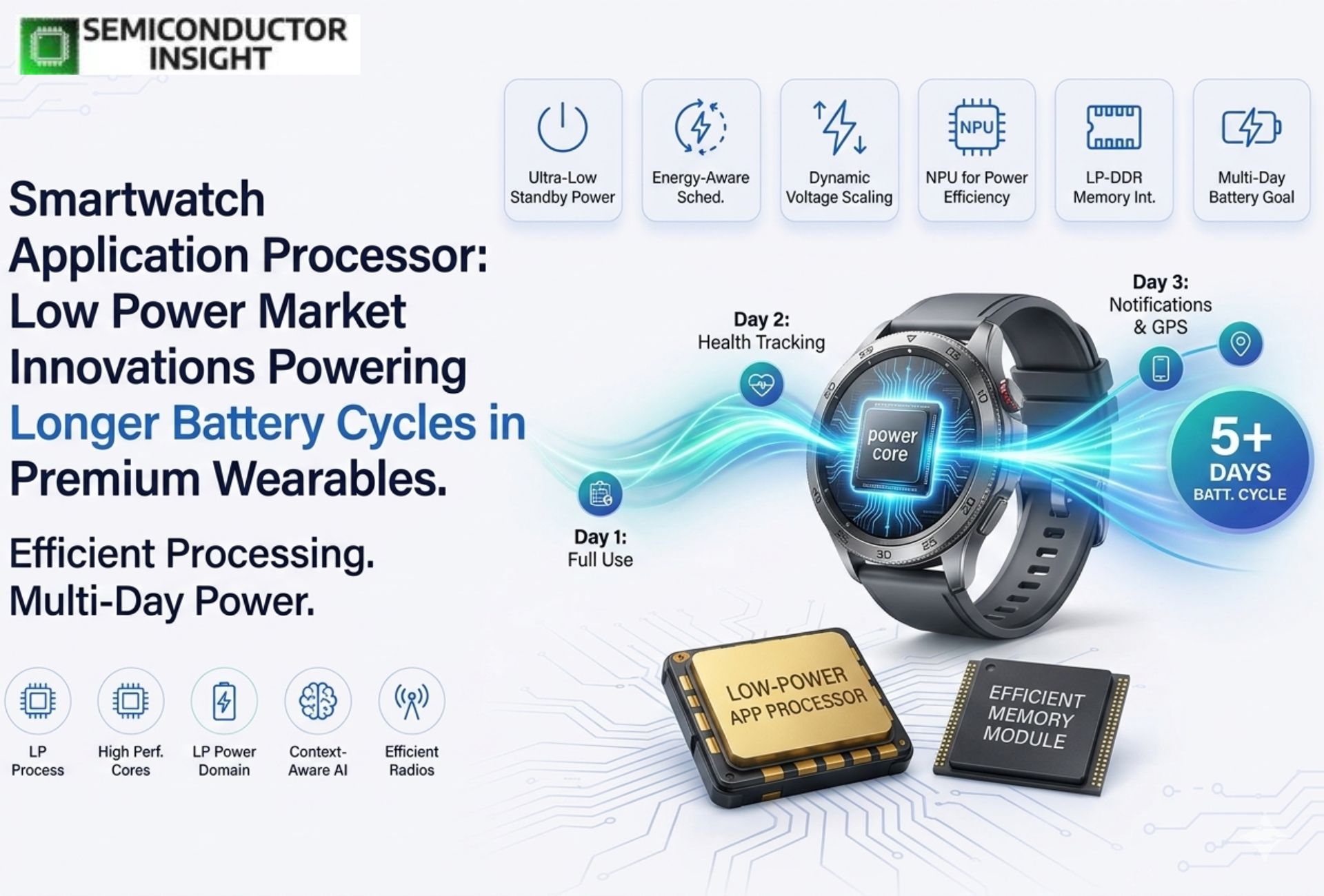
How Smartwatch Application Processor Low Power Market Is Enabling Longer Battery Cycles in Premium Wearables?
Smartwatches are no longer limited to notifications and fitness tracking. Modern wearable devices now function as compact computing platforms capable of handling health analytics, voice processing, wireless communication, AI-assisted interactions, and real-time sensor management. At the centre of this transformation is the smartwatch application processor low power market, where semiconductor companies are racing to build chips that balance performance with extreme energy efficiency.
Application processors for smartwatches are made with extended battery life, compact integration, and thermal efficiency in mind. Processors in smartphones are built to conduct raw processing. Semiconductor developers are increasingly interested in ultra-low-power architectures, as they let devices run continuously with tiny designs and light hardware profiles.
This transition is reshaping chip design priorities across the wearable semiconductor ecosystem.
The Battery Efficiency Race Is Driving Chip Innovation
Battery life remains one of the most important factors influencing smartwatch adoption globally. Consumers increasingly expect devices to deliver multi-day operation while supporting features such as GPS tracking, ECG monitoring, sleep analytics, Bluetooth connectivity, and AI-powered assistants.
To meet these expectations, semiconductor companies are integrating heterogeneous computing architectures that distribute workloads across low-power cores and specialized accelerators. This approach minimizes unnecessary energy consumption during background activities.
Recent smartwatch chipsets built on advanced semiconductor nodes are demonstrating major gains in efficiency. Taiwan Semiconductor Manufacturing Company (TSMC) and Samsung Foundry continue expanding production capabilities for smaller process technologies that support wearable chip miniaturization.
According to the International Energy Agency, global connected device usage continues rising rapidly as wearable electronics become part of broader digital lifestyles. This growth is placing additional pressure on semiconductor suppliers to optimize power consumption without compromising responsiveness.
Stay connected for additional in-depth information right here: https://semiconductorinsight.com/report/smartwatch-application-processor-low-power-market/
AI Processing Is Moving Directly Onto Smartwatch Chips
- Artificial intelligence is becoming a defining feature within the smartwatch application processor low power market. Instead of relying entirely on cloud processing, wearable devices are increasingly performing AI tasks directly on-device through edge computing architectures.
- Modern smartwatch processors can now support voice recognition, activity classification, biometric analysis, and predictive health insights locally. This reduces latency, improves privacy, and lowers dependence on continuous internet connectivity.
- Apple, Qualcomm, MediaTek, and Google are all investing in semiconductor platforms optimized for wearable AI workloads. Several next-generation smartwatches now include neural processing capabilities that enhance gesture recognition and adaptive user interfaces.
- In 2025, wearable AI integration expanded significantly as health-focused smartwatches adopted machine learning models for heart rhythm analysis, sleep pattern tracking, and workout optimization. Semiconductor efficiency has become essential because AI processing can quickly increase battery drain if chips are not carefully optimized.
Health Monitoring Features Are Increasing Processor Complexity
Healthcare-oriented wearables are adding new demands to semiconductor design. Smartwatch processors must now continuously interact with optical sensors, accelerometers, ECG systems, temperature monitors, and blood oxygen tracking modules.
According to the World Health Organization, cardiovascular diseases remain one of the leading causes of mortality worldwide, increasing interest in wearable monitoring technologies capable of supporting preventive healthcare initiatives.
This healthcare integration is directly influencing semiconductor engineering priorities. Chips designed for wearable medical monitoring must operate with low latency while maintaining continuous sensor communication throughout the day.
Some premium wearable platforms now process millions of biometric data points daily. Semiconductor developers are therefore focusing heavily on sensor fusion technologies that combine multiple data streams while minimizing power usage.
Semiconductor Packaging Is Becoming More Compact and Advanced
The smartwatch application processor low power market is also benefiting from advancements in semiconductor packaging technologies. Smaller wearable devices require highly integrated system-on-chip designs that combine processors, graphics units, wireless connectivity, memory management, and AI accelerators within minimal board space.
Advanced packaging methods such as fan-out wafer-level packaging and 3D integration are helping manufacturers reduce chip footprints while improving thermal performance.
This miniaturization trend is especially important because smartwatch manufacturers continue prioritizing thinner designs and larger display areas without increasing overall device size.
Industry publications from IEEE and semiconductor engineering journals have highlighted how packaging innovation is becoming equally important as transistor scaling in wearable electronics development.

Comments (0)