
How Smart Is Smart Battery Maintainer Market in 2026? Technology and Usage Trends Explained
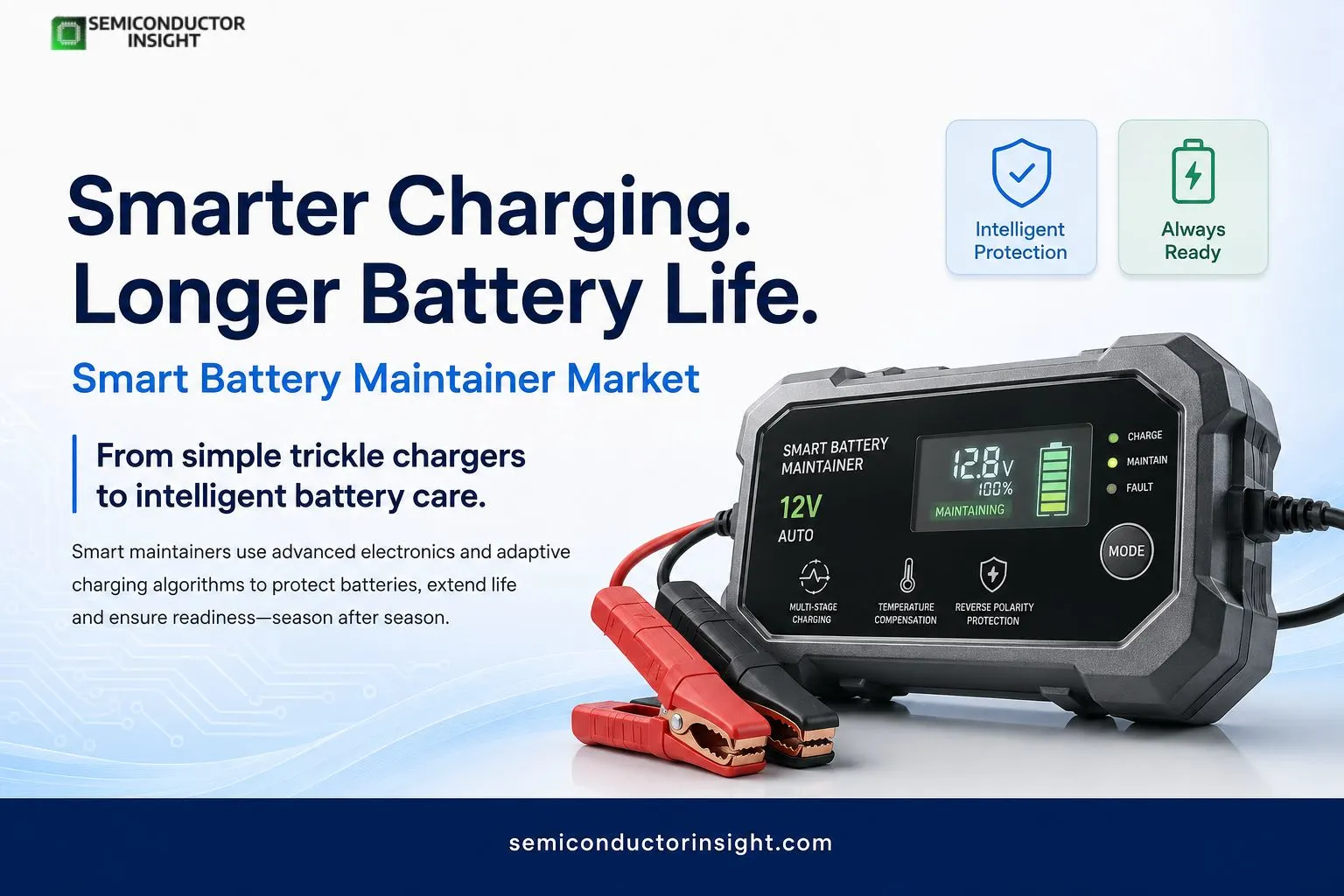
Smart Battery Maintainer Market is moving toward a more electronics-driven model as batteries increasingly remain connected to vehicles, recreational equipment, backup systems and stored machinery for extended periods. Smart maintainers monitor battery conditions and automatically modify charging behaviour, in contrast to traditional chargers that are primarily intended to supply a fixed current. Because of this, the product is especially helpful in situations when a battery may not be used for weeks or months but yet needs to be prepared for instant usage.
The technology combines power electronics, voltage sensing, microcontrollers, and current regulation and protection circuits. As battery chemistries diversify, these electronic controls are becoming more important because a charging profile suitable for one battery cannot simply be applied to another.
The Charger Is Becoming a Battery Management Device
- Modern maintainers increasingly operate through multiple charging stages rather than continuously delivering the same current.
- A typical intelligent system can identify battery voltage, initiate charging when required, reduce the charging rate as the battery approaches its target condition and switch into a maintenance mode.
- This approach addresses a basic problem with stored batteries: electrical charge gradually declines even when the equipment is not being used.
- Battery University notes that self-discharge varies by chemistry and temperature. Its technical guidance indicates that lead-acid batteries can lose roughly 3% of charge per month at 20°C, while elevated temperatures accelerate the process.
- For owners of motorcycles, classic cars, boats, generators and seasonal equipment, maintaining charge can therefore be more practical than repeatedly allowing the battery to discharge and subsequently recharging it.
12V Remains the Familiar Entry Point
The 12V battery ecosystem continues to provide an important application base for smart maintainers. Passenger vehicles, motorcycles, recreational vehicles, marine equipment and many small machines use 12V electrical systems, creating a broad installed base for compact maintenance chargers.
This also explains why many consumer-oriented maintainers combine automatic voltage detection with reverse-polarity protection, short-circuit protection and temperature monitoring. The objective is not simply to deliver electrical energy but to reduce the likelihood of inappropriate charging.
For manufacturers, this creates opportunities to differentiate products through connector systems, weather-resistant housings, display interfaces and automatic battery-status indicators rather than relying solely on charging current specifications.
Lithium Chemistry Is Forcing a Different Charging Logic
- The expansion of lithium-ion batteries is introducing another layer of complexity. Lithium-ion cells require tightly controlled charging and protection systems, making a lead-acid charging profile unsuitable for many lithium applications.
- Battery University identifies different storage behaviour for lead-acid and lithium-ion systems, noting that lithium-ion batteries are generally best stored at a partial state of charge rather than fully charged for extended periods.
- This is encouraging manufacturers to develop chemistry-specific maintainers rather than universal chargers that treat every battery identically. Smart products increasingly identify battery type manually or through selectable charging modes and then apply a corresponding voltage and current strategy.
Microcontrollers Are Quietly Transforming the Product
One of the biggest changes is taking place inside the enclosure. Microcontrollers can continuously evaluate voltage and charging conditions and use programmed algorithms to determine when charging should begin, pause or resume.
That makes the maintainer closer to a small embedded control system than a traditional power adapter. Semiconductor components such as MOSFETs, voltage regulators, current-sensing circuits, temperature sensors and control ICs form the electronic foundation.
The semiconductor connection is particularly significant because improvements in switching efficiency and sensing accuracy can help manufacturers build smaller chargers with more controlled thermal performance and more precise charging behaviour.
To find out more, feel free to browse our latest updated report: https://semiconductorinsight.com/report/smart-battery-maintainer-market/
Pulse Charging Is Becoming a Technology Watchpoint
Pulse-based charging remains an area of technical interest because controlled current pulses can be incorporated into battery charging strategies. Recent research has also examined how pulse charging can affect charging speed and battery degradation while considering the impact of intermittent charging loads on electrical systems.
For smart maintainers, the broader opportunity is algorithmic control. Instead of maintaining a battery through a single uninterrupted current profile, future systems can increasingly make decisions based on voltage, temperature, elapsed time and previous charging behaviour.
Seasonal Equipment Creates a Strong Use Case
The smart maintainer has a particularly clear role when equipment spends substantial time in storage. Motorcycles during winter, boats between seasons, recreational vehicles, collector cars and standby generators can all experience long periods without normal alternator or charging-system activity.
A maintainer connected during storage can keep the battery within an appropriate charge range and reduce the need for repeated manual charging. Battery University specifically recommends monitoring stored lead-acid batteries and recharging them before their state of charge becomes excessively low because prolonged low charge can contribute to sulfation.
Safety Electronics Are Becoming a Product Differentiator
- As charging products become more intelligent, protection is becoming as important as charging speed. Reverse-polarity detection, over-temperature monitoring, over-voltage protection, short-circuit protection and automatic shutdown are increasingly relevant features.
- This becomes especially important as lithium-based batteries become more common. Battery systems can respond differently to overcharging, excessive heat and deep discharge, so smart charging hardware must operate within chemistry-specific limits.
From Charger Hardware to Connected Battery Care
The next stage of Smart Battery Maintainer Market is likely to involve greater visibility into battery condition. LED indicators are already being supplemented by digital displays, Bluetooth connectivity and application-based monitoring in higher-end products.
The underlying concept is simple: users increasingly want to know whether a battery is healthy, charging, fully maintained or showing signs of deterioration without physically testing it. As sensors become cheaper and embedded electronics become more capable, the maintainer can evolve from a passive accessory into a small battery-health monitoring platform.
This shift places the product at the intersection of power semiconductors, embedded electronics, battery chemistry and connected-device technology, giving Smart Battery Maintainer Market a much broader technology profile than conventional trickle charging.

Comments (0)