
How Radar Motion Sensors Are Reshaping Automotive Safety and Smart Systems
A silent technological shift is redefining how machines understand movement, presence, and spatial awareness. Radar motion sensors market is emerging as a core pillar of modern semiconductor innovation, enabling intelligent sensing capabilities across automotive safety, industrial automation, smart homes, and security ecosystems. Unlike traditional detection technologies, radar sensors operate with remarkable precision in challenging environments such as darkness, fog, and extreme weather, making them essential in next-generation smart systems.
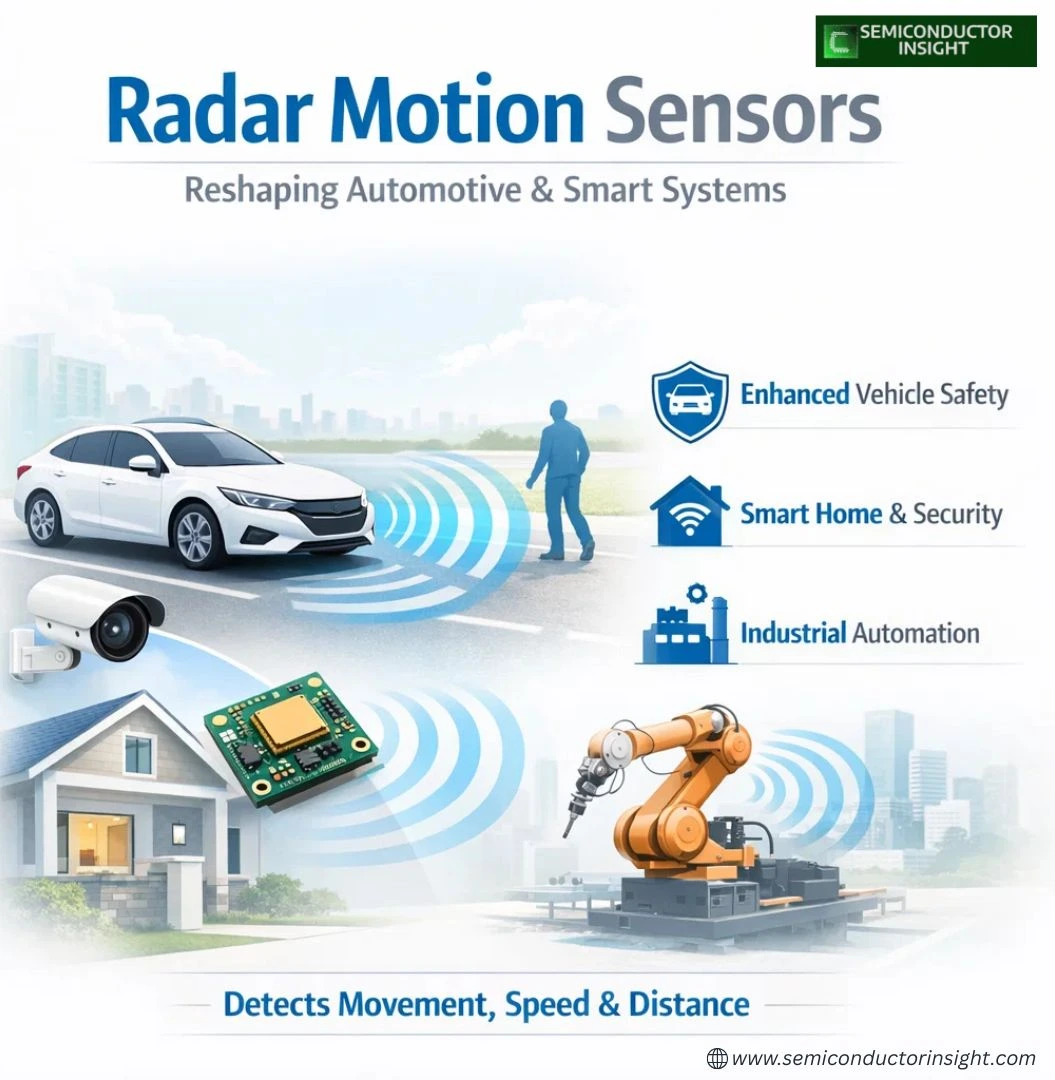
Radar motion sensors use electromagnetic waves to detect object movement, speed, and distance by measuring signal reflections. Their ability to provide high accuracy without physical contact has made them indispensable in automation-driven industries. Increasing digital transformation, connected infrastructure, and intelligent electronics continue to expand their adoption globally. The market is experiencing strong growth due to rising applications in automotive safety systems, smart surveillance, and industrial monitoring solutions.
Core Semiconductor Driving Radar Motion Detection
- At the heart of radar motion sensors lies advanced semiconductor integration, enabling compact, efficient, and high-performance detection systems. These sensors rely on specialized chipsets designed for signal transmission, reception, and processing.
- Modern radar sensors typically operate using millimetre wave frequencies, particularly 24 GHz, 60 GHz, and 77 GHz bands, each offering different detection ranges and resolution capabilities. High-frequency radar provides superior spatial resolution and enables accurate tracking of objects even in dense environments.
- Key technological components include transceiver modules, antenna arrays, signal processors, and microcontrollers, all integrated within compact semiconductor packages. Recent advancements in radar on chip architecture are reducing device size while improving energy efficiency and computational performance, supporting mass adoption across consumer and industrial electronics.
- The integration of artificial intelligence algorithms within radar systems further enhances motion classification, predictive tracking, and real-time analytics, transforming sensors from simple detection tools into intelligent perception systems.
Growing Application Diversity
Radar motion sensors are no longer limited to defence and aerospace applications. Their adoption is rapidly expanding across multiple commercial sectors.
In automotive systems, radar sensors enable adaptive cruise control, blind spot monitoring, and collision avoidance technologies, supporting safer driving experiences and autonomous mobility development. Over 130 million vehicles equipped with advanced driver assistance features were shipped globally, demonstrating the scale of radar adoption in transportation systems.
Smart home technologies represent another major growth area, where radar sensors enable presence detection, energy management, and intelligent lighting control. These sensors can detect motion through walls and operate effectively in low visibility conditions, making them superior to traditional infrared detection systems.
Industrial automation also benefits significantly from radar sensing, where motion detection enhances equipment monitoring, worker safety, and process optimization. Increasing adoption of Industry 4.0 technologies continues to strengthen demand for precise sensing solutions.
To Know More about the Report, You Can Freely Browse Our Latest Updated Report: https://semiconductorinsight.com/report/radar-motion-sensors-market/
Integration with Intelligent Systems and IoT Infrastructure
The convergence of radar sensing with Internet of Things infrastructure is unlocking new opportunities for connected environments. Radar sensors integrated with edge computing platforms enable real-time motion analysis and predictive monitoring across smart buildings and industrial facilities.
Advanced sensor fusion techniques combine radar data with cameras and other sensors to improve object detection accuracy and reduce system errors. This integration supports applications such as autonomous navigation, robotics, and smart city infrastructure.
Low-power radar solutions designed for battery-operated devices are also expanding adoption in wireless sensing networks, asset tracking systems, and energy-efficient monitoring platforms.
Have a Quick Glance on the Growing Semiconductor Opportunity
Radar motion sensors market reflects a broader transformation within the semiconductor industry toward intelligent sensing and automated decision systems. Increasing investments in autonomous vehicles, smart infrastructure, and connected devices continue to create strong demand for high-performance sensing technologies.
With continuous innovation in signal processing, AI integration, and high-frequency semiconductor design, radar motion sensors are evolving into essential components of modern electronic ecosystems. Their expanding role in safety, automation, and intelligent detection positions the technology at the forefront of next-generation semiconductor advancement.

Comments (0)