MARKET INSIGHTS
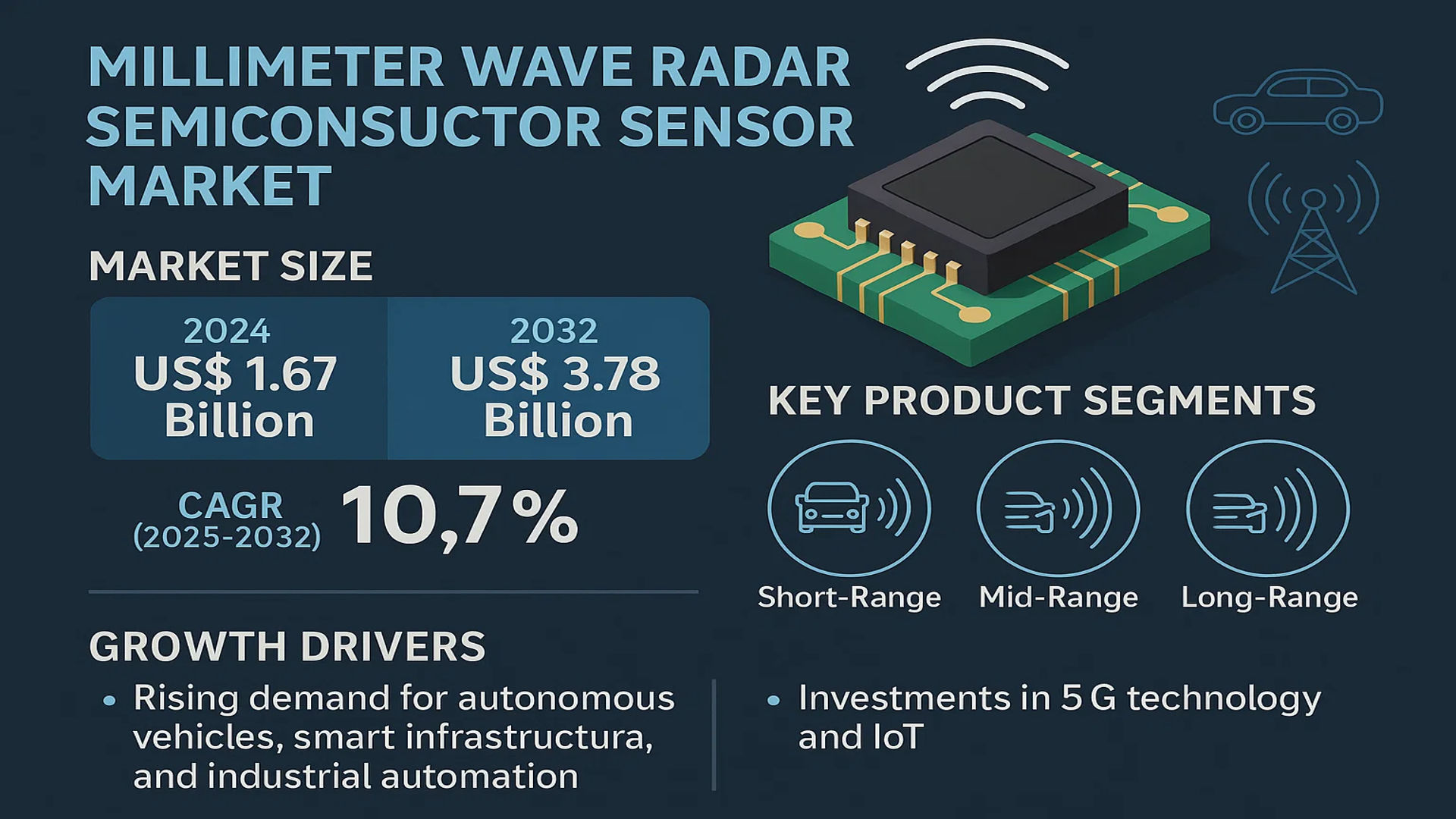
The global Millimeter Wave Radar Semiconductor Sensor market size was valued at US$ 1.67 billion in 2024 and is projected to reach US$ 3.78 billion by 2032, at a CAGR of 10.7% during the forecast period 2025-2032.
Millimeter wave radar semiconductor sensors are advanced components that operate in the 24GHz to 300GHz frequency range, enabling high-resolution detection of objects, speed, and distance. These sensors leverage radio waves to identify and track targets with precision, making them indispensable in applications requiring real-time object recognition and environmental mapping. Key product segments include short-range, mid-range, and long-range radar sensors, each serving distinct use cases across industries.
The market is expanding rapidly due to rising demand for autonomous vehicles, smart infrastructure, and industrial automation. Growth is further accelerated by increasing investments in 5G technology and the Internet of Things (IoT), where millimeter wave sensors enhance connectivity and spatial awareness. However, challenges like high production costs and signal interference in adverse weather conditions may temper adoption rates. Leading players such as Infineon Technologies, NXP Semiconductors, and Texas Instruments are driving innovation through compact, low-power sensor designs tailored for next-gen automotive and smart city applications.
MARKET DYNAMICS
MARKET DRIVERS
Expansion of Autonomous Vehicles to Fuel Millimeter Wave Radar Adoption
The automotive sector’s accelerating shift toward autonomous driving systems is creating unprecedented demand for millimeter wave radar semiconductor sensors. These sensors provide critical capabilities for advanced driver-assistance systems (ADAS), enabling object detection, collision avoidance, and adaptive cruise control functions even in challenging weather conditions. With governments worldwide mandating improved vehicle safety standards, the integration of radar sensors in passenger vehicles is projected to increase significantly. The global ADAS market penetration is expected to reach over 40% in new vehicle shipments by 2025, creating substantial growth opportunities for millimeter wave radar components.
5G Network Deployments Accelerating Demand for High-Frequency Components
The ongoing rollout of 5G infrastructure is driving substantial investment in millimeter wave technologies, as network operators require semiconductor solutions capable of operating in the 24GHz to 100GHz spectrum range. This has created a parallel demand for radar sensors that share similar high-frequency semiconductor architectures. The telecommunications industry’s need for small cell deployments in dense urban environments has further amplified this trend, with millimeter wave components proving essential for both communication and sensing applications. As 5G coverage expands to meet growing data consumption needs, the addressable market for compatible semiconductor sensors continues to broaden.
Smart City Initiatives Driving Industrial and Infrastructure Applications
Municipal investments in smart traffic management, security surveillance, and industrial automation are creating new deployment scenarios for millimeter wave radar sensors. These systems offer distinct advantages over competing technologies like LIDAR or cameras, particularly in scenarios requiring all-weather reliability and privacy-compliant monitoring. The ability to detect both stationary and moving objects with high precision makes these sensors ideal for applications ranging from parking guidance systems to perimeter security. With smart city projects receiving increased funding globally, the industrial and infrastructure segment is emerging as a key growth driver for millimeter wave sensor adoption.
MARKET RESTRAINTS
Signal Interference Challenges in Dense Environments
While millimeter wave radar technology offers significant advantages, it faces operational limitations in crowded RF environments. The proliferation of wireless devices operating in adjacent frequency bands can create interference that degrades sensor performance. This challenge is particularly acute in urban deployments where multiple radar systems may be operating simultaneously. The technical complexity of filtering noise from desired signals requires advanced signal processing algorithms that increase system cost and power consumption. These constraints currently limit the widespread adoption of millimeter wave sensors in certain high-density applications.
Other Restraints
Regulatory Constraints on Frequency Allocation
The availability of suitable frequency spectrum varies significantly by region, with regulatory bodies imposing different restrictions on millimeter wave band usage. This fragmentation creates complications for manufacturers seeking to develop globally compatible products. The lengthy approval processes for new frequency allocations can also delay product deployments, particularly in markets with stringent electromagnetic compatibility requirements.
Material Limitations at Higher Frequencies
As operating frequencies increase to achieve better resolution, semiconductor materials face fundamental physical constraints. Current silicon-based technologies encounter diminishing returns in performance and power efficiency at the upper ends of the millimeter wave spectrum. While alternative compound semiconductors show promise, they currently carry significantly higher production costs that limit their commercial viability for mass-market applications.
MARKET CHALLENGES
High Development Costs and Time-to-Market Pressures
The specialized nature of millimeter wave semiconductor design presents substantial barriers to entry for new market participants. Developing radar sensors that meet automotive-grade or industrial reliability standards requires extensive R&D investment and access to specialized testing facilities. The typical development cycle from design to volume production often exceeds 18 months, creating cash flow challenges for smaller firms. Additionally, the need for continuous innovation to improve resolution and reduce false detection rates places ongoing pressure on research budgets across the industry.
Other Challenges
Integration Complexity with Complementary Technologies
Modern sensor fusion architectures require millimeter wave radar to work seamlessly with cameras, ultrasonic sensors, and other detection systems. Achieving reliable data synchronization across these disparate technologies while maintaining real-time performance presents significant engineering hurdles. The lack of standardized interfaces between different sensor types further complicates system integration efforts.
Thermal Management in Compact Form Factors
As applications demand smaller sensor packages with higher performance, effective heat dissipation becomes increasingly problematic. Millimeter wave semiconductors generate substantial thermal loads that must be managed without compromising reliability or introducing signal distortion. These thermal constraints influence everything from product housing designs to acceptable operating environments, limiting deployment flexibility in some use cases.
MARKET OPPORTUNITIES
Emerging Industrial IoT Applications Create New Deployment Scenarios
The growth of Industry 4.0 initiatives is opening substantial opportunities for millimeter wave radar in manufacturing environments. These sensors are proving valuable for applications including material level monitoring, robotic guidance systems, and predictive maintenance. Unlike optical solutions, millimeter wave sensors can operate effectively in environments with dust, steam, or variable lighting conditions – common challenges in industrial settings. As factories continue their digital transformation, the demand for reliable non-contact sensing solutions is expected to accelerate significantly.
Advancements in AI Processing Enable New Capabilities
The integration of artificial intelligence with millimeter wave radar signal processing is creating opportunities for more sophisticated detection and classification algorithms. Modern AI approaches can extract detailed information about object composition, movement patterns, and environmental context from radar returns that previously couldn’t be interpreted. This advancement expands potential applications into areas like elderly care monitoring, retail analytics, and advanced security screening. The ability to glean meaningful insights from radar data without compromising privacy positions these solutions favorably for sensitive deployment scenarios.
Material Science Breakthroughs Enable Cost Reductions
Recent innovations in semiconductor packaging and antenna design are helping to lower the bill of materials for millimeter wave radar systems. The development of antenna-on-package solutions and high-volume manufacturing techniques for III-V compound semiconductors shows particular promise. These advancements could significantly reduce production costs while maintaining performance standards, potentially making millimeter wave radar viable for consumer electronics and other price-sensitive applications where penetration has previously been limited.
MILLIMETER WAVE RADAR SEMICONDUCTOR SENSOR MARKET TRENDS
Increasing Adoption in Automotive Applications to Drive Market Growth
The millimeter wave radar semiconductor sensor market is witnessing substantial growth, primarily due to advancements in autonomous vehicles and advanced driver-assistance systems (ADAS). Short-range radar (SRR) and long-range radar (LRR) technologies are becoming integral in detecting obstacles, adaptive cruise control, and collision avoidance systems. The global automotive radar market, valued at over $5.5 billion in 2023, is projected to continue expanding with a CAGR of approximately 9% through 2030, reinforcing demand for high-performance semiconductor sensors. Furthermore, regulatory mandates for vehicle safety in regions such as the EU and North America are accelerating adoption, as automakers integrate radar-based systems to meet NCAP safety ratings.
Other Trends
Expansion in Smart Infrastructure and IoT
Beyond automotive applications, millimeter wave radar sensors are gaining traction in smart cities, industrial automation, and security surveillance. With increasing urbanization, governments and enterprises are investing in smart traffic management and public safety solutions that rely on real-time radar data. The demand for 60 GHz and 77 GHz frequency bands has risen due to their high-resolution capabilities in detecting object movement, distance, and speed. This trend is further supported by the growing integration of IoT devices, where radar sensors enable touchless interactions and occupancy monitoring in commercial buildings, healthcare facilities, and retail environments.
Technological Innovations in Semiconductor Manufacturing
Advances in semiconductor fabrication, including silicon-germanium (SiGe) and gallium nitride (GaN) technologies, are enhancing the performance and reducing the cost of millimeter wave radar sensors. The shift towards smaller node processes (e.g., 28nm and below) is improving power efficiency and integration capabilities, making these sensors viable for mass-market consumer electronics. For instance, smartphone manufacturers are exploring millimeter wave radar for gesture recognition, facial recognition, and proximity sensing. Additionally, ongoing research in artificial intelligence (AI)-enabled radar processing is optimizing data interpretation, reducing false positives, and expanding use cases in robotics and industrial automation.
COMPETITIVE LANDSCAPE
Key Industry Players
Technological Innovation and Strategic Alliances Drive Market Position
The global Millimeter Wave Radar Semiconductor Sensor Market features a dynamic competitive environment shaped by technological advancements and strategic expansions. Leading players are focusing on high-performance radar solutions, particularly for automotive, industrial automation, and smart infrastructure applications. Companies like Texas Instruments and Infineon Technologies dominate due to their extensive R&D investments and diversified product portfolios tailored for short-range and long-range radar applications.
The market remains competitive as mid-sized players such as NOVELIC and Silicon Radar GmbH innovate with compact, energy-efficient radar sensors, catering to emerging IoT and smart city applications. These companies are actively expanding into Asia-Pacific markets, where demand for intelligent traffic management and industrial automation is rapidly growing.
Furthermore, mergers and acquisitions are reshaping the landscape. For instance, NXP Semiconductors strengthened its position by acquiring radar-sensor startups, enhancing its expertise in 77GHz and 79GHz millimeter-wave radar technology. Meanwhile, newer entrants like Ainstein AI are leveraging AI-driven radar analytics to differentiate their offerings in niche applications like drone navigation and retail sensing.
The market is also witnessing increased collaborations between semiconductor manufacturers and automotive OEMs to develop next-generation ADAS (Advanced Driver Assistance Systems). This trend, coupled with tightening safety regulations, underscores the importance of reliable millimeter-wave radar sensors in autonomous vehicles.
List of Key Millimeter Wave Radar Semiconductor Sensor Companies Profiled
- Texas Instruments (U.S.)
- Infineon Technologies (Germany)
- NXP Semiconductors (Netherlands)
- NOVELIC (Serbia)
- Silicon Radar GmbH (Germany)
- Ainstein AI (U.S.)
- AgilSense (Israel)
- Mistral (India)
- Dalian Iflabel Technology Co., Ltd. (China)
- Alpha Controls & Instrumentation Inc. (U.S.)
Segment Analysis:
By Type
Long-range Radar Sensor Segment Leads Due to High Adoption in Automotive and Aerospace Applications
The market is segmented based on type into:
- Short-range Radar Sensor
- Mid-range Radar Sensor
- Long-range Radar Sensor
By Application
Smart City Segment Dominates Owing to Rising Demand for Traffic Monitoring and Security Solutions
The market is segmented based on application into:
- Smart City
- Building Automation
- Lighting and Media Control
- Mobile Phone or Wearable Device
- Others
By Frequency Band
77-81 GHz Segment Prevails as Standard for Automotive and Industrial Applications
The market is segmented based on frequency band into:
- 24 GHz
- 60 GHz
- 77-81 GHz
- Others
By Technology
FMCW Technology Segment Holds Majority Share Due to Superior Range Resolution
The market is segmented based on technology into:
- FMCW (Frequency-Modulated Continuous Wave)
- CWs (Continuous Wave)
- Pulsed
Regional Analysis: Millimeter Wave Radar Semiconductor Sensor Market
Asia-Pacific
The Asia-Pacific region dominates the global Millimeter Wave Radar Semiconductor Sensor market, driven by rapid industrialization, urbanization, and technological adoption. Countries such as China, Japan, and South Korea are leading the charge, with significant investments in autonomous vehicles, smart cities, and IoT infrastructure. China’s aggressive push in 5G deployment and smart manufacturing has accelerated demand for high-precision radar sensors. Meanwhile, Japan’s automotive sector, led by key players like Toyota and Honda, continues to integrate advanced radar systems for ADAS (Advanced Driver-Assistance Systems). While cost sensitivity remains a challenge in emerging economies, governments are increasingly supporting R&D initiatives to bridge the gap.
North America
North America is a key innovator in the Millimeter Wave Radar Semiconductor Sensor market, fueled by strong R&D investments and early adoption of cutting-edge technologies. The U.S. accounts for the largest share, with semiconductor giants such as Texas Instruments and Infineon Technologies driving advancements in automotive and industrial applications. Regulatory support for autonomous vehicles, along with defense and aerospace investments, further propels market growth. However, supply chain disruptions and trade restrictions on semiconductor components pose challenges for local manufacturers. Despite this, collaborations between tech firms and automotive OEMs continue to expand the application scope of radar sensors.
Europe
Europe’s market is characterized by stringent regulatory standards and a strong emphasis on automotive safety and industrial automation. The EU’s focus on reducing road accidents has led to mandates for advanced radar-based safety systems in vehicles. Germany, in particular, is a hub for radar sensor innovation, with companies like NXP Semiconductors and Silicon Radar GmbH leading developments in short- and mid-range radar solutions. Additionally, the region’s growing smart infrastructure projects, particularly in Scandinavia and the Benelux countries, are creating new opportunities for millimeter-wave sensor deployment.
South America
The market in South America is nascent but presents long-term potential, particularly in Brazil and Argentina, where automotive and industrial sectors are gradually adopting radar-based systems. Economic instability and limited local manufacturing capabilities hinder faster adoption. Nevertheless, increasing foreign investments in automotive production and infrastructure modernization are expected to drive demand over the coming years. Partnerships with global semiconductor suppliers could help overcome technical and financial barriers in the region.
Middle East & Africa
This region shows emerging growth in the Millimeter Wave Radar Semiconductor Sensor market, primarily driven by smart city initiatives in the UAE, Saudi Arabia, and Israel. The defense sector also contributes to demand, particularly for long-range radar applications. However, limited domestic expertise in semiconductor manufacturing and reliance on imports constrain market expansion. Governments are gradually initiating policies to foster local tech ecosystems, which could unlock new opportunities in the long run.
Report Scope
This market research report provides a comprehensive analysis of the global and regional Millimeter Wave Radar Semiconductor Sensor markets, covering the forecast period 2025–2032. It offers detailed insights into market dynamics, technological advancements, competitive landscape, and key trends shaping the industry.
Key focus areas of the report include:
- Market Size & Forecast: Historical data and future projections for revenue, unit shipments, and market value across major regions and segments.
- Segmentation Analysis: Detailed breakdown by product type, technology, application, and end-user industry to identify high-growth segments and investment opportunities.
- Regional Outlook: Insights into market performance across North America, Europe, Asia-Pacific, Latin America, and the Middle East & Africa, including country-level analysis where relevant.
- Competitive Landscape: Profiles of leading market participants, including their product offerings, R&D focus, manufacturing capacity, pricing strategies, and recent developments such as mergers, acquisitions, and partnerships.
- Technology Trends & Innovation: Assessment of emerging technologies, integration of AI/IoT, semiconductor design trends, fabrication techniques, and evolving industry standards.
- Market Drivers & Restraints: Evaluation of factors driving market growth along with challenges, supply chain constraints, regulatory issues, and market-entry barriers.
- Stakeholder Analysis: Insights for component suppliers, OEMs, system integrators, investors, and policymakers regarding the evolving ecosystem and strategic opportunities.
Primary and secondary research methods are employed, including interviews with industry experts, data from verified sources, and real-time market intelligence to ensure the accuracy and reliability of the insights presented.
FREQUENTLY ASKED QUESTIONS:
What is the current market size of Global Millimeter Wave Radar Semiconductor Sensor Market?
-> Millimeter Wave Radar Semiconductor Sensor market size was valued at US$ 1.67 billion in 2024 and is projected to reach US$ 3.78 billion by 2032, at a CAGR of 10.7% during the forecast period 2025-2032.
Which key companies operate in Global Millimeter Wave Radar Semiconductor Sensor Market?
-> Key players include Texas Instruments, Infineon Technologies, NXP Semiconductors, Silicon Radar GmbH, NOVELIC, Mistral, Ainstein AI, and Steradian Semiconductor, among others.
What are the key growth drivers?
-> Key growth drivers include rising demand for autonomous vehicles, smart city infrastructure, IoT applications, and increasing adoption in industrial automation.
Which region dominates the market?
-> Asia-Pacific leads the market due to strong automotive and electronics manufacturing in China, Japan, and South Korea, while North America shows rapid growth in autonomous driving applications.
What are the emerging trends?
-> Emerging trends include integration with AI for object recognition, miniaturization of sensors, and development of higher frequency bands (77GHz-81GHz) for improved resolution.

Get Sample Report PDF for Exclusive Insights
Report Sample Includes
- Table of Contents
- List of Tables & Figures
- Charts, Research Methodology, and more...
 Download Sample Report PDF