Market Insights
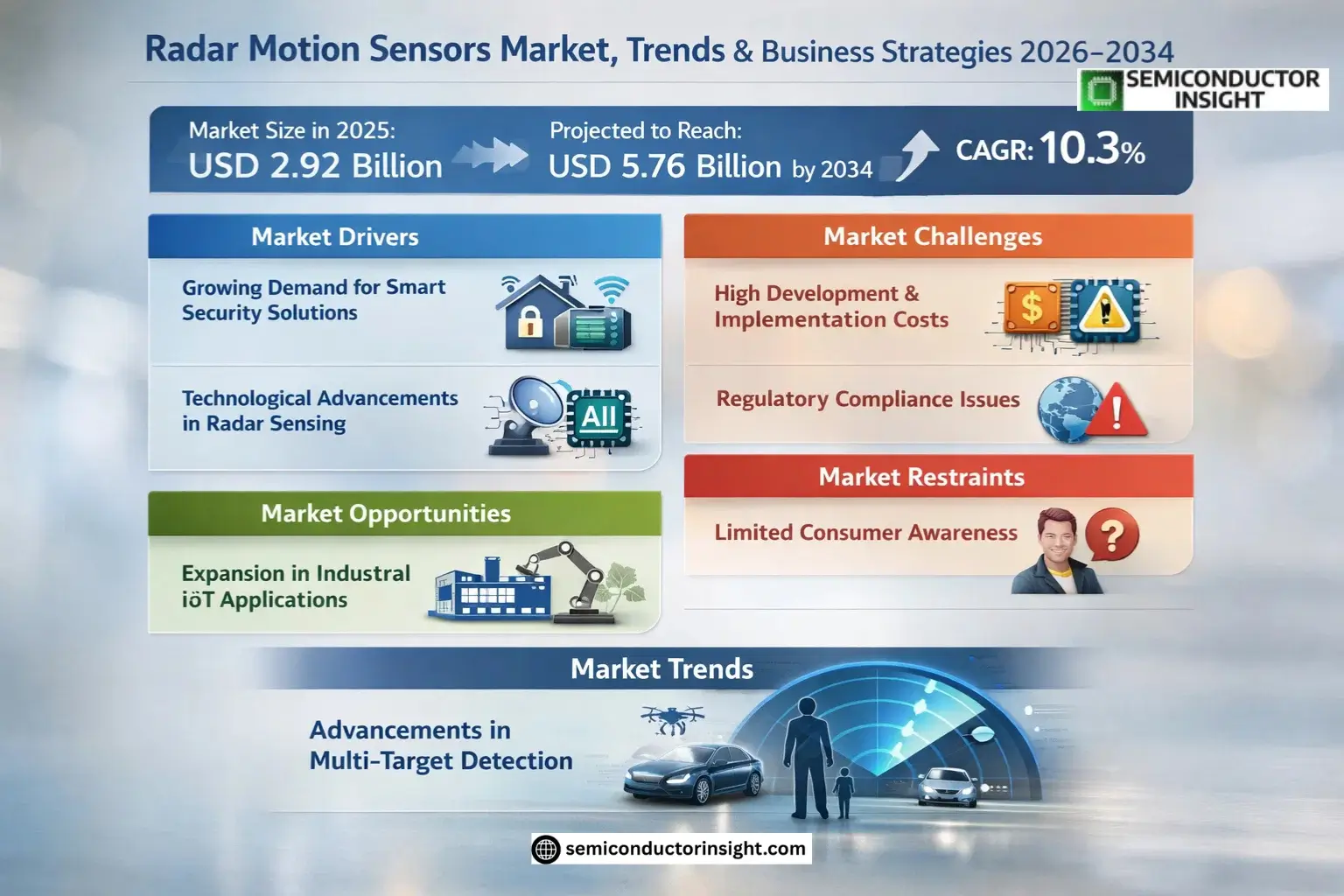
Global Radar Motion Sensors Market size was valued at USD 2.92 billion in 2025. The market is projected to grow from USD 3.22 billion in 2026 to USD 5.76 billion by 2034, exhibiting a CAGR of 10.3% during the forecast period.
Radar Motion Sensors are electronic devices that detect movement, presence, and velocity of objects by emitting radio waves and analyzing reflected signals’ characteristics such as frequency shift and time delay. Unlike passive infrared sensors, they actively transmit signals and can detect through non-metallic materials while maintaining reliable performance across varying ambient conditions. These sensors find applications in security alarms, automatic lighting systems, smart home automation, industrial safety equipment, and touchless interfaces.
The market growth is driven by increasing adoption of smart home devices, advancements in building automation technologies, and integration into automotive safety systems. Technological innovations focus on improving detection accuracy while reducing power consumption and form factor size through semiconductor integration. Key industry players differentiate their offerings through enhanced functionalities like multi-target tracking and presence detection capabilities alongside comprehensive developer support for diverse applications.
MARKET DRIVERS
Growing Demand for Smart Security Solutions
Radar Motion Sensors Market is experiencing significant growth due to increasing adoption in smart home and commercial security systems. With rising security concerns globally, these sensors offer superior detection accuracy compared to traditional infrared sensors, especially in challenging environments. The global smart home market expansion, projected to grow at over 13% CAGR, directly fuels demand for advanced radar-based motion detection.
Technological Advancements in Radar Sensing
Recent innovations in mmWave radar technology have enabled more compact, energy-efficient sensors with improved range and accuracy. Major manufacturers are integrating AI capabilities into radar motion sensors, allowing for sophisticated presence detection and behavioral analytics. The automotive sector’s adoption of radar for advanced driver-assistance systems (ADAS) has also accelerated technology transfer to consumer applications.
The shift toward non-contact sensing solutions post-pandemic has further boosted the Radar Motion Sensors Market, with applications expanding into touchless controls for public spaces and healthcare facilities.
MARKET CHALLENGES
High Development and Implementation Costs
While radar motion sensors offer superior performance, their production costs remain significantly higher than conventional PIR sensors. The complex RF circuitry and need for specialized components create barriers for widespread adoption in price-sensitive markets. This cost factor particularly affects emerging economies where budget constraints limit market penetration.
Other Challenges
Regulatory Compliance Issues
Differing frequency regulations across countries create complications for manufacturers developing global Radar Motion Sensors Market solutions. The 60GHz band, popular for high-resolution sensing, faces restrictions in several regions, forcing companies to maintain multiple product variants.
MARKET RESTRAINTS
Limited Consumer Awareness and Familiarity
Despite technological advantages, many end-users remain unfamiliar with radar-based motion detection capabilities. The market faces inertia from well-established infrared sensor technologies that dominate the consumer segment. Educational efforts and demonstration of clear ROI are required to overcome this adoption barrier in the Radar Motion Sensors Market.
MARKET OPPORTUNITIES
Expansion in Industrial IoT Applications
The Industrial IoT sector presents substantial growth potential for radar motion sensors, particularly in predictive maintenance and occupancy monitoring systems. Manufacturing facilities increasingly deploy radar sensors for equipment monitoring and worker safety applications, with the market projected to exceed USD 850 million in this segment by 2026.
Radar Motion Sensors Market Trends
Advancements in Multi-Target Detection Capabilities
Radar Motion Sensors Market is witnessing significant upgrades in multi-target tracking algorithms, enabling simultaneous detection of multiple objects with higher precision. Unlike traditional single-target systems, modern sensors can distinguish between humans, vehicles, and environmental movements at ranges up to 15 meters. This technological leap is particularly transforming security applications and industrial automation sectors where false alarm reduction is critical.
Other Trends
Energy Efficiency Improvements
Manufacturers are achieving 40-60% power consumption reductions in latest-generation radar motion sensors through optimized RF chip designs and adaptive duty cycling. Ultra-low-power variants below 1mW are enabling battery-operated IoT applications with 5+ year lifespans, broadening adoption in wireless security systems and smart building infrastructure.
Integration with Smart Home Ecosystems
Radar Motion Sensors Market is experiencing accelerated demand through seamless integration with major smart home platforms. Compatibility with Matter protocol and proprietary ecosystems from Google, Amazon, and Apple allows unified control of lighting, HVAC, and security systems. This interoperability is driving 25-30% annual growth in residential installations, particularly for presence detection in multi-room configurations.
Miniaturization and Cost Optimization
Advances in semiconductor packaging have enabled 60GHz mmWave radar sensors in sub-10mm form factors at 35% lower BOM costs compared to 2020 models. High-volume production of System-on-Chip solutions is making radar technology competitive with PIR sensors in price-sensitive consumer applications while maintaining superior performance in varying environmental conditions.
Industrial Safety Applications Expansion
Regulatory mandates for machine guarding and collision avoidance are propelling adoption of industrial-grade radar motion sensors with SIL-2/PL-c certifications. These sensors provide reliable presence detection in challenging environments with dust, vibration, or extreme temperatures where optical systems typically fail. The manufacturing sector accounts for 28% of professional-grade sensor deployments as of 2025.
COMPETITIVE LANDSCAPE
Key Industry Players
Global Radar Motion Sensor Market Dominated by Semiconductor and Industrial Automation Giants
Radar Motion Sensors Market is characterized by strong competition among established semiconductor companies and specialized sensor manufacturers. Infineon Technologies, Texas Instruments, and NXP Semiconductors collectively hold over 45% of market share, leveraging their expertise in RF technology and system-on-chip solutions. These industry leaders dominate the market through continuous innovation in mmWave radar technology, strategic partnerships with downstream application developers, and economies of scale in semiconductor manufacturing.
Niche players such as Pepperl+Fuchs, Turck, and Murata Manufacturing focus on specialized industrial and automotive applications, offering ruggedized sensors with enhanced environmental tolerance. Emerging Chinese manufacturers including Getteland Microelectronics and Lierda Science & Technology Group are gaining traction in the mid-range consumer and IoT segments through aggressive pricing and localization strategies. The market also features innovative startups like Ainstein developing advanced FMCW radar solutions for autonomous vehicle applications.
List of Key Radar Motion Sensor Companies Profiled
- Infineon Technologies
- Texas Instruments
- NXP Semiconductors
- Analog Devices
- Pepperl+Fuchs
- Turck
- Honeywell
- OMRON
- Murata Manufacturing
- Marelli
- Siteco
- Getteland Microelectronics
- S3 Semi
- Ainstein
- Seeed Studio
- Lierda Science & Technology Group
- Merrytek
Segment Analysis:
| Segment Category | Sub-Segments | Key Insights |
| By Type |
|
FMCW Radar Motion Sensor dominates the market due to superior performance characteristics:
|
| By Application |
|
Smart Home applications show strongest growth potential:
|
| By End User |
|
Commercial sector leads in adoption:
|
| By Frequency Band |
|
60 GHz mmWave technology shows strongest growth:
|
| By Detection Range |
|
Short Range sensors dominate current implementations:
|
Regional Analysis: Radar Motion Sensors Market
The defense sector utilizes radar motion sensors for perimeter security, surveillance systems, and autonomous vehicle detection. Advanced threat identification capabilities make these sensors critical components in modern defense infrastructure.
Increasing demand for contactless motion detection in residential security systems and smart appliances drives market growth. Radar sensors offer superior performance compared to PIR alternatives in challenging environmental conditions.
Factories implement radar motion sensors for worker safety monitoring and equipment control. These sensors provide reliable motion tracking in dust-filled or high-temperature environments where optical solutions fail.
Vehicle manufacturers integrate radar motion sensors for blind spot detection and parking assistance, supported by stringent safety regulations in the region.
Europe
Europe represents the second-largest market for radar motion sensors, with Germany and the UK leading in industrial and automotive applications. The region’s focus on energy efficiency drives demand for low-power radar solutions in building automation. Stringent EU regulations regarding worker safety and building codes create sustained demand for reliable motion detection across multiple sectors. European manufacturers emphasize miniaturization and power efficiency in their product designs, catering to both industrial and consumer applications.
Asia-Pacific
The Asia-Pacific radar motion sensors market shows the fastest growth rate, propelled by expanding smart city projects and increasing defense budgets. China dominates regional demand, particularly for surveillance and industrial automation applications. Japan and South Korea contribute significantly to technological advancements, focusing on automotive safety systems and IoT integration. The region benefits from cost-competitive manufacturing capabilities and growing awareness of contactless sensing benefits.
South America
Radar Motion Sensors Market in South America remains nascent but shows promising growth potential. Brazil leads regional adoption, primarily in security applications for commercial establishments and gated communities. Limited local manufacturing capabilities result in dependence on imports, though economic stability is gradually attracting foreign investment in sensor technologies.
Middle East & Africa
The Middle East demonstrates strong demand for high-end security systems in oil & gas facilities and government infrastructure. Israel leads in radar technology innovation, while GCC countries invest heavily in smart city deployments. Africa shows emerging opportunities in perimeter security for mining operations and critical infrastructure protection.
Report Scope
This market research report provides a comprehensive analysis of the Radar Motion Sensors Market, covering the forecast period 2025–2032. It offers detailed insights into market dynamics, technological advancements, competitive landscape, and key trends shaping the industry.
Key focus areas of the report include:
- Market Overview: The report begins with an overview outlining its current market scenario, key growth indicators, and industry transformation drivers. It discusses macroeconomic factors, demand–supply balance, regulatory landscape, and the strategic role of semiconductors in powering advancements across industries such as automotive, telecommunications, consumer electronics, and industrial automation.
- Market Size & Forecast: Historical data and future projections for revenue, unit shipments, and market value across major regions and segments.
- Segmentation Analysis: Detailed breakdown by product type, technology, application, and end-user industry to identify high-growth segments and investment opportunities.
- Regional Insights: Insights into market performance across North America, Europe, Asia-Pacific, Latin America, and the Middle East & Africa, including country-level analysis where relevant.
- Competitive Landscape: Profiles of leading market participants, including their product offerings, R&D focus, manufacturing capacity, pricing strategies, and recent developments such as mergers, acquisitions, and partnerships.
- Technology Trends & Innovation: Assessment of emerging technologies, integration of AI/IoT, semiconductor design trends, fabrication techniques, and evolving industry standards.
- Market Drivers & Restraints: Evaluation of factors driving market growth along with challenges, supply chain constraints, regulatory issues, and market-entry barriers.
- Stakeholder Insights: Insights for component suppliers, OEMs, system integrators, investors, and policymakers regarding the evolving ecosystem and strategic opportunities.
Primary and secondary research methods are employed, including interviews with industry experts, data from verified sources, and real-time market intelligence to ensure the accuracy and reliability of the insights presented.
FREQUENTLY ASKED QUESTIONS:
What is the current market size of Radar Motion Sensors Market?
-> Radar Motion Sensors Market size was valued at USD 2.92 billion in 2025. The market is projected to grow from USD 3.22 billion in 2026 to USD 5.76 billion by 2034, exhibiting a CAGR of 10.3% during the forecast period.
What is the global production capacity and average price of Radar Motion Sensors?
-> In 2025, the global production capacity was approximately 426,666,667 units, with actual production reaching 320,000,000 units at an average market price of USD 10 per unit.
Which key companies operate in Radar Motion Sensors Market?
-> Key players include Infineon Technologies, Texas Instruments, NXP Semiconductors, Analog Devices, Pepperl+Fuchs, Turck, Honeywell, OMRON, Murata Manufacturing, among others.
What are the key growth drivers?
-> Key growth drivers include proliferation of smart home devices, advancements in building automation, increasing automotive safety integration, and rising demand for contactless interaction solutions.
What are the primary applications of Radar Motion Sensors?
-> These sensors are widely used in security alarms, automatic lighting control, smart home automation, industrial equipment safety, and touchless user interfaces.
Which region dominates the market?
-> Asia holds the largest market share, with significant growth seen in China, Japan, South Korea, and Southeast Asia.
What are the emerging technology trends?
-> Emerging trends focus on higher detection accuracy, lower power consumption, miniaturization, and integration of multi-target tracking capabilities.
Get Sample Report PDF for Exclusive Insights
Report Sample Includes
- Table of Contents
- List of Tables & Figures
- Charts, Research Methodology, and more...
 Download Sample Report PDF