

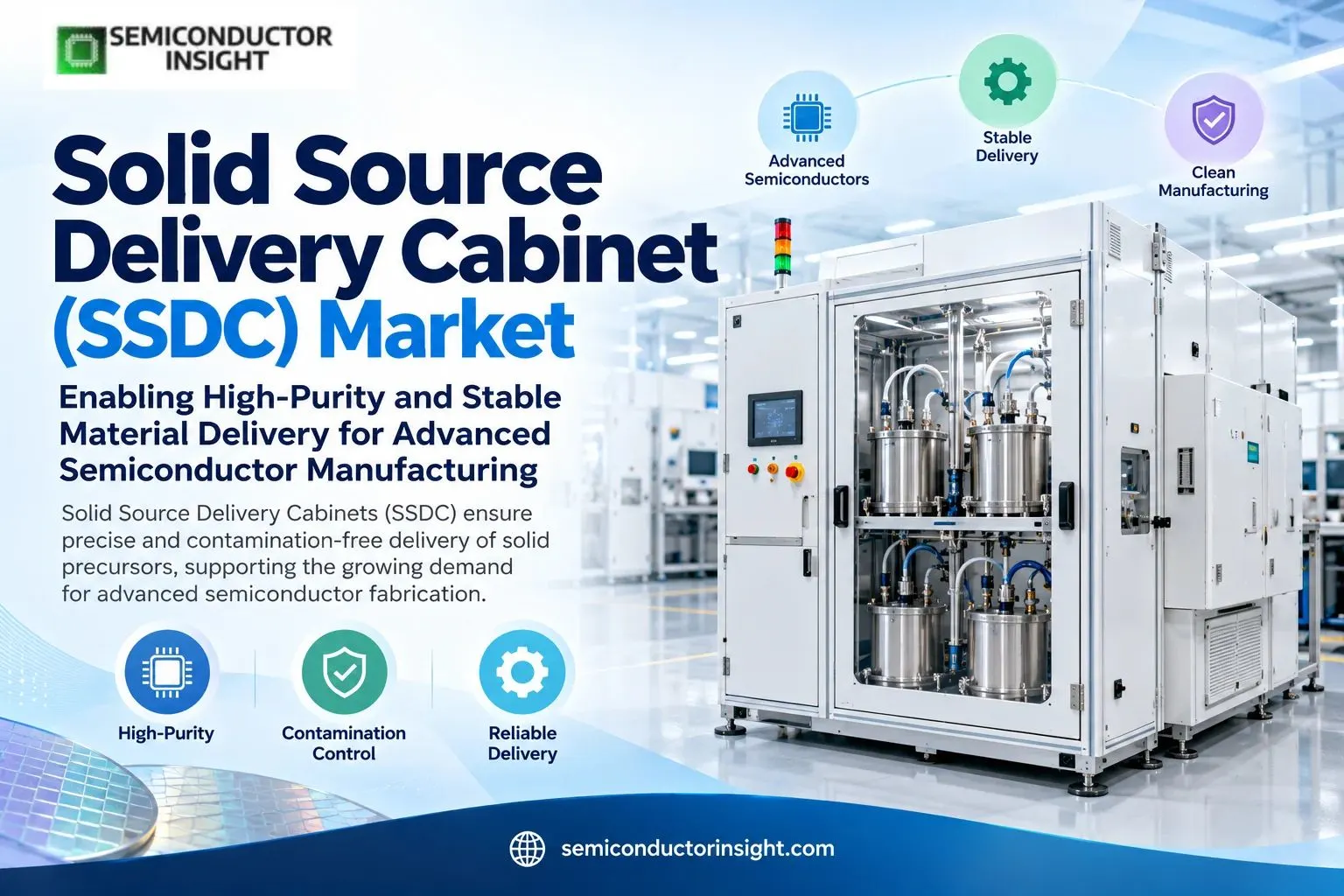
How Is the Solid Source Delivery Cabinet (SSDC) Market Changing in 2026 as Advanced Fabs Push for Higher Uptime?
Solid Source Delivery Cabinets are becoming an increasingly important part of semiconductor process infrastructure because advanced deposition processes cannot depend on inconsistent precursor delivery.
An SSDC stores and supplies solid chemical precursors to process equipment while controlling heating, vaporization, purge sequences and source changeover. Entegris describes its SSDC as a fully automated delivery system designed to extend solid-material supply beyond conventional onboard containers and support continuous chemical delivery.
The importance of this equipment is rising as semiconductor manufacturing moves toward more complicated deposition structures. ALD and CVD increasingly require controlled delivery of specialized materials, making the delivery cabinet an operational part of the deposition process rather than simply a chemical-storage enclosure.
2026 Fab Investment Is Expanding the Addressable Equipment Base
- The semiconductor manufacturing environment provides a strong backdrop for SSDC adoption.
- SEMI reported global semiconductor equipment billings of $40.53 billion in the second quarter of 2026, representing a 23% year-over-year increase.
- The organization linked the momentum to investment in leading-edge logic, DRAM and advanced packaging supporting AI infrastructure.
- Its 2026 World Fab Forecast tracks more than 1,600 semiconductor facilities and production lines, while the latest 300mm outlook tracks 424 fabs and production lines worldwide. SEMI
- For SSDC suppliers, every new advanced deposition line represents potential demand for additional precursor-management infrastructure.
Why Continuous Delivery Matters More at Advanced Nodes
Traditional source containers can require intervention when precursor material is depleted or when a source must be changed. An automated SSDC changes that equation. Entegris’ SSDC 1000 uses dual canisters and automated purge, heating, container-change and switchover sequences. It can operate in carrier-gas or vapor-delivery configurations and supports manifold temperatures up to 200°C, with higher-temperature capabilities under development.
The basic operating logic can be represented as:
Source canister → controlled heating → precursor transport → manifold regulation → automated switchover → ALD/CVD chamber
This architecture reduces the dependence on manual intervention while helping maintain continuity during source replacement.
ALD and CVD Are Creating More Demanding Delivery Requirements
The connection between SSDCs and deposition is particularly important in advanced semiconductor manufacturing. Entegris lists ALD, CVD and high-k capacitor and gate-dielectric applications for the SSDC 1000. Its product portfolio also includes ProE-Vap delivery systems supporting materials such as HfCl4 and ZrCl4 for semiconductor deposition applications.
As device structures become three-dimensional, deposition increasingly requires precise control of film thickness and material exposure. A delivery system therefore has to provide stable precursor conditions instead of simply moving material from a container to a tool.
AI Chips Are Indirectly Changing Precursor Infrastructure
- The AI semiconductor boom is affecting SSDC demand through the equipment chain rather than through direct consumer visibility.
- SEMI expects 2026 wafer-fab equipment sales to reach $143.9 billion, with leading-edge logic and advanced memory among the major investment areas.
- DRAM equipment spending is projected at $38.8 billion, while NAND equipment spending is projected at $13.9 billion.
- The relevance to solid precursor delivery is straightforward: more advanced logic, HBM and 3D memory structures require increasingly sophisticated deposition and materials-processing capabilities.
Our most recent updated related study is available for free at this link: https://semiconductorinsight.com/report/solid-source-delivery-cabinet-ssdc-market/
The Design Priorities Are Moving From Storage to Process Control
Modern SSDCs are increasingly differentiated by what happens inside the cabinet. Uniform heating, pressure stability, automated purging, source redundancy, data logging and controlled switchover can directly affect how reliably precursor material reaches the process chamber.
Entegris’ SSDC architecture includes multiple uniform heating zones, a PLC-based control system, touchscreen operation, data logging and optional tool-side valve, temperature and flow monitoring. entegris.com
That creates a new value proposition:
Solid precursor → controlled thermal environment → stable delivery → fewer interruptions → higher tool utilization
The Emerging Procurement Conversation
For fabs and deposition-tool manufacturers, SSDC selection is increasingly tied to uptime and integration rather than cabinet specifications alone. Compatibility with precursor chemistry, temperature range, source capacity, automated sequences, communication protocols and multi-branch delivery can influence how effectively the system fits into a high-volume manufacturing environment.
The broader semiconductor infrastructure is moving toward greater automation, and solid precursor delivery is following the same trajectory. As advanced logic, memory and AI-related manufacturing capacity expands, SSDCs are positioned to become a more visible enabling technology behind reliable ALD and CVD production.

Comments (0)