Key Statistics
Key Takeaways
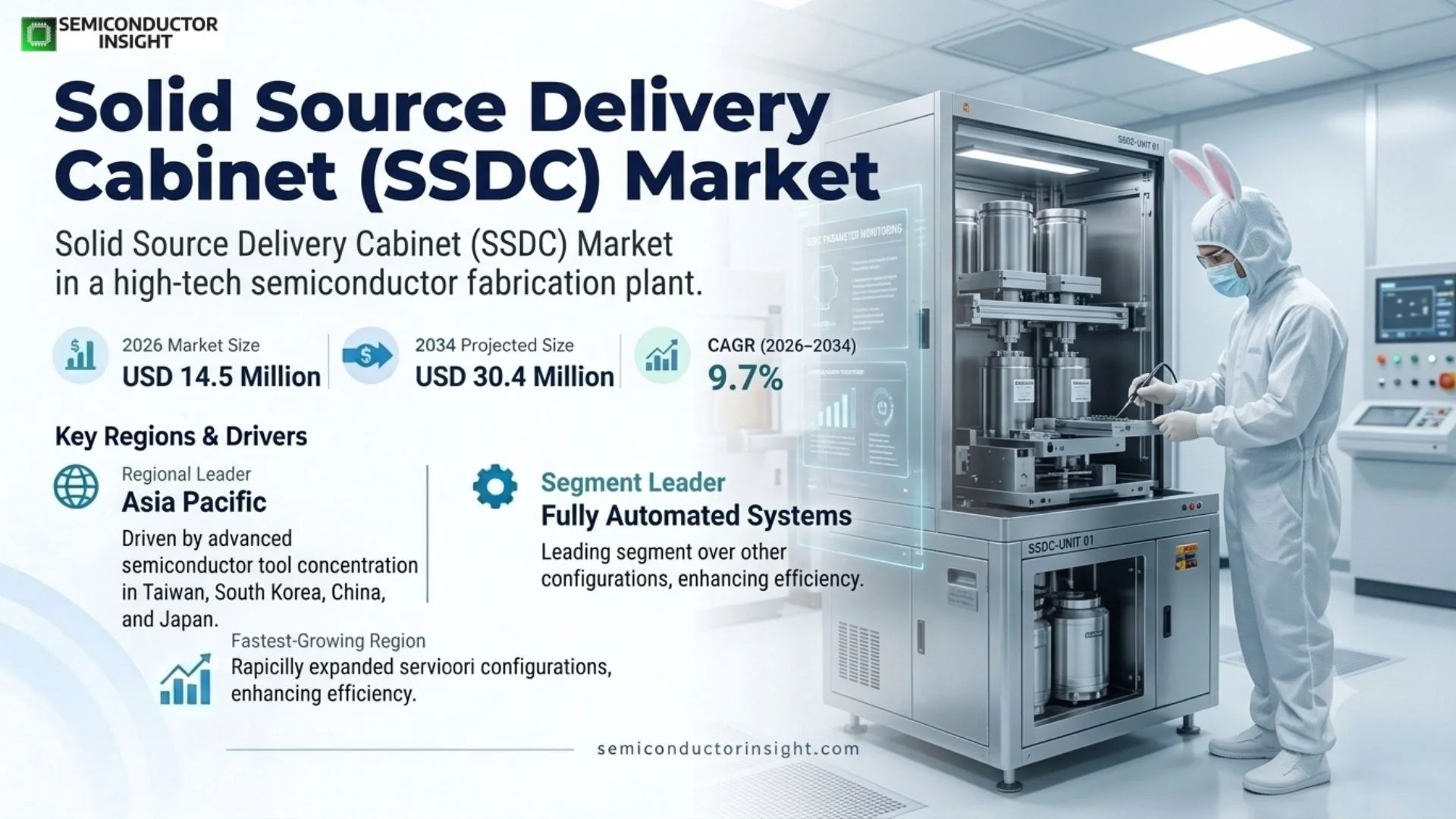
- Market size: The market stands at USD 13.2 million in 2025 and is projected to reach USD 30.4 million by 2034, representing a 9.7% CAGR across 2026–2034.
- ALD/CVD is the core application because advanced semiconductor processes increasingly use solid precursors that require stable heating, carrier-gas control and uninterrupted delivery to deposition tools.
- Fully automated systems are the main value segment, reducing manual container handling through automated purge, heat-up, changeover and switchover sequences.
- Asia Pacific leads demand because the region contains the largest concentration of semiconductor wafer fabs and deposition-tool installations.
- Tool uptime is the main economic value proposition; larger containers, dual-canister architectures and automated switchover can reduce production interruptions during precursor replenishment.
Solid Source Delivery Cabinet (SSDC) Market Overview
Solid Source Delivery Cabinet Market is valued at USD 13.2 million in 2025 and is projected to reach USD 30.4 million by 2034, expanding at a 9.7% CAGR during 2026–2034. The 2026 market level is USD 14.5 million. The market is small but strategically important because advanced deposition depends on precise, contamination-controlled precursor delivery. Automated cabinets support longer tool utilization, dual-canister continuity, controlled heating and integration with ALD/CVD process equipment as solid precursor use expands.
Solid Source Delivery Cabinets are semiconductor chemical-delivery systems designed to supply low-volatility solid precursors to deposition equipment. They heat and manage precursor containers, control carrier gas or vapor delivery, automate purge and changeover sequences, and isolate operators from manual handling. The systems are used where onboard source containers are too small or where continuous supply, repeatability and high tool utilization justify a centralized cabinet.
Demand is closely linked to atomic layer deposition and chemical vapor deposition because advanced high-k dielectrics, gate materials and other thin films increasingly rely on precursor chemistries that can be solid at normal operating conditions. Stable delivery requires uniform heating, low pressure drop and controlled gas flow so that precursor vapor reaches the process chamber consistently. Poor delivery can create film non-uniformity, downtime or precursor decomposition.
The economic case is based on utilization and process stability rather than cabinet volume alone. Entegris documents larger source containers and dual-container capability in its SSDC platform to reduce unnecessary downtime during container changes. Automated purge, heat-up and switchover also reduce operator intervention, which is valuable in high-volume fabs where deposition tools are expensive, tightly scheduled and sensitive to changes in precursor delivery conditions.
Segment Analysis: By Type
By type, the market is segmented into fully automated delivery systems and other configurations. Fully automated cabinets represent the main value segment because advanced fabs seek repeatable precursor handling, automated purge sequences and uninterrupted supply. Other systems include simpler or customized delivery architectures used in development, specialty deposition or lower-volume environments where full redundancy may not be required.
| Type | Technical / commercial role | Market position |
|---|---|---|
| Fully Automated Delivery System | Automated heating, purge, container change and switchover with PLC-based control and process-tool integration. | Largest value segment because high-volume fabs prioritize uptime, repeatability and lower operator intervention. |
| Others | Semi-automated, customized or lower-complexity solid-precursor delivery systems. | Niche demand in R&D, specialty deposition, LED and lower-volume environments where full redundancy may not be required. |
Additional Segmentation: By Delivery Mode
Delivery mode includes carrier-gas delivery and vapor delivery. Carrier-gas architectures transport precursor vapor with a controlled gas stream, while vapor-delivery configurations are selected where precursor and process conditions allow direct vapor handling. The cabinet must maintain uniform heating and low pressure drop in either mode because condensation, unstable vaporization or excessive residence time can change delivered dose and downstream film properties.
| Delivery Mode | Demand characteristics |
|---|---|
| Carrier Gas Delivery | A controlled carrier gas passes through or over the solid precursor to transport vapor to the process tool. |
| Vapor Delivery | Precursor vapor is delivered through a heated manifold without relying on the same carrier-gas configuration; suitability depends on chemistry and vapor pressure. |
Segment Analysis: By Application
By application, ALD/CVD represents the primary market because these deposition processes use an expanding portfolio of metal-organic and other solid precursors for high-k dielectrics, gate stacks, barriers and specialty films. Other applications include LED and emerging compound-semiconductor deposition uses where stable solid-chemical supply is required. Purchasing decisions are driven by process stability, tool uptime, safety and the ability to support longer production runs.
| Application | Demand characteristics |
|---|---|
| ALD/CVD | Core application for high-k, gate dielectric, metal and specialty thin-film deposition; strongest need for repeatability and continuous supply. |
| Others including LED | Specialty compound-semiconductor, LED, R&D and emerging deposition processes using solid precursors. |
Additional Segmentation: By System Configuration
System configuration varies by number of delivery branches, container architecture and redundancy. Entegris documents SSDC configurations with one to three branches and dual canisters. Multi-branch systems can feed several process points or tools, while dual-canister configurations enable automatic switchover and longer continuous operation between manual replenishment events. The preferred architecture depends on precursor consumption, tool count and acceptable changeover downtime.
| System Configuration | Commercial relevance |
|---|---|
| 1–3 Branch Systems | Flexible configurations for one or multiple delivery points with integrated manifold control. |
| 3-Branch Systems | Higher-branch architecture suited to multi-point delivery requirements and larger tool clusters. |
| Dual-Canister Continuous Supply | Redundant source containers support automatic switchover and reduce downtime during precursor change. |
Regional Analysis
Asia Pacific leads SSDC demand because Taiwan, South Korea, China and Japan host the largest concentration of advanced semiconductor deposition tools. North America is a high-value market for leading-edge logic, memory and equipment development, while Europe has important power, logic and specialty fabs. Regional demand follows deposition capacity and precursor complexity rather than downstream electronics sales, making local fab investment the most relevant demand indicator.
Why is SSDC demand concentrated near advanced wafer-fabrication clusters?
Solid precursor delivery cabinets are installed beside expensive deposition tools, so demand occurs where ALD and CVD capacity is located. Regions with more advanced fabs use more sophisticated precursor chemistries and place higher value on automation and uptime. Greenfield fab construction also creates an initial equipment opportunity, followed by replacement, expansion and additional branch demand as process recipes evolve and source-container consumption changes.
| Region | Position | Growth outlook | Demand profile | Supplier selection |
|---|---|---|---|---|
| Asia Pacific | Largest | High | Advanced foundry + memory | Tool qualification and local service |
| North America | High-value | High | Leading-edge logic, memory, R&D | Process integration and uptime |
| Europe | Strategic | Steady-high | Power, logic, specialty fabs | Safety and chemical compatibility |
| South America | Small | Selective | R&D / specialty | Imported systems and support |
| Middle East & Africa | Emerging | Project-led | New fab projects | Project qualification and logistics |
Competitive Landscape
The market is concentrated because SSDCs are highly specialized systems rather than commodity cabinets. Entegris is a major supplier with a defined Solid Source Delivery Cabinet product line and ProE-Vap precursor technology. SEMPA and Brooks Instrument also participate in precursor-delivery and flow-control solutions. Competition centers on chemical compatibility, temperature uniformity, pressure drop, automation, safety and integration with deposition tools.
Reliability carries a high economic value because an ALD or CVD tool can cost millions of dollars and lost production time can exceed the price difference between delivery systems. Dual-canister architectures, automated purge and switchover, diagnostics and data logging therefore create measurable customer value. Vendors that demonstrate longer uninterrupted runs and stable precursor utilization can defend premium pricing and stronger service relationships.
Supplier relationships often begin during process development because precursor properties determine vessel, heating and flow requirements. Once a chemistry is qualified with a cabinet and tool configuration, changing the delivery system can require process revalidation. This gives early design-in suppliers an advantage and explains why technical collaboration with precursor companies, equipment OEMs and fab process teams is central to market access.
| Competitive tier | Representative companies | Primary differentiation |
|---|---|---|
| Integrated solid-precursor delivery leader | Entegris | SSDC systems, ProE-Vap containers, automated control and broad semiconductor materials relationships. |
| Specialized precursor delivery | SEMPA | Specialty chemical and precursor delivery systems for deposition environments. |
| Flow and delivery technology | Brooks Instrument | Mass-flow and precursor-delivery expertise supporting semiconductor process control. |
Key companies profiled
Entegris, SEMPA and Brooks Instrument are the principal companies identified in the market scope. Entegris has a dedicated SSDC product line, while SEMPA and Brooks Instrument contribute precursor-delivery, flow-control and semiconductor process expertise. The small supplier set reflects the engineering specialization, chemical compatibility requirements and qualification burden of solid-chemical delivery systems.
Production Capacity Analysis
SSDC manufacturing capacity depends on high-purity stainless-steel or coated components, heated manifolds, valves, mass-flow hardware, PLC controls, cabinets and clean assembly. Unlike a standard enclosure, each system must be configured around precursor chemistry, operating temperature, branch count and tool interface. Engineering and qualification throughput can therefore be a tighter capacity constraint than cabinet fabrication itself.
Demand scales with deposition-tool installations rather than wafer starts alone. A fab adding new ALD chambers or introducing a solid precursor may require new cabinets even without increasing wafer capacity. Conversely, one multi-branch SSDC can support several delivery points. Effective market capacity is therefore influenced by architecture, number of branches, container size, redundancy and whether customers choose continuous-supply configurations.
Market Dynamics
The market grows as advanced semiconductor processes adopt more solid precursors and fabs place greater value on tool uptime. Automated cabinets improve consistency and reduce manual handling, but demand is constrained by the small number of process steps that require external solid-source delivery and by high engineering costs. Growth is strongest when new materials move from research into high-volume ALD or CVD production.
Market Drivers
| Driver | Impact | Commercial mechanism |
|---|---|---|
| More ALD/CVD layers | High | Advanced devices add deposition steps and new precursor chemistries that require controlled solid-source delivery. |
| Tool uptime requirements | High | Dual containers and automatic switchover reduce production interruptions. |
| New high-k and metal materials | Medium-High | Novel films introduce low-volatility precursors that need heated, precise delivery. |
| Fab expansion | Medium | New deposition capacity creates initial SSDC installations and later branch additions. |
Advanced deposition uses more specialized precursors
Gate-all-around structures, high-k dielectrics and complex metal stacks increase the number of deposition steps and chemistries. Some precursors are solids with low vapor pressure, making stable delivery more difficult than conventional gas or liquid supply. SSDCs address this by controlling heating, gas flow and container management outside the process tool.
Tool utilization justifies automation
Deposition tools are expensive and operate at high utilization in volume fabs. Manual container changes can interrupt production and create contamination risk. Dual-canister cabinets with automatic switchover maintain continuous chemical supply and allow operators to service one source while another remains online, improving productive tool time.
Uniform thermal control improves precursor stability
Solid precursor delivery depends on maintaining temperature throughout the container and manifold so the material vaporizes consistently without condensing or decomposing. Multi-zone heating and low-pressure-drop manifolds help stabilize delivery. Better thermal control supports film uniformity, repeatable process conditions and more predictable precursor consumption.
New fabs create chemical-delivery infrastructure demand
Greenfield fabs and capacity expansions require gas and chemical systems before process tools begin production. SSDCs are a small part of total fab equipment spending, but every qualifying deposition line creates a potential installation. The opportunity increases as new materials move into more layers per wafer.
Market Restraints
| Restraint | Impact | Commercial consequence |
|---|---|---|
| Small addressable installed base | High | Only process steps using suitable solid precursors require dedicated cabinets. |
| High engineering cost | Medium-High | Customized heating, valves, controls and safety increase system price. |
| Chemical-specific qualification | Medium-High | Each precursor may require dedicated validation and materials compatibility. |
| Skilled maintenance requirements | Medium | Heated chemical systems need trained technicians and robust service support. |
The market is inherently specialized
Most semiconductor chemicals are delivered as gases or liquids, so SSDCs address a narrower subset of precursor chemistries. Market growth therefore depends on whether new solid precursors move into high-volume manufacturing. A large increase in wafer starts does not automatically translate into equivalent cabinet demand.
Systems are expensive relative to simple source vessels
Automated cabinets include heated manifolds, redundant containers, PLC controls, valves, sensors and safety systems. This raises acquisition cost compared with onboard or simpler delivery approaches. Customers adopt SSDCs when the value of uptime, larger source volume and automation clearly exceeds the added capital expense.
Precursor compatibility slows standardization
Different solid precursors have different vapor pressures, decomposition temperatures and materials compatibility. A configuration optimized for one chemistry may not be suitable for another without changes in coating, heating or gas flow. This limits the degree to which suppliers can sell a completely standardized cabinet.
Service expertise is essential
SSDCs integrate chemicals, heat, gas flow and controls near deposition equipment. Maintenance errors can affect tool uptime or process safety. Fabs therefore prefer suppliers with trained field engineers, diagnostics and spare-parts support, which can make market entry difficult for smaller equipment companies.
Market Opportunities
Gate-all-around and advanced-node materials
Leading-edge device structures use more conformal deposition and new materials. If additional solid precursors are selected for high-volume processes, each chemistry can create new cabinet demand and branch expansion inside existing fabs.
High-volume continuous supply
Dual-canister and multi-branch systems create a premium opportunity where fabs need long uninterrupted runs. Vendors can sell uptime and lower operator intervention rather than only hardware, supporting higher value per installation.
Precursor-vendor partnerships
Chemical suppliers benefit when their materials can be delivered consistently. Joint qualification between precursor producers, SSDC vendors and deposition OEMs can shorten customer adoption and create preferred combinations that are difficult for competitors to displace.
Greenfield fab projects
New fabs in the United States, Europe and Asia need complete chemical-delivery infrastructure. Early participation in facility and tool design can secure SSDC specifications before process lines enter qualification, creating long service and expansion opportunities.
Supply Chain Analysis
Components. High-purity containers, valves, seals, heated tubing, manifolds, sensors and control hardware form the equipment base. Materials must tolerate precursor chemistry and operating temperature without introducing contamination. Component traceability is important because failures can affect chemical safety and process stability.
Cabinet assembly. Suppliers integrate heating zones, purge logic, gas or vapor delivery, branch manifolds and PLC controls into a safe enclosure. Uniform thermal behavior and low pressure drop are central design goals. Dual-canister systems add redundancy and automatic changeover capability for long production runs.
Qualification. The cabinet is validated with a specific precursor, deposition tool and process recipe. Supplier engineers may work with chemical vendors and OEMs to optimize temperature, gas flow and purge sequences. This technical stage creates a high switching cost once a production configuration is proven.
High-volume use. Fabs operate SSDCs as part of the deposition infrastructure. Maintenance includes source replacement, valve service, calibration and preventive checks. Continuous operation, diagnostics and rapid field support determine whether the cabinet delivers its promised tool-utilization benefit over the equipment lifecycle.
Recent Developments in the Solid Source Delivery Cabinet (SSDC) Market
Developments tracked through September 2026. Entries are limited to events that materially affect product capability, manufacturing capacity, customer adoption, channel access or the competitive structure of the market.
- 1 June 2025
Entegris published updated SSDC 1000 documentation describing automated purge, heat-up, container change and switchover, dual-canister capability and one-to-three-branch delivery. The product targets ALD, CVD and high-k dielectric applications. Source - 25 June 2025
SEMI forecast advanced process capacity at 7nm and below to grow 69% from 2024 through 2028. More advanced wafer capacity supports demand for ALD/CVD deposition infrastructure and the precursor-delivery systems attached to it. Source - 24 June 2022
Brooks Instrument outlined precise gas delivery methods for liquid and solid precursors, emphasizing that new transistor structures and process nodes require accurate, repeatable precursor delivery for wafer performance and uniformity. Source
Report Scope & Segmentation
| Attribute | Scope |
|---|---|
| Base year | 2025 |
| Estimated year | 2026 |
| Forecast period | 2026–2034 |
| 2025 market size | USD 13.2 million |
| 2026 estimated size | USD 14.5 million |
| 2034 projected size | USD 30.4 million |
| CAGR (2026–2034) | 9.7% |
| Largest market in 2025 | Asia Pacific |
| By Type | Fully Automated Delivery System; Others |
| By Application | ALD/CVD; Others including LED |
| By Delivery Mode | Carrier Gas Delivery; Vapor Delivery |
| By System Configuration | 1–3 Branch Systems; 3-Branch Systems; Dual-Canister Continuous Supply |
| Companies profiled | Entegris; SEMPA; Brooks Instrument |
Frequently Asked Questions
What is the Solid Source Delivery Cabinet market size in 2025?
The global Solid Source Delivery Cabinet market is valued at USD 13.2 million in 2025. The market covers specialized semiconductor equipment that supplies solid chemical precursors to deposition tools, principally in ALD and CVD applications.
What is the SSDC market forecast for 2034?
The market is projected to reach USD 30.4 million by 2034, representing a 9.7% CAGR during 2026–2034. The corresponding 2026 market level is USD 14.5 million.
Which region leads the SSDC market?
Asia Pacific leads because Taiwan, South Korea, China and Japan contain the largest concentration of advanced semiconductor foundry and memory deposition capacity.
What is a Solid Source Delivery Cabinet?
An SSDC is a heated, controlled chemical-delivery system that supplies vapor from solid precursors to semiconductor process equipment. It can automate purge, heat-up, container change and switchover to improve repeatability and tool uptime.
Why are SSDCs used in ALD and CVD?
ALD and CVD increasingly use low-volatility solid precursors for high-k dielectrics, metal films and other advanced layers. These materials require stable heating and controlled gas or vapor delivery to maintain consistent film deposition.
What is the main benefit of dual-canister systems?
Dual canisters allow automatic switchover so one source can continue feeding the tool while the other is replaced or serviced. This reduces unnecessary downtime and supports longer continuous deposition runs.
What delivery modes are used in SSDCs?
Systems can be configured for carrier-gas delivery or vapor delivery depending on precursor properties and process requirements. Both approaches require temperature control, low pressure drop and reliable purge sequences.
Who are the major SSDC suppliers?
The market scope identifies Entegris, SEMPA and Brooks Instrument. Entegris has a dedicated SSDC product line, while the others contribute solid-precursor delivery and flow-control expertise.
What limits SSDC adoption?
The addressable market is specialized because only selected solid precursors need external delivery cabinets. High equipment cost, chemical-specific qualification and the need for skilled maintenance also limit adoption.
What will drive SSDC growth through 2034?
Growth will depend on additional solid precursors entering high-volume ALD and CVD, more advanced-node deposition layers, new fabs and customers placing greater value on automated continuous chemical supply and tool utilization.
Research Sources & Evidence Base
View research sources used in this market overview
- Entegris – Solid Precursors and Delivery Systems. Solid-precursor delivery architecture and SSDC application context.
- Entegris – Solid Source Delivery Cabinet SSDC 1000. Automated sequences, delivery modes, branches and dual-canister configuration, 2025.
- Brooks Instrument – Precise Control of Gas Delivery for Liquid and Solid Precursors. Solid-precursor delivery methods and process-control requirements.
- SEMI – Advanced chipmaking capacity forecast through 2028. Advanced fab-capacity growth supporting deposition infrastructure.
Get Sample Report PDF for Exclusive Insights
Report Sample Includes
- Table of Contents
- List of Tables & Figures
- Charts, Research Methodology, and more...
 Download Sample Report PDF