

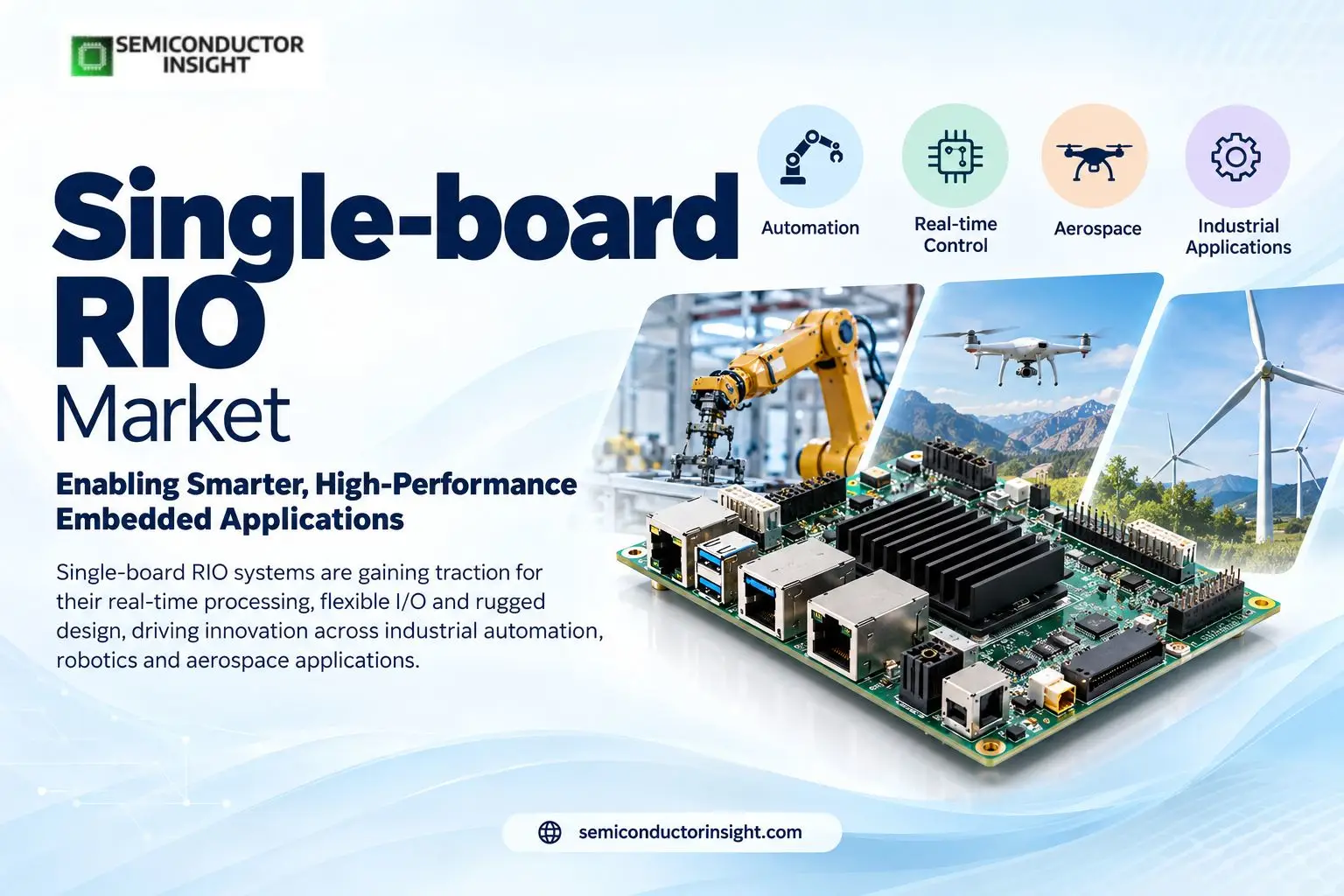
How Is the Single-board RIO Module Market Evolving in 2026 Across Industrial and Embedded Control Systems?
The Single-board RIO concept sits at an unusual intersection of semiconductor hardware, embedded computing and industrial automation. Rather than functioning as a conventional plug-in computer, a single-board RIO platform combines a processor, FPGA-based programmable logic and I/O capabilities on a compact PCB that can be integrated directly into an OEM product.
National Instruments describes Single-Board RIO as an embedded control platform intended for high-volume OEM applications requiring performance, reliability and customization. The architecture is based around FPGA performance and real-time deterministic processing while allowing manufacturers to avoid designing every control function from the ground up.
Why FPGA and Processor Integration Matters?
The value of the architecture becomes clearer when a machine has to perform several jobs simultaneously.
Sensor acquisition
↓
FPGA-level signal processing
↓
Deterministic control
↓
Real-time processor
↓
Application software
↓
Network / machine communication
An FPGA can execute many operations in parallel, while the processor handles higher-level operating-system and application tasks. This division is particularly useful where timing cannot depend entirely on a conventional operating-system software loop.
The RIO architecture therefore brings semiconductor-level programmability into equipment that traditionally relied on fixed-function controllers.
For additional report info, feel free to view our most recent edition: https://semiconductorinsight.com/report/single-board-rio-module-market/
The Hardware Numbers Tell the Story
The specifications of existing sbRIO platforms show how much functionality can fit onto a single board. The sbRIO-9609, for example, integrates an Intel Atom E3845 quad-core processor running at 1.91 GHz with a Xilinx Artix-7 200T FPGA, 2 GB DDR3L memory and 4 GB eMMC storage. It also provides two Gigabit Ethernet ports, CAN connectivity and an RMC interface.
More recent sbRIO-9627 documentation lists a dual-core 667 MHz ARM Cortex-A9 processor, 512 MB DRAM and 512 MB nonvolatile memory alongside a Xilinx Zynq-7000 XC7Z020 programmable SoC. The device is specified for operation from −40°C to +85°C.
These specifications illustrate why the category is more than an ordinary embedded computer: processing, programmable logic, communications and I/O are brought together within one OEM-oriented architecture.
The I/O Layer Is Becoming More Specialized
- One of the strongest characteristics of Single-Board RIO is the breadth of board-level I/O options.
- NI’s current product portfolio includes modules covering CAN, CANopen, current, digital, LIN, relay, serial, sound and vibration, strain and load, temperature and voltage functions.
- That breadth matters because OEM developers rarely build identical machines.
- A semiconductor test system may need high-speed analog acquisition, an automotive platform may require CAN, while a machine-vision or motion-control application may demand tightly synchronized digital signals.
- Instead of redesigning the controller around every application, the RIO approach allows the computing core and I/O architecture to be adapted to the machine.
2026 Brings a More Interesting Connectivity Story
A recent NI technical update published in June 2026 demonstrates how the platform continues to be adapted for specialized communications. NI documented LVDS transmission and reception through a RIO Mezzanine Card, using FPGA-based configuration and 2.5 V LVDS signaling.
That matters because LVDS remains useful where systems require high-speed differential signaling with controlled electrical characteristics. The ability to configure such interfaces at the FPGA level gives OEM designers another route to customize the board without creating a completely new controller.
Where the Architecture Fits
The Single-board RIO Module Market is closely connected with applications where timing, customization and physical integration matter more than simply having maximum general-purpose computing power.
Industrial automation is one obvious area, but the architecture also fits:
- Semiconductor and electronics test equipment
• Aerospace instrumentation
• Machine monitoring
• Advanced laboratory equipment
• Automotive test platforms
• Energy and power-control equipment
• High-speed data acquisition
• Custom OEM machinery
The underlying theme is consistent: the controller needs to become part of the machine rather than remain a separate computer attached to it.
A Different Route to OEM Product Development
Traditional approach:
Custom PCB → processor selection → FPGA design → I/O circuits → drivers → validation → production
RIO-oriented approach:
Embedded RIO platform → configure FPGA → select I/O → develop control software → integrate into OEM product
The second route does not eliminate engineering work, but it can reduce the amount of hardware that an OEM must create independently. NI specifically positions Single-Board RIO around accelerated custom embedded development and lower nonrecurring engineering requirements compared with fully custom hardware.
The Semiconductor Connection Is Deeper Than It Looks
- Although Single-board RIO is marketed as an embedded control platform, its evolution is fundamentally tied to semiconductor capabilities.
- Faster processors, larger FPGA fabrics, programmable SoCs, higher-speed interfaces and increasingly capable memory architectures determine what designers can place onto a single board.
- That makes the market particularly relevant to the broader movement toward edge intelligence. Instead of sending every sensor event to a remote computer, machines can increasingly acquire, process and react to data locally.
For OEM developers, the attraction is straightforward: a compact board that combines programmable logic, deterministic processing and configurable I/O can become the control core of an entire machine. As industrial equipment becomes more software-defined, the Single-board RIO architecture is consequently moving from being simply a controller option toward becoming a flexible semiconductor-enabled building block for specialized automation systems.

Comments (0)