MARKET INSIGHTS
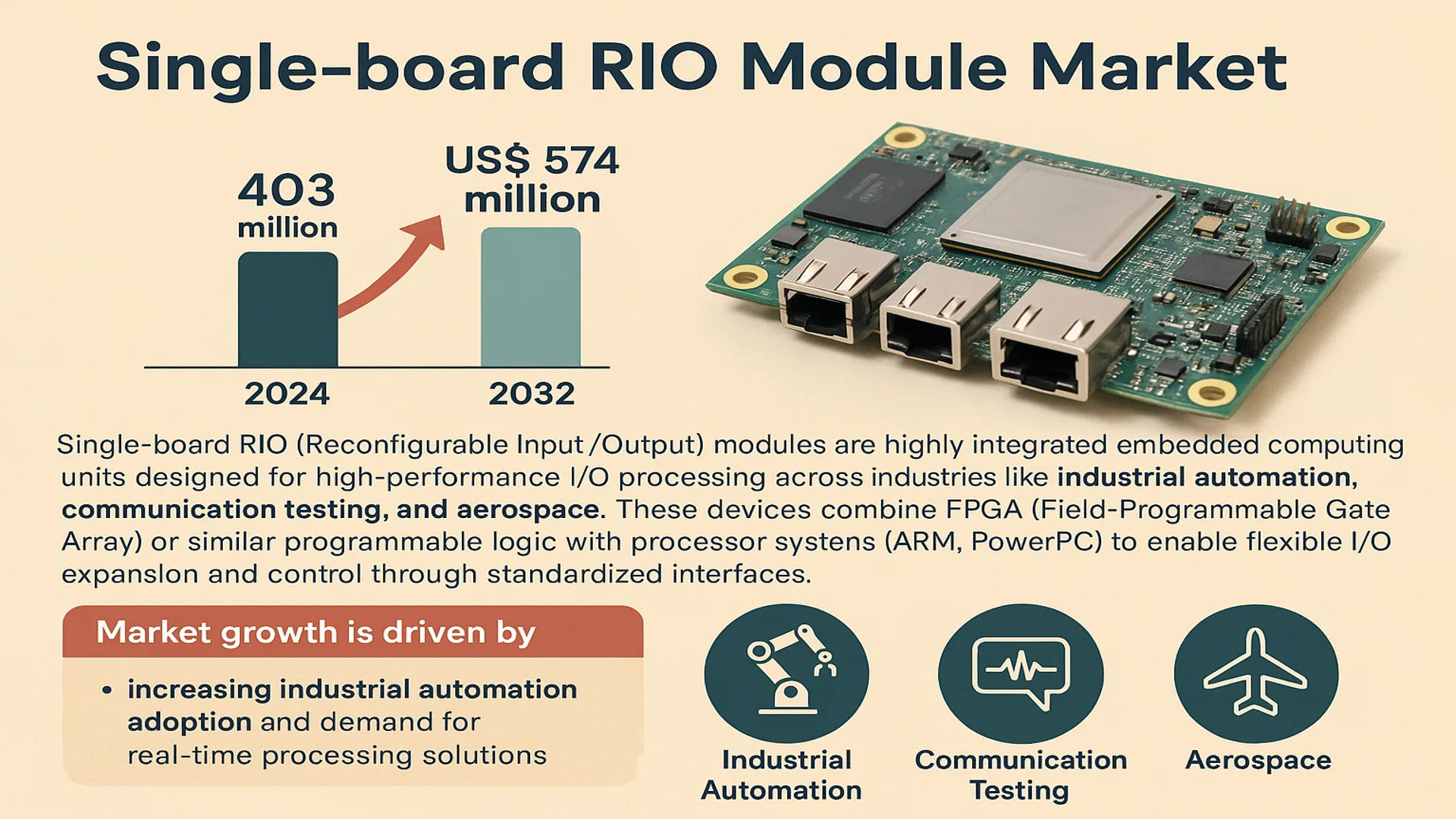
The global Single-board RIO Module Market was valued at 403 million in 2024 and is projected to reach US$ 574 million by 2032, at a CAGR of 5.3% during the forecast period.
Single-board RIO (Reconfigurable Input/Output) modules are highly integrated embedded computing units designed for high-performance I/O processing across industries like industrial automation, communication testing, and aerospace. These devices combine FPGA (Field-Programmable Gate Array) or similar programmable logic with processor systems (ARM, PowerPC) to enable flexible I/O expansion and control through standardized interfaces.
Market growth is driven by increasing industrial automation adoption and demand for real-time processing solutions. While the U.S. leads in technological adoption, China’s market is expanding rapidly due to manufacturing growth. The FPGA-dominant segment holds significant market share due to its reconfigurability advantages. Key players like NI, Keysight, and AMD dominate the competitive landscape through continuous innovation in embedded computing solutions.
MARKET DYNAMICS
MARKET DRIVERS
Rising Adoption of Industrial Automation to Boost Single-board RIO Module Demand
The global push toward Industry 4.0 and smart manufacturing is accelerating the adoption of single-board RIO modules across industrial automation applications. These compact yet powerful modules enable real-time control, data acquisition, and high-speed processing for complex industrial systems. Manufacturers increasingly favor FPGA-based solutions due to their reconfigurability and parallel processing capabilities, which are critical for modern automation tasks. The industrial automation sector is expected to maintain a steady growth rate of over 7% annually through 2032, directly influencing demand for these embedded computing solutions. Deployments in robotic control systems, predictive maintenance applications, and production line monitoring are particularly driving market expansion.
Expanding Test & Measurement Applications in Telecommunications to Drive Growth
Next-generation communication technologies including 5G and 6G networks are creating substantial demand for advanced test equipment incorporating single-board RIO modules. These platforms provide the necessary performance for testing complex wireless protocols while maintaining the flexibility to adapt to evolving standards. The global telecommunications test equipment market is projected to exceed $7 billion by 2027, with modular reconfigurable solutions capturing an increasing share. Recent developments in massive MIMO testing and millimeter wave validation particularly benefit from the high-speed parallel processing capabilities of FPGA-dominant RIO modules. Leading vendors are responding with specialized product offerings targeting 5G NR test applications.
Defense and Aerospace Sector Investments to Sustain Long-Term Demand
Military modernization programs worldwide continue to drive adoption of ruggedized single-board RIO modules for avionics, electronic warfare, and satellite communication systems. These applications demand high reliability combined with the ability to perform in-field updates to mission-critical systems. Defense spending growth in major economies, particularly in radar modernization and unmanned systems development, supports steady market expansion. The aerospace and defense segment accounts for approximately 28% of the global embedded computing market, with reconfigurable I/O solutions gaining increasing adoption due to their longevity in extended program lifecycles.
MARKET RESTRAINTS
High Initial Costs and Complexity Limit Widespread Adoption
While single-board RIO modules offer compelling technical advantages, their adoption faces challenges from significant upfront investment requirements. Custom development with FPGA technology demands specialized engineering expertise and development tools that can increase total project costs by 30-50% compared to traditional embedded solutions. Small and medium enterprises in particular often find these cost structures prohibitive, restricting market penetration among cost-sensitive customers. The need for concurrent hardware and software development expertise further compounds this challenge, creating barriers to entry for organizations without established FPGA capabilities.
Supply Chain Constraints Impact Manufacturing and Lead Times
The semiconductor ecosystem supporting single-board RIO production continues to face periodic disruptions, particularly for high-performance FPGA components. Lead times for certain devices remain extended beyond 50 weeks in some cases, forcing manufacturers to maintain larger safety stocks and increasing overall system costs. These constraints are particularly acute in the aerospace and defense segments where component qualification requirements limit alternative sourcing options. While the situation has improved from pandemic-era extremes, ongoing geopolitical factors and capacity limitations in advanced packaging continue to challenge supply chain stability.
Design Complexity and Skills Shortage Pose Implementation Challenges
The increasing performance requirements of modern applications are driving single-board RIO modules toward more complex architectures combining multiple FPGAs with heterogeneous processing elements. This trend creates significant design verification challenges and extends development cycles. At the same time, the industry faces an acute shortage of engineers proficient in both hardware description languages and real-time software development. The specialized expertise required to fully leverage these platforms remains concentrated among a limited pool of experienced professionals, slowing broader market adoption. Training programs and development tool improvements are gradually addressing this gap, but the skills shortage remains a persistent market restraint.
MARKET OPPORTUNITIES
Emerging AI at the Edge Applications to Open New Growth Avenues
The rapid expansion of edge AI implementations presents significant opportunities for single-board RIO modules, particularly those combining FPGA flexibility with AI accelerator capabilities. Industrial predictive maintenance, autonomous mobile robots, and smart city infrastructure increasingly require low-latency inferencing paired with deterministic I/O control. Market projections indicate the edge AI processor market will grow at over 20% CAGR through 2030, with reconfigurable solutions well positioned to capture a portion of this expansion. Vendors are responding with new product lines featuring integrated machine learning toolchains and pre-validated acceleration libraries.
Adoption in Renewable Energy Systems to Drive Future Growth
The global transition toward renewable energy infrastructure creates substantial opportunities for single-board RIO applications in power conversion and grid management systems. Solar inverters, wind turbine controls, and battery management systems increasingly utilize reconfigurable I/O platforms to handle complex control algorithms while meeting stringent safety requirements. With annual investments in clean energy technologies projected to exceed $1.7 trillion by 2030, this represents a strategically important growth market. The ability to perform hardware-in-the-loop simulation and implement field-upgradable control logic makes these platforms particularly valuable in evolving renewable energy applications.
Medical Device Innovation to Create New Application Areas
Advancements in medical robotics, imaging systems, and point-of-care diagnostics are driving adoption of single-board RIO modules in regulated healthcare applications. These platforms offer the combination of deterministic control and signal processing performance required for next-generation medical devices while accommodating post-market updates through reconfigurable logic. The medical electronics market is forecast to maintain above-average growth, with particular expansion in minimally invasive surgical systems and AI-enhanced diagnostic equipment. Recent regulatory guidance on software-defined medical devices further supports the case for FPGA-based solutions in this high-value segment.
MARKET CHALLENGES
Increasing Competition from Alternative Architectures
The single-board RIO market faces intensifying competition from alternative computing architectures including GPUs, dedicated ASICs, and heterogeneous system-on-module designs. While FPGAs maintain advantages in determinism and flexibility, newer AI accelerator chips and software-defined approaches are eroding traditional differentiators in some application areas. This competitive pressure requires continuous innovation in performance and development toolchains to maintain market position. Vendors must balance the specialized capabilities of reconfigurable logic against the software ecosystem advantages of competing architectures.
Regulatory and Certification Hurdles in Critical Applications
Deployment of single-board RIO modules in safety-critical industries such as aerospace, automotive, and medical devices requires rigorous certification processes that can significantly extend time-to-market. Compliance with standards like DO-254 for aviation electronics or ISO 13485 for medical devices demands extensive documentation and verification efforts. These requirements impose substantial development costs and can delay product introductions during periods of evolving regulatory requirements. While necessary for ensuring system reliability, certification overhead remains a persistent challenge limiting agility in regulated markets.
Technology Obsolescence and Long-Term Support Requirements
The rapid pace of semiconductor innovation creates challenges for single-board RIO vendors in maintaining long product lifecycles, particularly for defense and industrial applications requiring 10-15 year support periods. FPGA manufacturers typically maintain shorter commercial lifespans for their components than enterprise system vendors, forcing costly redesign cycles. This tension between cutting-edge performance requirements and extended product support needs remains an ongoing challenge, requiring careful component selection strategies and investment in lifetime buy programs to ensure supply continuity for long-term customers.
SINGLE-BOARD RIO MODULE MARKET TRENDS
Industrial Automation Expansion Driving Market Growth
The increasing adoption of automation in industries such as manufacturing, energy, and automotive is a major growth driver for the Single-board RIO Module market. These modules provide a flexible and scalable solution for real-time control and monitoring, enabling manufacturers to enhance operational efficiency while reducing downtime. FPGA-dominant Single-board RIO Modules, which account for over 60% of the market share, are particularly favored due to their reprogrammable nature, allowing for rapid adaptation to new industrial requirements. Furthermore, growing investments in Industry 4.0 technologies have accelerated demand, with the industrial automation sector expected to contribute nearly 40% to the market revenue by 2032.
Other Trends
Rise of Communication Testing Applications
The telecom and networking sectors are increasingly leveraging Single-board RIO Modules for high-speed signal processing and protocol testing. As 5G networks expand globally, the need for advanced testing solutions has surged, with the communication test segment projected to grow at a CAGR of 6.8% from 2024 to 2032. These modules facilitate reliable validation of complex RF and digital signals, ensuring compliance with evolving communication standards. Key regions such as North America and Asia-Pacific are witnessing heightened investments in 5G infrastructure, fueling further adoption in this segment.
Technological Advancements in FPGA and Processor Integration
Innovations in FPGA and multi-core processor architectures are significantly enhancing the capabilities of Single-board RIO Modules. Manufacturers are increasingly focusing on Processor + FPGA collaborative designs, which combine the flexibility of programmable logic with the computational power of ARM or PowerPC processors. These advancements enable more efficient parallel processing, making the modules ideal for aerospace and defense applications, where high-speed data acquisition and signal integrity are critical. The aerospace segment alone is expected to contribute over 20% to the market by 2032, driven by increasing demand for avionics testing and unmanned systems.
COMPETITIVE LANDSCAPE
Key Industry Players
Leading Players Drive Market Growth Through Innovation and Strategic Expansion
The global Single-board RIO Module market exhibits a dynamic competitive landscape shaped by established technology providers and emerging innovators. National Instruments (NI), a pioneer in test and measurement solutions, dominates the market with its robust CompactRIO platform, which holds approximately 25% revenue share as of 2024. The company’s strength lies in its comprehensive ecosystem of reconfigurable I/O modules and software tools tailored for industrial applications.
Keysight Technologies and Advanced Micro Devices (AMD) represent significant challengers, collectively accounting for nearly 30% of market revenues. Keysight’s focus on communication testing solutions and AMD’s high-performance FPGA technology portfolio position them strongly in aerospace and telecommunications verticals.
The market also features specialized players like Speedgoat and Opal-RT, which differentiate themselves through real-time simulation capabilities. These companies have gained traction in the automotive and power systems sectors, where hardware-in-the-loop (HIL) testing demands are growing at 7-9% annually.
Strategic partnerships are reshaping the competitive dynamics, with recent collaborations between Adlink Technology and industrial automation leaders enhancing their market position. Meanwhile, Molex is making significant inroads through acquisitions that expand its ruggedized I/O solutions for defense applications.
List of Key Single-board RIO Module Manufacturers
- National Instruments (NI) (U.S.)
- Keysight Technologies (U.S.)
- Advanced Micro Devices (AMD) (U.S.)
- Speedgoat (Switzerland)
- Adlink Technology (Taiwan)
- Opal-RT Technologies (Canada)
- Molex (U.S.)
- Trenz Electronic (Germany)
- Enclustra (Switzerland)
- Concurrent Technologies (U.K.)
- Curtiss-Wright Defense Solutions (U.S.)
Segment Analysis:
By Type
FPGA-Dominant Segment Leads the Market Due to High Flexibility in Industrial Applications
The market is segmented based on type into:
- FPGA-dominant
- Processor + FPGA collaborative
- Subtypes: ARM-based, PowerPC-based, and others
By Application
Industrial Automation Segment Holds Major Share Owing to Rising Demand for Smart Manufacturing
The market is segmented based on application into:
- Industrial Automation
- Communication Test
- Aerospace
- Others
By Processor Architecture
ARM-Based Solutions Gain Traction Due to Low Power Consumption and High Efficiency
The market is segmented based on processor architecture into:
- ARM-based
- PowerPC-based
- x86-based
- RISC-V
By End-User Industry
Manufacturing Sector Accounts for Significant Adoption with Industry 4.0 Implementation
The market is segmented based on end-user industry into:
- Electronics Manufacturing
- Automotive
- Aerospace & Defense
- Telecommunications
- Energy
Regional Analysis: Single-board RIO Module Market
North America
North America currently dominates the global Single-board RIO Module market, driven by advanced industrial automation adoption and strong defense-related R&D expenditure. The U.S. market accounted for over 40% of the global share in 2023, with key applications in industrial automation and aerospace. Companies like National Instruments (NI) and Keysight maintain strong footholds here, leveraging the region’s technological leadership. Growth is further propelled by increasing investments in Industry 4.0 implementation across manufacturing sectors and rising demand for test & measurement solutions in semiconductor and telecom industries. The U.S. Department of Defense’s $842 billion 2024 budget allocation for advanced electronics boosts FPGA-based RIO module adoption in aerospace applications.
Europe
Europe demonstrates significant adoption of Single-board RIO Modules, particularly in industrial automation and automotive test systems. Germany remains the largest market within the region, accounting for nearly 30% of European demand, due to its robust manufacturing base. The presence of leading automotive manufacturers and stringent industrial safety regulations are driving deployment in process control applications. Companies like Trenz Electronic and Enclustra benefit from the region’s focus on industrial IoT solutions. While market growth remains steady, challenges exist in terms of complex regulatory compliance and relatively slower adoption of new technologies compared to North America.
Asia-Pacific
Asia-Pacific represents the fastest-growing region for Single-board RIO Modules, with a projected CAGR of 6.8% through 2032. China accounts for over 50% of regional demand, driven by massive expansion in industrial automation, aggressive semiconductor development programs, and AI hardware acceleration initiatives. The country’s push for technological self-sufficiency in IC design and manufacturing bolsters local players like Wuhan Vision Optoelectronics. Japan and South Korea contribute significantly, particularly in high-precision industrial applications. However, price sensitivity in emerging markets limits adoption of premium solutions, favoring hybrid processor-FPGA configurations over high-end FPGA-dominant modules.
South America
The South American market remains relatively underdeveloped but shows promising growth in industrial automation applications. Brazil leads regional adoption with increasing investments in process automation for oil & gas and mining sectors. Market development faces constraints including economic volatility, lack of local technical expertise, and dependency on imported solutions. Most adoption occurs through multinational corporations implementing standardized automation solutions across their regional operations. The mining sector’s digital transformation presents the most immediate growth opportunity for ruggedized RIO modules in harsh environment operations.
Middle East & Africa
MEA demonstrates emerging potential, primarily driven by infrastructure development initiatives and growing industrial automation in Gulf Cooperation Council countries. The UAE and Saudi Arabia account for most regional demand, particularly in oil & gas automation and smart city projects. The defense sector represents a key growth area, with increasing preference for modular test systems in military electronics. Limited local technical expertise and preference for turnkey solutions over modular systems pose challenges to market expansion. However, government initiatives to diversify economies beyond oil create long-term opportunities in manufacturing automation.
Report Scope
This market research report provides a comprehensive analysis of the Global Single-board RIO Module Market, covering the forecast period 2024–2032. It offers detailed insights into market dynamics, technological advancements, competitive landscape, and key trends shaping the industry.
Key focus areas of the report include:
- Market Size & Forecast: Historical data and future projections for revenue, unit shipments, and market value across major regions and segments. The market was valued at USD 403 million in 2024 and is projected to reach USD 574 million by 2032 at a CAGR of 5.3%.
- Segmentation Analysis: Detailed breakdown by product type (FPGA-dominant, Processor + FPGA collaborative), application (Industrial Automation, Communication Test, Aerospace, Others), and end-user industries to identify high-growth segments.
- Regional Outlook: Insights into market performance across North America, Europe, Asia-Pacific, Latin America, and Middle East & Africa, with country-level analysis for key markets including U.S., China, Germany, and Japan.
- Competitive Landscape: Profiles of leading market participants including NI, Keysight, AMD, Speedgoat, and Adlink, covering their product portfolios, market share (top 5 players held ~% revenue share in 2024), and strategic developments.
- Technology Trends: Analysis of FPGA advancements, processor integration, real-time computing capabilities, and evolving industrial automation standards.
- Market Drivers & Restraints: Evaluation of industrial automation growth, 5G infrastructure deployment, defense spending, alongside supply chain constraints and technical complexity challenges.
- Stakeholder Analysis: Strategic insights for embedded system developers, industrial automation providers, test & measurement companies, and investors.
The research methodology combines primary interviews with industry experts and secondary data from verified sources, ensuring reliable and accurate market intelligence.
FREQUENTLY ASKED QUESTIONS:
What is the current market size of Global Single-board RIO Module Market?
-> Single-board RIO Module Market was valued at 403 million in 2024 and is projected to reach US$ 574 million by 2032, at a CAGR of 5.3% during the forecast period.
Which key companies operate in this market?
-> Leading players include NI, Keysight Technologies, AMD (Xilinx), Speedgoat, Adlink Technology, Opal-RT, and Molex.
What are the key growth drivers?
-> Growth is driven by industrial automation adoption, 5G infrastructure development, aerospace modernization, and increasing demand for real-time processing solutions.
Which region dominates the market?
-> North America leads in market share, while Asia-Pacific shows the highest growth potential, particularly in China and Japan.
What are the emerging trends?
-> Emerging trends include AI integration in FPGAs, hybrid processing architectures, and miniaturization of RIO modules for space-constrained applications.

Get Sample Report PDF for Exclusive Insights
Report Sample Includes
- Table of Contents
- List of Tables & Figures
- Charts, Research Methodology, and more...
 Download Sample Report PDF