
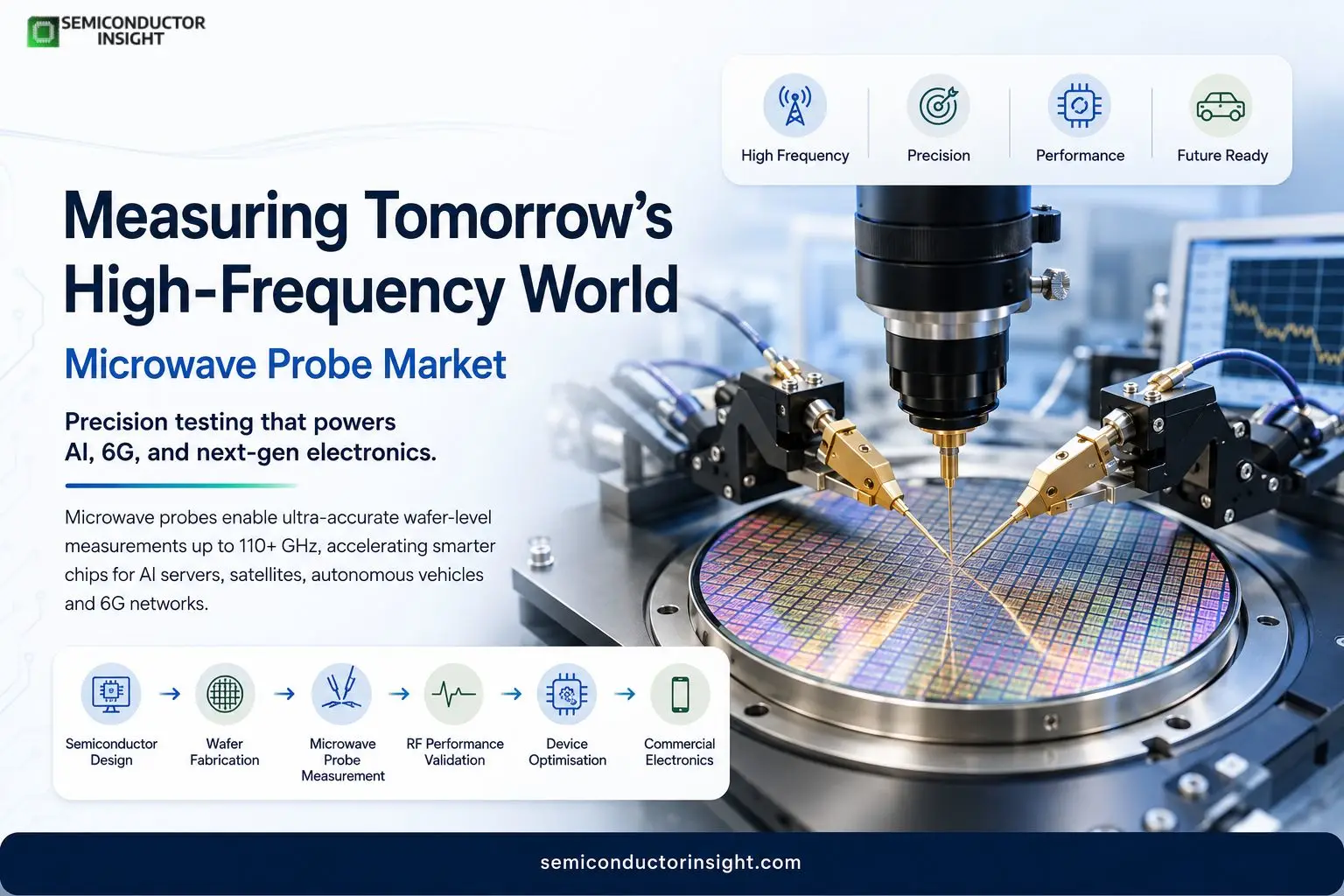
How is the Microwave Probe Market Helping Semiconductor Engineers Improve Chip Reliability?
The semiconductor industry is entering an era where performance is measured not only by transistor density but also by signal integrity at extremely high frequencies. As devices designed for artificial intelligence, satellite communications, autonomous vehicles and next-generation wireless networks continue pushing into microwave and millimetre-wave frequency bands, precision testing has become just as important as chip fabrication itself. At the centre of this transformation is the microwave probe a specialised measurement tool that enables engineers to evaluate electrical characteristics directly on semiconductor wafers before devices reach production.
Microwave probes are designed to minimise signal loss, maintain impedance accuracy, and provide highly repeatable measurements across frequencies that can exceed 110 GHz, in contrast to conventional probes used for low-frequency measurements. Specialised research systems extend beyond 330 GHz for advanced terahertz investigations. As semiconductor makers pursue increasingly complicated radio-frequency (RF) and high-speed integrated circuits, their importance has dramatically expanded.
Precision Testing Has Become a Cornerstone of Modern Chip Development
- Every advanced semiconductor passes through multiple stages of electrical verification before entering commercial production. Microwave probes allow engineers to evaluate RF amplifiers, power devices, integrated antennas, sensors and high-frequency transistors directly on wafers without requiring permanent packaging.
- This capability significantly reduces development time because design adjustments can be implemented before costly packaging and assembly processes begin. It also improves manufacturing efficiency by identifying performance variations at an earlier stage.
- The growing adoption of gallium nitride (GaN), silicon carbide (SiC), indium phosphide (InP) and advanced silicon RF technologies has further increased demand for microwave probing systems capable of maintaining measurement accuracy at increasingly higher frequencies.
- According to the IEEE and leading semiconductor research laboratories, many commercial RF characterisation systems now routinely operate between 40 GHz and 110 GHz, while specialised university and national laboratory platforms extend into sub-terahertz frequency ranges supporting experimental 6G communication research.
The Silent Technology behind AI Servers and 6G Networks
Although microwave probes rarely receive public attention, they play a critical role in developing technologies used every day. AI data centres rely on high-speed networking chips that must undergo precise RF validation before deployment. Satellite communication systems require microwave components capable of operating reliably under demanding environmental conditions, while advanced automotive radar modules depend on highly accurate wafer-level testing during development.
One of the strongest areas of growth is millimetre-wave technology. Modern automotive radar systems commonly operate around 77 GHz, enabling adaptive cruise control, collision avoidance and autonomous driving functions. Meanwhile, emerging 6G research programmes are already investigating communication frequencies above 100 GHz, requiring even greater measurement precision during semiconductor development.
Recent demonstrations by global research organisations have shown wireless communication links operating above 300 GHz, illustrating how microwave probing technologies continue evolving alongside future communication standards.
Semiconductor Design
│
▼
Wafer Fabrication
│
▼
Microwave Probe Measurement
│
▼
RF Performance Validation
│
▼
Device Optimisation
│
▼
Commercial Electronics
Performance Trends Transforming Electronic Communication Solutions
Rather than market values, the scale of microwave probe adoption becomes evident through developments across semiconductor manufacturing and wireless technology.
Global semiconductor fabrication facilities continue expanding to meet rising demand for advanced computing devices. According to SEMI, worldwide silicon wafer shipments exceeded 14 billion square inches annually, while more than 100 semiconductor fabrication projects have been announced or are under construction globally in recent years.
Wireless innovation is progressing at a similar pace. The GSMA reports that global 5G connections surpassed 2 billion, creating increasing demand for RF front-end modules, filters, amplifiers and antenna technologies that depend on high-frequency measurement during development.
Artificial intelligence infrastructure is another important contributor. Modern AI accelerator processors contain tens of billions of transistors, with some of the most advanced chips integrating well above 100 billion transistors. Testing these increasingly sophisticated devices requires highly accurate RF and microwave characterisation throughout the design cycle.
Lastly before we wrap up, don’t forget to look at our most recent exclusive report for in-depth insights: https://semiconductorinsight.com/report/microwave-probe-market/
Engineers Are Measuring More Than Electrical Signals
- The role of microwave probing has expanded beyond traditional electrical testing. Modern systems combine precision positioning, thermal control, automated calibration and software-driven analysis to provide engineers with deeper insights into device behaviour.
- Today’s advanced probe stations can evaluate semiconductor performance under varying temperatures ranging from approximately -65°C to over 300°C, allowing researchers to simulate harsh aerospace, automotive and industrial operating environments before products enter commercial use.
- Automation has also become a defining feature. Robotic wafer handling, machine vision alignment and AI-assisted measurement software now reduce operator variability while increasing throughput in semiconductor laboratories. These technologies are particularly valuable as chip manufacturer’s transition towards more complex packaging architectures and heterogeneous integration.
As semiconductor innovation continues accelerating across AI, quantum computing and high-frequency wireless communications, microwave probes are evolving from specialised laboratory instruments into indispensable tools supporting the next generation of electronic engineering. In Part 2, we will explore breakthrough probe technologies, emerging applications in quantum and terahertz research, leading innovators, and the scientific advances redefining precision semiconductor measurement.

Comments (0)