
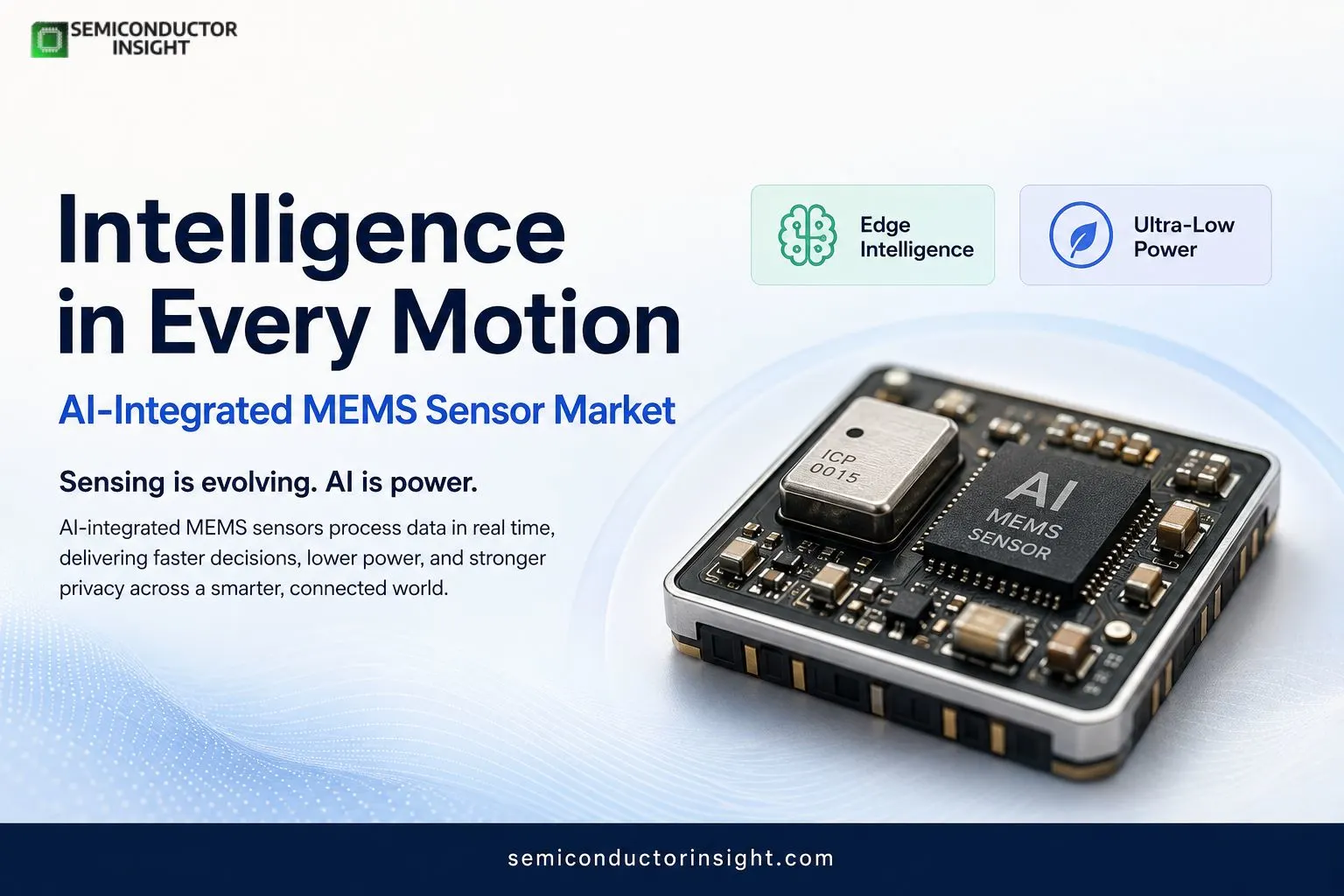
How Is the AI-Integrated MEMS Sensor Market Supporting Tiny Devices with Bigger Intelligence?
Artificial intelligence is no longer confined to cloud platforms and large processors. It is increasingly moving into miniature sensing devices that can interpret their surroundings in real time. This shift has positioned the AI-Integrated MEMS Sensor Market at the center of semiconductor innovation, where micro-electromechanical systems are evolving into intelligent components capable of processing motion, pressure, vibration, sound, and environmental signals directly on-device.
Instead of merely collecting data, the latest MEMS sensors perform local inference, enabling faster decisions, lower power consumption, and enhanced privacy. This architectural transformation is supporting autonomous vehicles, wearable healthcare, industrial robotics, smart factories, and AI-enabled consumer electronics across the globe.
The Semiconductor Industry Is Bringing Intelligence inside the Sensor
- Traditional MEMS sensors transmitted raw signals to external processors for analysis. Today’s AI-integrated devices combine sensing elements with embedded machine-learning accelerators, digital signal processors, and ultra-low-power microcontrollers. This architecture minimizes communication delays while reducing cloud dependency.
- Industry adoption continues to accelerate. According to the European Commission, more than 30 billion connected IoT devices are expected to be operating globally before the end of the decade, while IDC estimates worldwide data generation will exceed 390 zettabytes annually by 2028. Processing such enormous sensor data volumes directly at the edge has become increasingly important, making intelligent MEMS one of the fastest-evolving semiconductor technologies.
- Recent examples include Bosch Sensortec’s AI-enabled smart sensors for wearables, STMicroelectronics’ intelligent inertial sensors with embedded machine learning, and Analog Devices’ advanced condition-monitoring MEMS platforms for predictive industrial maintenance.
Tiny Structures Are Delivering Remarkable Computing Efficiency
MEMS sensors are based on the integration of microscopic mechanical structures and integrated electronic circuits by the silicon processing technologies, which is different from the traditional semiconductor devices. With AI integration, these devices can learn movement patterns, detect equipment abnormalities, classify gestures, monitor vibrations and filter environmental noise without the need to transmit continuous raw data streams.
Today MEMS structures are manufactured in modern facilities to a thickness of only a few micrometers. Advanced wafer-level packaging enhances reliability and enables compact integration into smartphones, medical implants, drones and automotive electronic control units.
Edge Intelligence Is Reshaping Sensor Performance
The strongest momentum within the AI-Integrated MEMS Sensor Market comes from edge computing. Processing information locally dramatically lowers response times while reducing wireless bandwidth requirements and energy consumption.
Examples already deployed globally include:
- AI-based fall detection in wearable medical devices.
- Predictive maintenance systems monitoring industrial motors and turbines.
- Cabin occupancy sensing in intelligent vehicles.
- Gesture recognition in augmented reality headsets.
- Vibration monitoring inside semiconductor manufacturing equipment.
- Smart agriculture systems measuring soil vibration and environmental conditions.
The International Federation of Robotics reported that global operational industrial robots surpassed 4.3 million units, with factories increasingly depending on intelligent sensing technologies for autonomous operation and predictive diagnostics.
Supply Cycles Are Shaping Component Selection More Than Ever
Engineers designing AI-enabled electronic systems increasingly evaluate timing components alongside MEMS sensors because supply continuity has become as important as electrical performance. During recent semiconductor supply disruptions, lead times for several quartz crystal oscillators extended significantly due to specialized crystal processing, packaging constraints, and limited manufacturing capacity. In contrast, MEMS timing devices benefited from silicon-based semiconductor fabrication, allowing production to scale more efficiently through standard CMOS manufacturing lines.
MEMS timing components also offer greater flexibility for programmable frequencies, improved resistance to mechanical shock, and simplified inventory management because a single programmable device can replace multiple fixed-frequency quartz oscillators. Quartz components, however, continue to provide excellent long-term frequency stability for numerous communication, industrial, and precision timing applications. As AI hardware becomes increasingly complex, manufacturers are selecting timing technologies not only for electrical characteristics but also for supply resilience, manufacturing scalability, and design flexibility.
For More Detailed Insights, You Can Surf Our Latest Report Here: https://semiconductorinsight.com/report/ai-integrated-mems-sensor-market/
Packaging Technology Has Become an Innovation Platform
- Advanced wafer-level packaging now enables MEMS sensors, AI processors, memory, and power management circuits to coexist inside highly compact semiconductor packages.
- Through-silicon vias, fan-out packaging, and heterogeneous integration significantly reduce signal loss while improving computational efficiency.
- Major semiconductor manufacturers are increasingly investing in co-packaged sensing architectures that combine multiple sensing modalities including inertial measurement units, microphones, pressure sensors, and environmental detectors into unified AI-enabled modules capable of understanding complex real-world environments.
Software Is Becoming as Important as Silicon
The newest generation of MEMS platforms depends heavily on software optimization. Neural network compression, TinyML frameworks, adaptive calibration algorithms, and firmware updates allow sensor intelligence to improve throughout the device lifecycle without requiring hardware replacement.
Organizations such as NASA continue utilizing MEMS-based inertial sensors in aerospace applications, while medical researchers are deploying intelligent MEMS devices for continuous patient monitoring and rehabilitation systems. At the same time, semiconductor manufacturers are expanding investments in AI-ready sensor ecosystems that integrate hardware, software, and development tools into unified platforms.
This convergence of semiconductor engineering, embedded artificial intelligence, and ultra-miniaturized sensing is redefining how machines perceive and respond to the physical world, establishing AI-integrated MEMS sensors as a cornerstone of next-generation electronics.

Comments (0)