
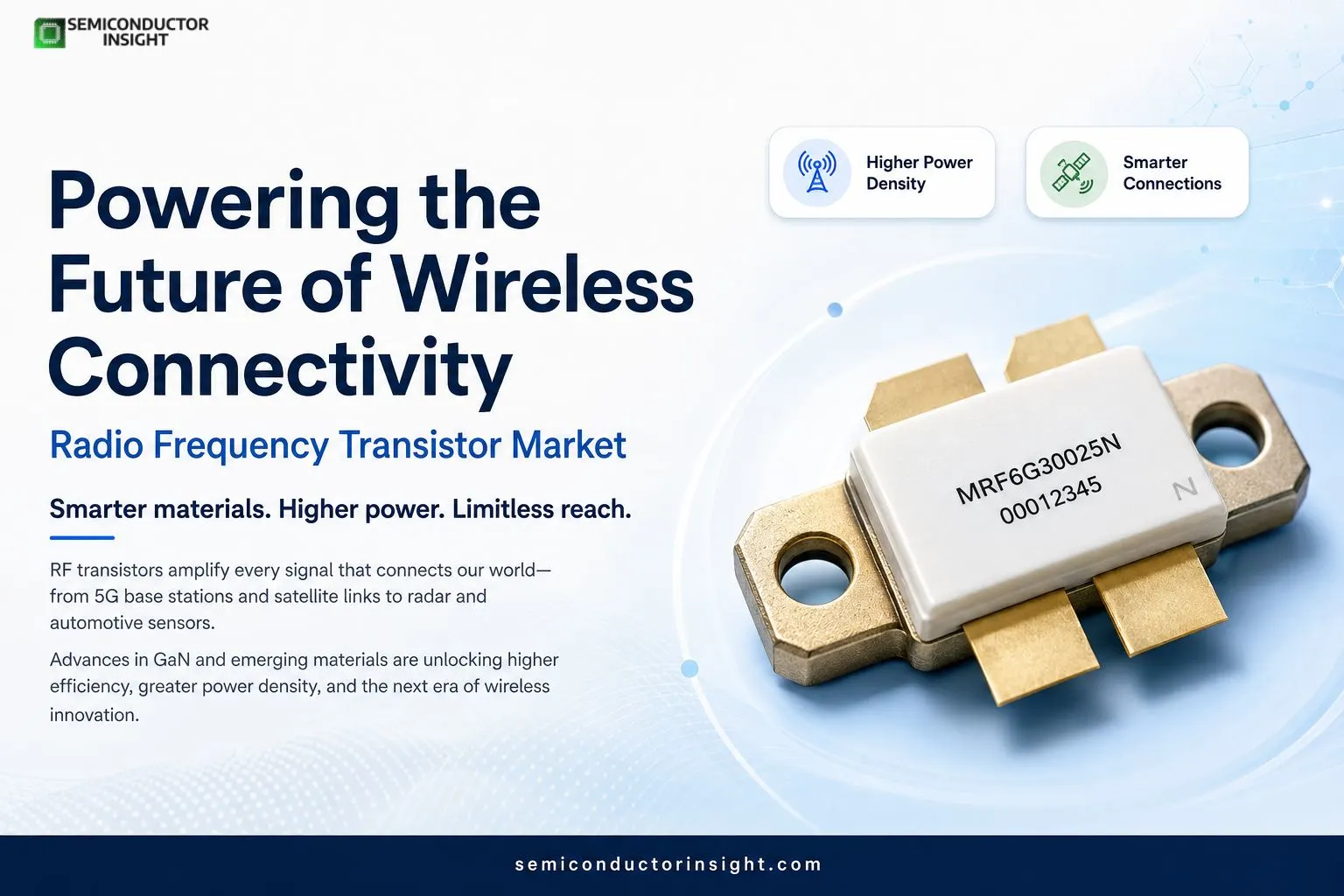
How GaN Devices Are Changing Amplification Limits in 2026? Radio Frequency Transistor Work
Radio frequency transistors sit at the heart of every wireless link that moves data, tracks objects, or connects distant platforms. They take a low-level signal and raise its power so the energy can travel through air or space without vanishing into noise. The devices have moved through several material generations, each expanding what engineers can ask of a single chip.
Silicon laterally diffused MOSFETs, known as LDMOS, became the workhorse for cellular base stations through the 2G, 3G, and 4G eras. Their cost advantage and ruggedness kept them dominant below roughly 3 GHz for decades. As networks pushed higher in frequency and demanded greater efficiency, gallium nitride devices began to take the lead. GaN high-electron-mobility transistors can deliver power densities several times higher than silicon at the same frequency. NASA technical notes note that GaN field-effect transistors hold the potential to operate at power densities up to ten times those of conventional RF devices, a figure that matters when every watt of heat must be managed inside a tight enclosure.
- In previous years researchers at NTT reported the world’s first aluminum-nitride-based high-frequency transistor aimed at post-5G systems.
- The announcement marked a further step beyond GaN toward materials that can handle still higher frequencies and voltages while keeping losses low.
- Such devices are expected to support wider coverage and faster data rates once the supporting infrastructure catches up.
Active Electronically Scanned Arrays and the Demand for Dense Modules
Modern radar systems no longer rely on a single large dish. Instead they use thousands of small transmit-receive modules arranged in a flat array. Each module contains RF transistors that both send pulses and listen for returns. The U.S. Navy’s AN/SPY-6 air and missile defense radar employs thousands of GaN modules per face.
Similar technology flies on the F-35 and is specified for several next-generation fighter programs under development in multiple countries. The ability of GaN to produce high power at X-band frequencies while remaining compact allows these arrays to track more targets with greater precision and less cooling burden than earlier silicon designs.
Satellite Links and the Power Budget Constraint
In orbit every watt of transmitter power must be generated from limited solar panels or batteries. GaN amplifiers have become the preferred choice for many satellite uplinks and cross-links because they convert supply power into RF energy more efficiently than earlier technologies.
The same efficiency also reduces the thermal load that must be radiated into space. Ground stations that communicate with constellations of small satellites likewise benefit from transistors that can deliver tens to hundreds of watts across C-band and Ku-band while maintaining linearity.
Automotive and Short-Range Sensing Circuits
Closer to the ground, RF transistors appear in 5.8 GHz radar modules used for adaptive cruise control and collision avoidance. They also serve low-noise amplifier roles in global navigation satellite system receivers and in ultra-wideband links that measure precise distances inside vehicles.
Infineon’s portfolio of discrete RF transistors covers many of these functions, offering devices that operate from the low megahertz range up to 12 GHz with noise figures as low as 0.4 dB in selected parts. The same family supports Wi-Fi routers, set-top boxes, and industrial automation links that require stable amplification at modest power levels.
Our most recent updated related study is available for free at this link: https://semiconductorinsight.com/report/radio-frequency-transistor-market/
Base Station Continuity and Recent Supply Shifts
While new materials expand performance, the installed base of LDMOS devices continues to keep existing networks running. In 2026 a notable change occurred when NXP announced the end of life for its high-power LDMOS and GaN RF transistor lines and the planned closure of its 150 mm GaN-on-SiC fab in Arizona. The move leaves fewer large-scale sources for certain high-power parts and has prompted system designers to qualify alternative suppliers more quickly. The transition underscores how tightly the availability of these specialized transistors is linked to the continuity of wireless infrastructure.
Across radar arrays, satellite terminals, cellular radios, and vehicle sensors the same core device type continues to evolve. Each advance in material or packaging raises the power that can be delivered at a given frequency or lowers the noise that obscures a weak return signal. The practical result is clearer radar pictures, longer satellite links, denser cellular coverage, and safer short-range sensing, all resting on the performance of radio frequency transistors.

Comments (0)