
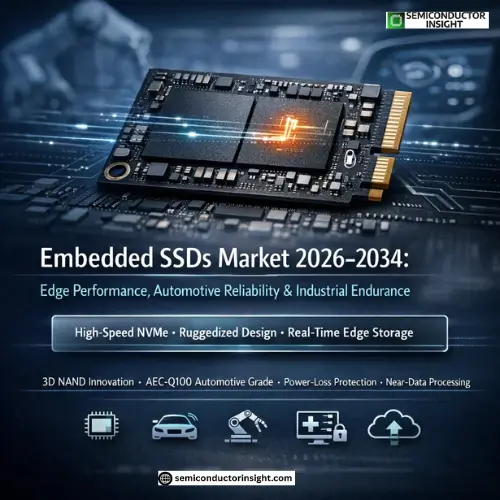
How Embedded SSDs Are Powering the Future of Smart Devices and Industrial Systems?
Embedded SSDs Market is experiencing a significant transformation as storage requirements escalate across edge computing, industrial automation, automotive systems, and medical devices. In contrast to conventional storage, embedded SSDs combine high-speed data access, energy economy, and stress resistance in small form factors, making them essential for systems where performance and dependability are crucial.
These SSDs are distinct from consumer drives; they are engineered for constant operation in demanding environments, where data integrity and uptime are non-negotiable. Their importance spans from rugged industrial machinery to connected vehicles and critical healthcare systems, underlining how storage technology is becoming a core element of digital transformation in embedded systems.
Real-Time Data Processing and Edge Workloads
Modern embedded systems are often tasked with real-time processing, where latency can impact both performance and safety. Embedded SSDs are optimized for rapid read/write cycles, enabling seamless data logging, analytics, and decision-making at the edge without dependence on remote cloud servers.
For example, edge AI workloads in industrial robots and smart infrastructure require storage capable of handling bursts of sensor data, model execution logs, and system states. Embedded SSDs with high NVMe bandwidth and advanced firmware are tailored to support these dynamic workloads, ensuring systems stay responsive even under heavy I/O pressure.
Automotive Digital Storage Revolution
The automotive sector is now one of the most compelling growth arenas for embedded SSDs. Modern vehicles are effectively computing platforms on wheels, equipped with advanced infotainment systems, advanced driver assistance systems (ADAS), and autonomous navigation features. The average premium vehicle generates hundreds of gigabytes of data per hour from high-resolution cameras to LIDAR and radar sensors creating extensive storage needs that only rugged, embedded SSDs can fulfil reliably.
Embedded SSDs in automotive applications must endure extreme temperatures, vibration, and continuous read/write activity. To meet these requirements, manufacturers are developing SSDs that comply with AEC-Q100 standards, ensuring long-term reliability even in harsh conditions.
Medical Devices and Data Integrity
Healthcare’s rapid digitization is another domain where embedded SSDs are proving indispensable. Medical equipment such as portable ultrasound systems, life-critical patient monitoring devices, and diagnostic imaging machines demand storage that guarantees data integrity, rapid retrieval, and adherence to strict regulatory requirements.
Embedded SSDs, as opposed to consumer SSDs, provide enhanced error correction and power-loss protection (PLP), which is crucial for systems that handle patient data or real-time diagnostics and protects sensitive data during unexpected power occurrences.
Interface Evolution and Performance Protocols
The performance of embedded SSDs is intimately connected to evolving storage interfaces and protocols. Traditional SATA interfaces are increasingly being displaced by NVMe and PCIe Gen4/Gen5 connections, which deliver vastly superior throughput and lower latency.
For embedded applications, this means devices can handle high-frequency read/write cycles without bottlenecks, crucial for AI inference at the edge, rapid software updates, and real-time sensor fusion tasks. Emerging interfaces such as Compute Express Link (CXL) also promise to blur the lines between storage and memory, enabling new architectures where storage can participate in compute-intensive processes more directly.
Endurance Engineering and Life-Cycle Innovations
One of the most unique aspects of embedded SSD development is endurance optimization ensuring storage solutions withstand billions of program/erase cycles without significant degradation. Advances in 3D NAND memory, wear-leveling algorithms, and dynamic thermal controls have extended lifespans and reliability far beyond what was previously possible.
Manufacturers are also exploring in-NAND encryption engines that protect data without performance penalties, embedding cryptographic engines within the flash architecture itself for low-power, high-security operations ideal for sensitive embedded deployments.
Sector-Specific Use Cases: Beyond Storage
Embedded SSDs are no longer confined to simple data storage roles. In emerging applications like near-data processing (NDP), SSDs are beginning to host compute functions within the storage layer itself, significantly reducing data movement and boosting energy efficiency. Research prototypes demonstrate that integrating compute resources directly inside SSDs can accelerate workflows while consuming far less energy than traditional host-centric processing.
This paradigm shift is especially relevant in systems where minimizing latency and power draw is crucial such as autonomous robotics, high-frequency trading systems, and real-time signal processing platforms.
Embedded World 2026 and Market Showcases
The upcoming Embedded World 2026 event is a reflection of how embedded storage technology is progressing. Leaders in the space are preparing to showcase industrial SATA and PCIe Gen5 SSDs, wide-temperature models, and server-optimized boot solutions designed for next-generation embedded and edge applications.
These products highlight ongoing innovation, focusing on high bandwidth, mission-critical reliability, and sustained performance all of which are essential as devices from smart factories to connected vehicles evolve in complexity and capability.
Lastly before we wrap up, don’t forget to look at our most recent exclusive report for in-depth insights:
https://semiconductorinsight.com/report/embedded-ssds-market/
Price Pressures and NAND Supply Trends
Amid this innovation, the storage ecosystem is seeing supply constraints and pricing volatility, particularly as AI and data center demand absorb larger shares of NAND flash production. This shift has led to elevated costs for SSDs and embedded storage components, impacting both development budgets and product pricing strategies.
Embedded SSD designers must balance rising material costs with customer demands for performance and durability challenge that is shaping product roadmaps and procurement decisions across industries.
As embedded systems become ever more intelligent and interconnected, embedded SSDs emerge as essential enablers of performance, resilience, and real-time data processing. From smart machines and autonomous vehicles to life-saving medical equipment, next-generation storage is helping redefine what embedded systems can achieve. By marrying advanced interface protocols, endurance engineering, and miniaturized form factors, embedded SSDs are integral to the future of intelligent devices propelling industries toward smarter, faster, and more reliable technology solutions.

Comments (0)