
How Edge Computing Is Reshaping Smart Meter (Electricity, Water, and Gas) SoC Market?
Electricity, gas, and water meters once operated as passive measurement devices. Today, they behave more like miniature edge computers packed with communication modules, AI-enabled analytics, encryption engines, RF connectivity, and real-time sensing capabilities. At the centre of this transformation sits the System-on-Chip architecture, the semiconductor engine driving the global smart metering ecosystem.
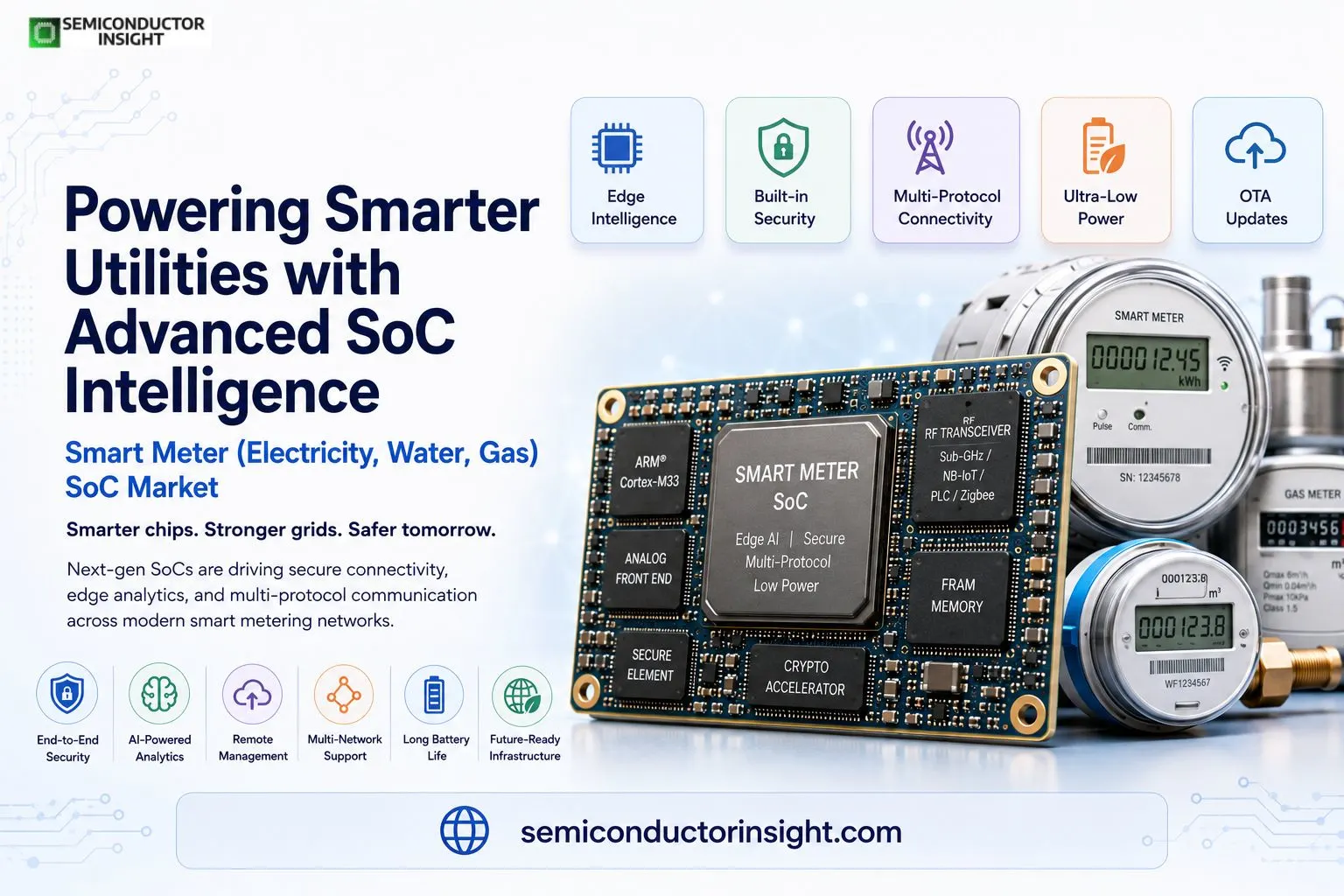
The newest smart meter SoCs are no longer designed only for billing accuracy. Utilities now expect chips capable of edge analytics, outage prediction, tamper detection, remote firmware updates, and interoperability across NB-IoT, RF mesh, Zigbee, PLC, and cellular standards. Semiconductor vendors are responding by integrating analogue front ends, microcontrollers, memory, connectivity blocks, and cybersecurity modules into compact low-power silicon.
A major milestone emerged recently when Indian engineering company Cyient partnered with Azimuth AI to unveil an indigenous 40nm SoC for smart electricity meters. The chip is expected to enter commercial deployment by 2026 and represents one of India’s first privately developed smart-meter semiconductor platforms.
Smart Meter Silicon Is Becoming a Cybersecurity Battlefield
As millions of smart meters connect to critical infrastructure networks, cybersecurity has become a defining semiconductor requirement.
Advanced Metering Infrastructure systems generate enormous volumes of consumption data, making them attractive targets for cyberattacks and privacy breaches. Researchers studying AMI privacy frameworks are now exploring differential privacy, federated learning, homomorphic encryption, and secure multiparty computation for utility networks.
Chipmakers are responding with hardware-level security features, including:
- Secure enclaves
- Hardware root-of-trust
- Cryptographic accelerators
- Anti-tamper detection
- Secure key storage
- Quantum-resistant encryption readiness
Emerging quantum-safe smart meter initiatives are already incorporating CRYSTALS-Kyber and CRYSTALS-Dilithium implementations into dedicated security processors.
This shift is particularly important because utilities now classify smart metering networks as national critical infrastructure rather than ordinary billing systems.
Why Utility Companies Suddenly Care About Semiconductor Architecture
Utilities historically purchased meters as hardware appliances. That procurement mindset is changing rapidly because the intelligence layer now matters more than the enclosure itself.
Modern utility networks demand chips that can process energy data locally rather than constantly transmitting raw information to centralised servers. This edge-processing capability reduces latency and lowers communication costs. Semiconductor firms are therefore embedding lightweight AI acceleration and predictive monitoring features directly into metering SoCs.
For electricity meters, SoCs increasingly support dynamic load balancing, voltage anomaly detection, and distributed renewable integration. Water meter chips are evolving toward ultrasonic flow processing and leak pattern recognition. Gas meter semiconductors are focusing heavily on ultra-low-power operation because battery life often exceeds 10 years.
Texas Instruments, NXP Semiconductors, STMicroelectronics, Renesas, and Silicon Labs remain deeply active in this ecosystem, particularly for microcontroller and connectivity integration. Recent smart-meter MCU designs emphasise ferroelectric RAM, secure boot capability, and reduced standby power consumption.
Stay connected for additional in-depth information right here: https://semiconductorinsight.com/report/smart-meter-electricity-water-gas-soc-market/
The Rise of Multi-Protocol Metering Silicon
One of the biggest semiconductor challenges inside smart metering involves communication fragmentation. Utilities across countries rely on entirely different networking standards.
Instead of manufacturing separate chips for each protocol, semiconductor developers are moving toward flexible multi-standard SoCs capable of supporting:
- RF mesh networking
- Narrowband IoT
- LTE-M
- Power line communication
- Zigbee
- Wi-SUN
This convergence is pushing chip complexity upward. A single metering SoC now combines RF transceivers, analogue sensing blocks, ARM-based processing cores, EEPROM or FRAM memory, and embedded security accelerators.
The architectural shift mirrors what happened in smartphone processors a decade ago, although smart meter chips prioritise longevity and reliability over raw performance.
Utilities increasingly prefer firmware-upgradable platforms because regulations and communication standards evolve frequently. Semiconductor suppliers able to deliver OTA-capable architectures are gaining stronger design wins in AMI deployments.
India’s Smart Meter Rollout Is Reshaping Semiconductor Demand
India has become one of the most closely watched smart-meter deployment arenas globally. Under modernisation initiatives such as the Revamped Distribution Sector Scheme (RDSS), utilities are accelerating Advanced Metering Infrastructure installations across states.
Industry discussions indicate that installation rates have sharply accelerated as utilities attempt to digitise power distribution and reduce technical losses. Smart meters are increasingly viewed as tools for theft reduction, automated billing, and grid visibility.
This deployment wave is creating downstream opportunities for:
- Semiconductor packaging firms
- Embedded software providers
- RF module suppliers
- Power management IC manufacturers
- Foundry partners
- Secure element developers
Domestic semiconductor localisation is becoming especially important because governments want strategic independence in utility infrastructure.
Edge AI Is Quietly Entering Metering Chips
Perhaps the most overlooked development in the smart meter SoC ecosystem is the emergence of edge intelligence.
New-generation metering semiconductors increasingly analyse data locally to identify:
- Power theft patterns
- Leakage behavior
- Abnormal voltage signatures
- Consumption anomalies
- Transformer overload risk
Instead of transmitting every event to the cloud infrastructure, chips can prioritise meaningful alerts and reduce network congestion.
This evolution transforms smart meters from measurement terminals into distributed sensing nodes across national utility grids.
The next decade of semiconductor innovation in smart metering may therefore depend less on meter accuracy and more on how intelligently SoCs process, secure, compress, and interpret infrastructure data at the edge.

Comments (0)